Average Home Price in Denver CO (2026): Trends & Data
$562,183. That’s what a typical home costs in Denver right now. A year ago, that number was about $19,000 higher. Prices are sliding — down 3.3% year over year — and the trend hasn’t reversed yet.
Quick answer: The average home price in Denver, CO is $562,183 as of February 2026, down 3.3% year over year according to Zillow.
Current Home Prices in Denver
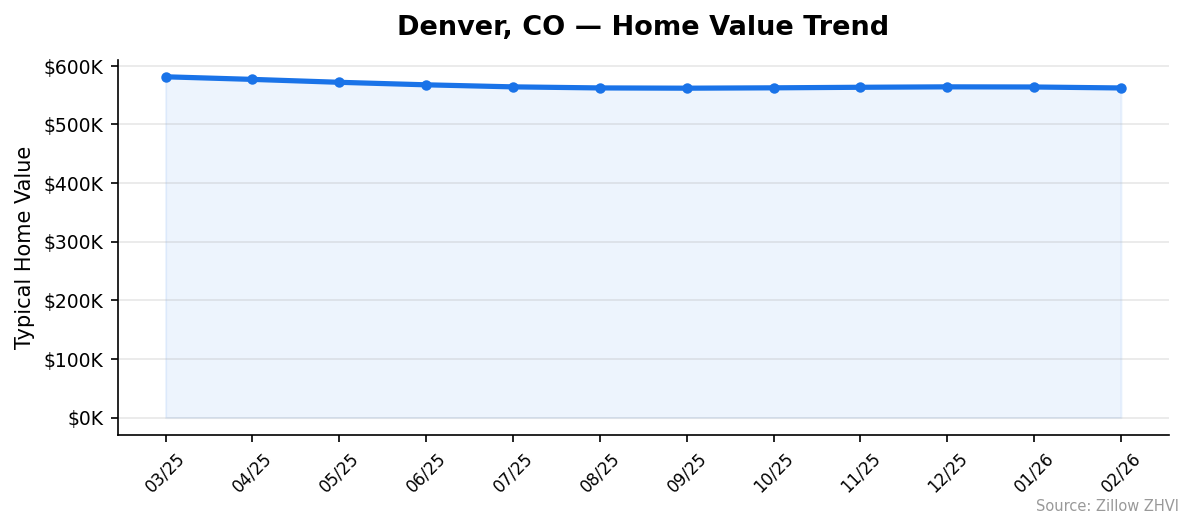
The Denver housing market has cooled off. After peaking near $581,000 in early 2025, the typical home value has dropped nearly $19,000 over twelve months.
| Metric | Value |
|---|---|
| Median home value | $562,183 |
| Year-over-year change | -3.3% |
| Lowest value (by ZIP) | $262,422 |
| Highest value (by ZIP) | $948,320 |
| ZIP codes tracked | 27 |
The -3.3% annual decline may not sound dramatic, but on a $562K home, that’s roughly $19,100 in lost equity. For sellers who bought at the peak, the math is starting to pinch.
The price range across Denver is enormous. The gap between the cheapest and most expensive ZIP codes is nearly $686,000. That spread tells you Denver isn’t one market — it’s dozens of micro-markets stacked on top of each other.
If you’re a buyer, the direction is working in your favor for the first time in years. Monthly declines have been small but consistent, and there’s no sign yet of a bounce back.
Denver Home Prices by Neighborhood
Where you buy in Denver matters more than when you buy. The price difference between the most and least expensive neighborhoods would buy you an entire house in most U.S. cities.
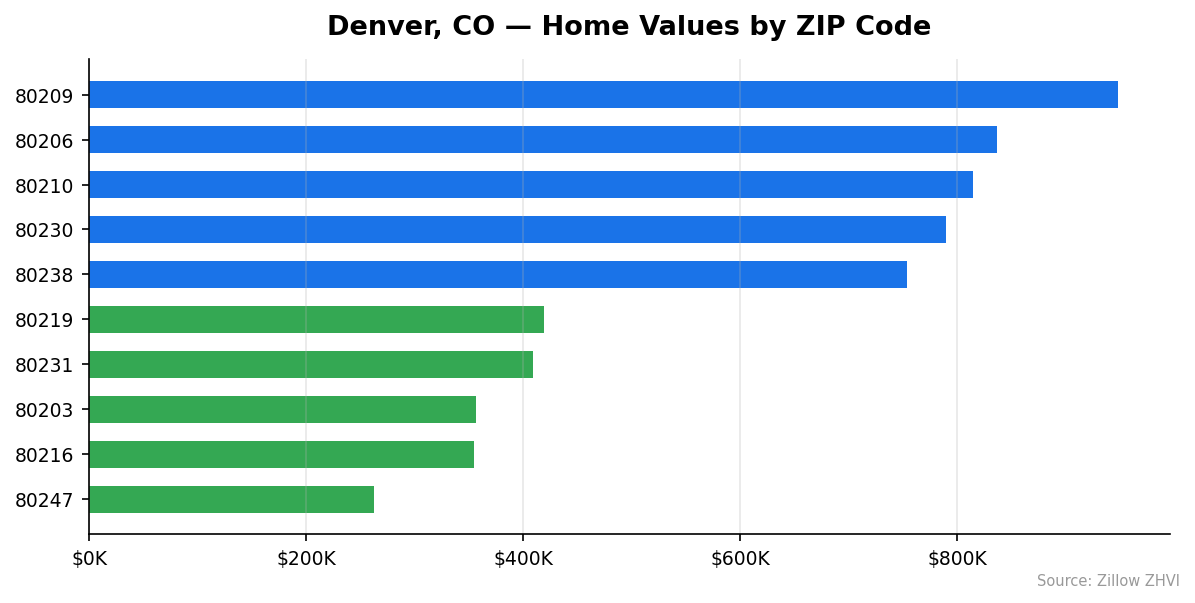
Here are Denver’s ZIP codes ranked by typical home value:
| ZIP Code | Typical Home Value |
|---|---|
| 80209 | $948,320 |
| 80206 | $836,205 |
| 80210 | $814,100 |
| 80230 | $789,920 |
| 80238 | $753,183 |
| 80212 | $722,559 |
| 80211 | $692,916 |
| 80220 | $645,543 |
| 80207 | $583,051 |
| 80246 | $564,219 |
| 80205 | $563,030 |
| 80202 | $556,649 |
| 80222 | $551,326 |
| 80224 | $547,050 |
| 80204 | $523,259 |
| 80236 | $512,346 |
| 80237 | $494,217 |
| 80218 | $491,388 |
| 80249 | $463,675 |
| 80223 | $450,813 |
| 80221 | $448,086 |
| 80239 | $425,044 |
| 80219 | $419,528 |
| 80231 | $409,371 |
| 80203 | $356,096 |
| 80216 | $354,627 |
| 80247 | $262,422 |
The top three ZIPs — 80209, 80206, and 80210 — all sit above $800,000. These are Denver’s established wealthy neighborhoods near Washington Park, Cherry Creek, and the Country Club area.
On the other end, 80247 stands out at $262,422. That’s 53% below the city median and the only ZIP under $300,000. If you’re looking for a way into the Denver market at a lower price point, that’s where the numbers lead.
Rent vs Buy in Denver
Renting is cheaper than buying in Denver right now. It’s not close.
Here’s what monthly rents look like across Denver’s neighborhoods:
| ZIP Code | Typical Monthly Rent | Typical Home Value |
|---|---|---|
| 80212 | $2,551 | $722,559 |
| 80207 | $2,307 | $583,051 |
| 80219 | $2,306 | $419,528 |
| 80221 | $2,232 | $448,086 |
| 80238 | $2,128 | $753,183 |
| 80236 | $2,122 | $512,346 |
| 80211 | $2,117 | $692,916 |
| 80209 | $2,104 | $948,320 |
| 80230 | $2,081 | $789,920 |
| 80249 | $1,962 | $463,675 |
| 80210 | $1,954 | $814,100 |
| 80205 | $1,922 | $563,030 |
| 80202 | $1,919 | $556,649 |
| 80216 | $1,873 | $354,627 |
| 80204 | $1,845 | $523,259 |
| 80223 | $1,822 | $450,813 |
| 80247 | $1,815 | $262,422 |
| 80206 | $1,812 | $836,205 |
| 80237 | $1,797 | $494,217 |
| 80239 | $1,700 | $425,044 |
| 80222 | $1,702 | $551,326 |
| 80220 | $1,675 | $645,543 |
| 80224 | $1,628 | $547,050 |
| 80203 | $1,532 | $356,096 |
| 80218 | $1,488 | $491,388 |
| 80231 | $1,486 | $409,371 |
| 80246 | $1,375 | $564,219 |
A rough mortgage calculation on the median home: put 20% down on $562,183, and you’re financing about $449,746. At a 7% rate over 30 years, your principal and interest alone runs roughly $2,993 per month. Add property taxes and insurance, and you’re likely north of $3,500.
Compare that to typical rents in the $1,700–$2,550 range. Buying costs $1,000+ more per month in most neighborhoods. The price-to-rent ratio strongly favors renting — at least in the short term.
That said, if you plan to stay 7+ years, the equity story starts to matter. But with prices falling 3.3% annually, the timeline to break even on a purchase just got longer.
Population Growth and Migration
Denver’s population reached 729,019 in 2024. The city is growing, but slowly — up just 1.6% over four years.
The growth hasn’t been a straight line. Denver actually lost residents in 2021, dipping to 711,530 before recovering.
| Year | Population |
|---|---|
| 2020 | 717,620 |
| 2021 | 711,530 |
| 2022 | 714,851 |
| 2023 | 721,367 |
| 2024 | 729,019 |
That 2021 dip tracks with pandemic-era migration patterns seen in many expensive cities. Since then, people have been coming back — roughly 17,500 net new residents between 2021 and 2024.
Denver is growing more slowly than its neighbors:
| City | 2024 Population | 4-Year Growth |
|---|---|---|
| Greeley | 114,363 | 4.6% |
| Aurora | 403,130 | 4.2% |
| Thornton | 146,689 | 3.2% |
| Colorado Springs | 493,554 | 2.5% |
| Denver | 729,019 | 1.6% |
| Centennial | 108,853 | 0.6% |
Aurora and Greeley are growing at more than double Denver’s rate. That pattern — faster growth in surrounding cities — suggests people want to be near Denver but are choosing cheaper alternatives. When the suburbs grow faster than the core, it usually means the core is pricing people out.
For housing demand, 1.6% growth over four years is modest. It adds residents, but not at a pace that would create intense upward pressure on prices.
Denver Housing Market Trends
Here’s how the average home price in Denver has moved month by month over the past year:
| Month | Average Home Value | Min (by ZIP) | Max (by ZIP) |
|---|---|---|---|
| Mar 2025 | $581,228 | $287,730 | $949,966 |
| Apr 2025 | $576,791 | $284,237 | $946,569 |
| May 2025 | $571,827 | $280,246 | $942,783 |
| Jun 2025 | $567,535 | $276,226 | $939,369 |
| Jul 2025 | $564,042 | $272,154 | $936,768 |
| Aug 2025 | $562,229 | $268,813 | $936,120 |
| Sep 2025 | $561,796 | $266,392 | $937,621 |
| Oct 2025 | $562,401 | $265,014 | $940,482 |
| Nov 2025 | $563,341 | $264,196 | $944,257 |
| Dec 2025 | $564,076 | $263,697 | $947,613 |
| Jan 2026 | $563,823 | $263,240 | $949,353 |
| Feb 2026 | $562,183 | $262,422 | $948,320 |
The pattern is clear: a sharp decline from March through September 2025, then a brief plateau, followed by another dip in early 2026.
The steepest drop happened between March and June 2025, when values fell about $13,700 in three months. The market briefly stabilized in the fall — October through December saw values hover around $563,000–$564,000. But that stability didn’t hold. January and February 2026 resumed the slide.
The cheapest ZIP codes have been hit hardest in percentage terms. The minimum value dropped from $287,730 to $262,422 — an 8.8% decline. The most expensive areas held up better, with the max value falling only about $1,600 over the full period.
Is Denver a Good Place to Buy in 2026?
The data points toward a buyer’s market. Prices are falling. Inventory pressure has eased. And the 3.3% annual decline gives you room to negotiate.
If you’re a buyer who has been waiting, conditions are better now than they were a year ago. You’re paying roughly $19,000 less for the same house. If the trend continues, waiting a few more months could save you more.
But “better” doesn’t mean “cheap.” The median home still costs $562,183. With a 20% down payment, you need $112,000 in cash and a mortgage payment north of $3,000 per month. You need a household income well above $100,000 to make those numbers work comfortably.
If you’re a seller, timing matters. The plateau from October to December 2025 didn’t last. Listing sooner rather than later may limit your downside.
Denver Housing Market Outlook for 2026-2027
The 12-month trend shows steady price erosion with no clear floor yet. From March 2025 to February 2026, the average home value dropped every quarter.
The fall 2025 plateau briefly suggested the market might stabilize around $563,000. It didn’t. January and February 2026 resumed the decline, with values falling another $1,900.
If the current pace continues — roughly $1,600 per month of decline since October — the average home value could drift toward $555,000 by mid-2026. The three-month trend from December to February suggests the pace of decline may be accelerating slightly after the fall pause.
The cheapest neighborhoods are falling faster than the most expensive ones. That divergence could widen if economic conditions tighten further.
Nothing in this data suggests a rebound is imminent. The downward trend has persisted for 11 consecutive months from the March 2025 peak.
Frequently Asked Questions
What is the average home price in Denver?
The average home price in Denver is $562,183 as of February 2026. This figure represents the typical home value across 27 ZIP codes tracked in the Denver market. Prices range from $262,422 in the most affordable ZIP (80247) to $948,320 in the most expensive (80209).
Are home prices going up or down in Denver?
Home prices in Denver are going down. Values have fallen 3.3% year over year and have declined steadily since peaking at $581,228 in March 2025. The drop has been consistent, with only a brief plateau in fall 2025 before prices resumed falling.
Is it cheaper to rent or buy in Denver?
Renting is cheaper than buying in Denver on a monthly basis. Typical rents range from $1,375 to $2,551 depending on the neighborhood. A mortgage on the median-priced home at 7% interest with 20% down would cost roughly $2,993 per month in principal and interest alone — before taxes and insurance push the total well above $3,500.
What is the most affordable neighborhood in Denver?
ZIP code 80247 is the most affordable neighborhood in Denver, with a typical home value of $262,422. That’s 53% below the citywide median. Other affordable options include 80216 ($354,627) and 80203 ($356,096).
Methodology
Home values are based on the Zillow Home Value Index (ZHVI), a smoothed measure of typical home values in the 35th to 65th percentile range. Rent estimates use the Zillow Observed Rent Index (ZORI). Population figures come from the U.S. Census Bureau Population Estimates Program (2020-2024 vintage). All datasets are publicly available. Housing data updated 2026-02-28.