Fayetteville Home Prices: $236K, Up 0.5% — 9 ZIPs Analyzed (2026)
$236,096. That’s what a typical home costs in Fayetteville, NC right now. Prices inched up just 0.5% over the past year — barely keeping pace with inflation. For a military town with a population over 209,000, that number sits well below most North Carolina metros.
Quick answer: The average home price in Fayetteville, NC is $236,096 as of February 2026, up 0.5% year over year according to Zillow.
Current Home Prices in Fayetteville
| Metric | Value |
|---|---|
| Median Home Value | $236,096 |
| Year-over-Year Change | +0.5% |
| Lowest ZIP Median | $143,551 |
| Highest ZIP Median | $294,172 |
| Number of ZIPs Tracked | 9 |
| Data as of | February 2026 |
A half-percent gain is essentially flat. While other North Carolina cities like Charlotte and Raleigh have posted stronger appreciation, Fayetteville’s market is moving sideways.
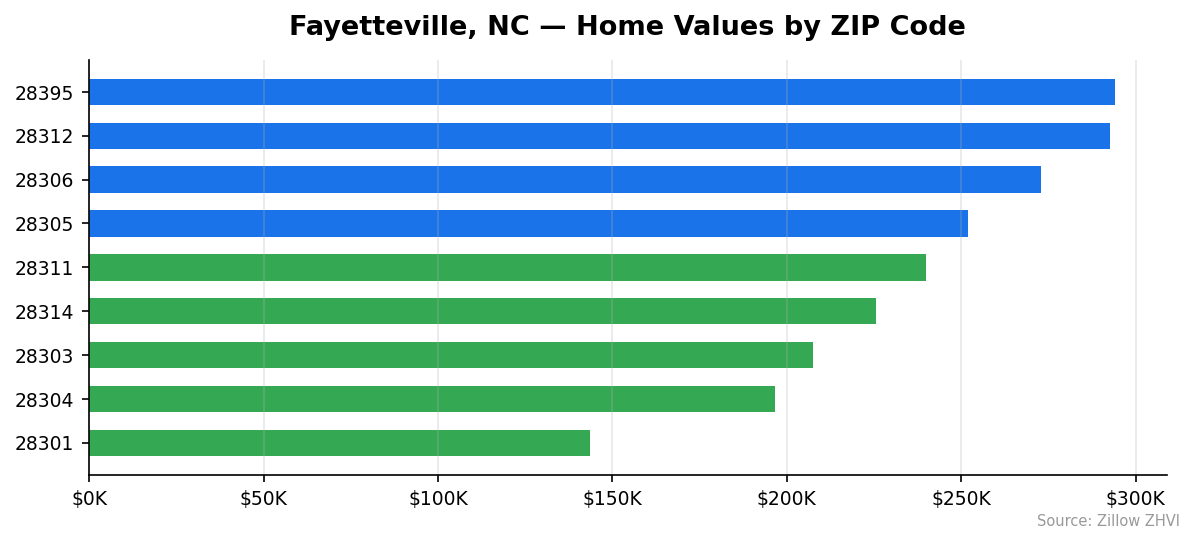
The spread between the cheapest and most expensive ZIP codes is over $150,000. That gap tells you Fayetteville isn’t one market — it’s several. A buyer’s experience in 28301 looks nothing like what you’d find in 28395.
The $236K median puts Fayetteville well below the national average. For context, that’s less than half of what homes cost in Raleigh and roughly a quarter of Charlotte’s priciest neighborhoods. If affordability is your main concern, the numbers here are hard to argue with.
Fayetteville Home Prices by Neighborhood
| ZIP Code | Median Home Value | Median Rent |
|---|---|---|
| 28395 | $294,172 | N/A |
| 28312 | $292,714 | N/A |
| 28306 | $272,932 | $1,555 |
| 28305 | $251,936 | $1,239 |
| 28311 | $239,834 | $1,368 |
| 28314 | $225,458 | $1,409 |
| 28303 | $207,613 | $1,482 |
| 28304 | $196,655 | $1,437 |
| 28301 | $143,551 | $1,340 |
Most Expensive ZIPs
28395 leads at $294,172, sitting 25% above the city median — rent data isn’t tracked here, suggesting a more owner-occupied area. 28312 follows closely at $292,714, also without rent tracking. 28306 rounds out the top three at $272,932 with the highest rents in the city at $1,555/month.
Most Affordable ZIPs
28301 is the clear bargain at $143,551 — roughly 39% below the city average, with rents at $1,340/month. 28304 comes in at $196,655, offering prices 17% below median despite rents of $1,437. 28303 at $207,613 sits 12% under the city average with rents of $1,482, one of the higher rent figures in the city.
One pattern stands out: some of the cheapest ZIPs to buy actually have higher rents than pricier areas. In 28303, you’d pay $1,482/month to rent but the home values are $30K below city average. That mismatch is worth investigating if you’re deciding between renting and buying.
Rent vs Buy in Fayetteville
Rents across Fayetteville’s tracked ZIP codes range from $1,239 to $1,555 per month. The city-wide average falls around $1,400.
| ZIP | Monthly Rent | Home Value | Rent-to-Price Ratio |
|---|---|---|---|
| 28306 | $1,555 | $272,932 | 0.57% |
| 28303 | $1,482 | $207,613 | 0.71% |
| 28304 | $1,437 | $196,655 | 0.73% |
| 28314 | $1,409 | $225,458 | 0.63% |
| 28311 | $1,368 | $239,834 | 0.57% |
| 28301 | $1,340 | $143,551 | 0.93% |
| 28305 | $1,239 | $251,936 | 0.49% |
Here’s the rough math. A $236K home with 10% down and a 6.5% rate gives you a monthly mortgage payment of about $1,343. Add taxes and insurance, and you’re likely in the $1,600-$1,800 range. That’s modestly above the average rent of $1,400.
But you’re building equity. With prices flat, you’re not banking on appreciation — the case for buying here rests on locking in your housing cost and the long-term payoff of ownership.
ZIP 28301 stands out for investors. The 0.93% rent-to-price ratio is the strongest in the city. A $143K property pulling $1,340/month in rent is a better yield than you’ll find in most mid-size cities.
Population Growth and Migration
Fayetteville is losing residents. The city’s population dropped from 210,894 in 2020 to 209,496 in 2024 — a decline of 0.7%.
| Year | Population |
|---|---|
| 2020 | 210,894 |
| 2021 | 212,265 |
| 2022 | 211,425 |
| 2023 | 209,873 |
| 2024 | 209,496 |
The population peaked in 2021 at 212,265 and has dropped every year since. That three-year slide sets Fayetteville apart from most of North Carolina, where cities are growing fast.
| City | 2024 Population | 4-Year Growth |
|---|---|---|
| Wilmington | 125,284 | +8.1% |
| Charlotte | 943,476 | +7.8% |
| Raleigh | 499,825 | +7.3% |
| Durham | 301,870 | +7.2% |
| Concord | 112,395 | +7.1% |
| Fayetteville | 209,496 | -0.7% |
Every comparison city is growing at 7% or above. Fayetteville is the outlier. As a military-dependent economy tied to Fort Liberty, population swings often reflect troop deployments and base policy rather than organic migration.
For housing, declining population means softer demand. That helps explain the flat price growth — fewer buyers competing for homes keeps a lid on appreciation.
Fayetteville Housing Market Trends
| Month | Avg Value | Low | High |
|---|---|---|---|
| Feb 2026 | $236,096 | $143,551 | $294,172 |
| Jan 2026 | $235,233 | $143,519 | $291,476 |
| Dec 2025 | $234,055 | $143,102 | $289,703 |
| Nov 2025 | $232,839 | $142,757 | $288,000 |
| Oct 2025 | $231,772 | $142,344 | $286,668 |
| Sep 2025 | $231,170 | $141,951 | $286,015 |
| Aug 2025 | $231,143 | $142,237 | $285,733 |
| Jul 2025 | $231,762 | $143,263 | $285,960 |
| Jun 2025 | $232,749 | $144,953 | $286,342 |
| May 2025 | $233,726 | $146,343 | $286,721 |
| Apr 2025 | $234,466 | $147,355 | $287,079 |
| Mar 2025 | $234,978 | $147,995 | $287,373 |
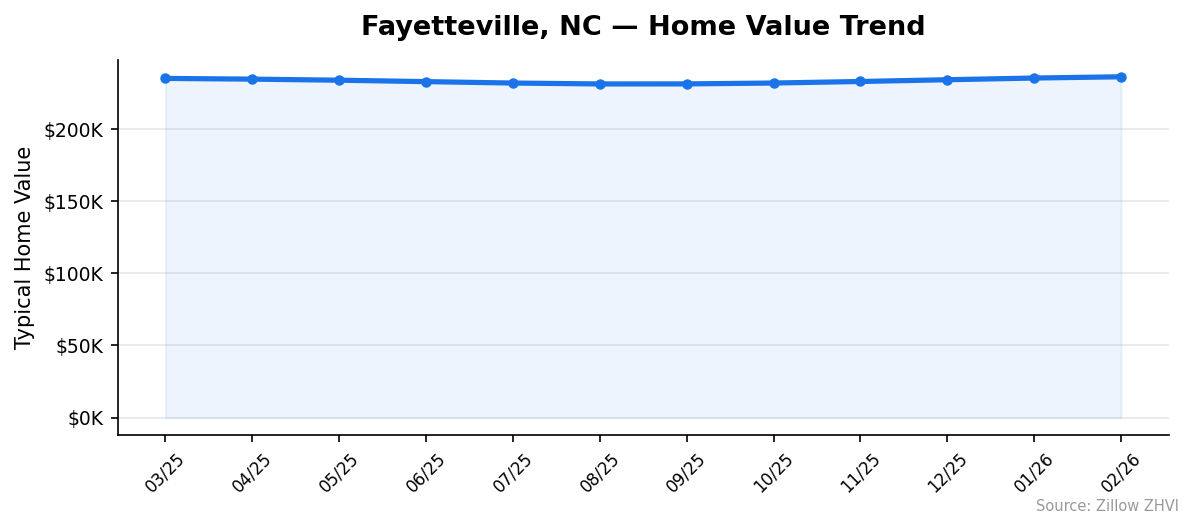
The 12-month trend tells two stories. From March 2025 through August 2025, prices drifted down — dropping from $234,978 to $231,143. Then the market reversed. Since August, prices have climbed for six straight months, gaining about $5,000.
The floor price (lowest ZIP) tells a different story. It fell from $147,995 in March to $141,951 in September, then barely recovered to $143,551 by February. The cheapest areas aren’t bouncing back as fast.
Meanwhile, the ceiling keeps rising. The most expensive ZIP went from $287,373 to $294,172 — an increase of nearly $7,000 in a year. The gap between the top and bottom is widening.
Is Fayetteville a Good Place to Buy in 2026?
The data points to a balanced market leaning slightly toward buyers. Here’s what supports that:
Prices are nearly flat year-over-year at +0.5%. You’re not chasing a runaway market. There’s no bidding-war pressure reflected in these numbers.
The population is declining. Fewer people means less competition for homes. Sellers don’t have the bargaining power they’d have in Charlotte or Raleigh.
Entry prices are low. At $143,551, the cheapest ZIP in Fayetteville costs less than a median home in most American cities. Even the city-wide median of $236K is accessible with an FHA loan and modest down payment.
The risk? Flat prices mean your home may not appreciate much. If you’re buying as an investment vehicle, the returns are modest. If you’re buying to live in and want stable, affordable payments, Fayetteville delivers.
Fayetteville Housing Market Outlook for 2026-2027
The six-month upward trend from September 2025 through February 2026 suggests mild positive momentum heading into spring and summer. If the current pace continues — roughly $800-$1,000 per month in gains — the city median could push toward $240K-$242K by late 2026.
But this isn’t a boom. The year-over-year gain of 0.5% is one of the slowest in North Carolina. With population still declining, there’s a natural ceiling on demand-driven appreciation.
The 3-month trend from December to February shows acceleration: gains of $1,178, then $863. Spring buying season may add fuel. Don’t expect dramatic moves in either direction. This is a market that rewards patience, not speculation.
Similar Markets in NC
If you’re shopping in North Carolina, these cities offer useful comparisons:
- Charlotte — The state’s largest city at 943K residents, with 7.8% population growth driving higher prices and more competition.
- Raleigh — The Triangle’s anchor city has nearly 500K residents and strong tech-sector demand. Expect to pay well above Fayetteville’s median.
- Durham — Growing at 7.2% with a university-driven economy. A step up in price from Fayetteville but still below Raleigh.
- Greensboro — A Triad city that offers a closer price comparison to Fayetteville without the military-base dependency.
- Wilmington — Coastal living with the fastest growth in the comparison set at 8.1%. Higher prices but a very different lifestyle.
Frequently Asked Questions
What is the average home price in Fayetteville?
The average home price in Fayetteville is $236,096 as of February 2026. That figure represents the city-wide median across 9 tracked ZIP codes. Individual neighborhoods range from $143,551 in 28301 to $294,172 in 28395.
Are home prices going up or down in Fayetteville?
Prices are up 0.5% year over year — essentially flat. The market dipped from March through August 2025, then reversed course with six consecutive months of gains. The trend is mildly positive but well below the pace seen in other North Carolina cities.
Is it cheaper to rent or buy in Fayetteville?
It depends on the ZIP code. Average rent across tracked areas is about $1,400/month. A mortgage on the city median of $236K (10% down, 6.5% rate) runs about $1,343/month before taxes and insurance. After those costs, buying is slightly more expensive month-to-month, but you’re building equity instead of paying a landlord.
What is the most affordable neighborhood in Fayetteville?
ZIP code 28301 is the most affordable at $143,551 — 39% below the city median. Rent there averages $1,340/month, which gives it the highest rent-to-price ratio in the city at 0.93%. It’s the strongest value play for both buyers and investors.
Is Fayetteville growing or shrinking?
Fayetteville is shrinking. The population fell from 210,894 in 2020 to 209,496 in 2024, a decline of 0.7% over four years. This contrasts sharply with nearby cities like Wilmington (+8.1%), Charlotte (+7.8%), and Raleigh (+7.3%), all of which are growing rapidly.
Methodology
Home values are based on the Zillow Home Value Index (ZHVI), a smoothed measure of typical home values in the 35th to 65th percentile range. Rent estimates use the Zillow Observed Rent Index (ZORI). Population figures come from the U.S. Census Bureau Population Estimates Program (2020-2024 vintage). All datasets are publicly available. Housing data updated 2026-02-28.