Charleston Home Prices: $791K, Up 2.4% — 7 ZIPs Analyzed (2026)
$791,270. That’s the typical home value in Charleston, SC as of February 2026, up 2.4% from a year ago. Prices have climbed every month for the past eight months, and the gap between the cheapest and most expensive ZIPs is now nearly $1 million.
Quick answer: The average home price in Charleston, SC is $791,270 as of February 2026, up 2.4% year over year according to Zillow.
Current Home Prices in Charleston
Charleston is firmly in seven-figure territory at the top end and below $500K at the bottom. The spread tells the story of a market split between historic peninsula real estate and outer-ring suburbs.
| Metric | Value |
|---|---|
| Median home price | $791,270 |
| Year-over-year change | +2.4% |
| Lowest ZIP median | $464,605 |
| Highest ZIP median | $1,459,339 |
| ZIP codes analyzed | 7 |
| Data through | February 2026 |
The 2.4% annual gain is modest by Charleston standards but meaningful given how high the base already is. A 2.4% move on $791K adds about $18,500 in value over twelve months — more than the full annual rent on the cheapest two-bedrooms in the metro.
The price floor matters too. At $464,605, even Charleston’s most affordable ZIP sits well above the South Carolina state median. You won’t find a sub-$300K starter market here. The cheapest neighborhood is more expensive than the typical home in Columbia, Greenville, or Spartanburg.
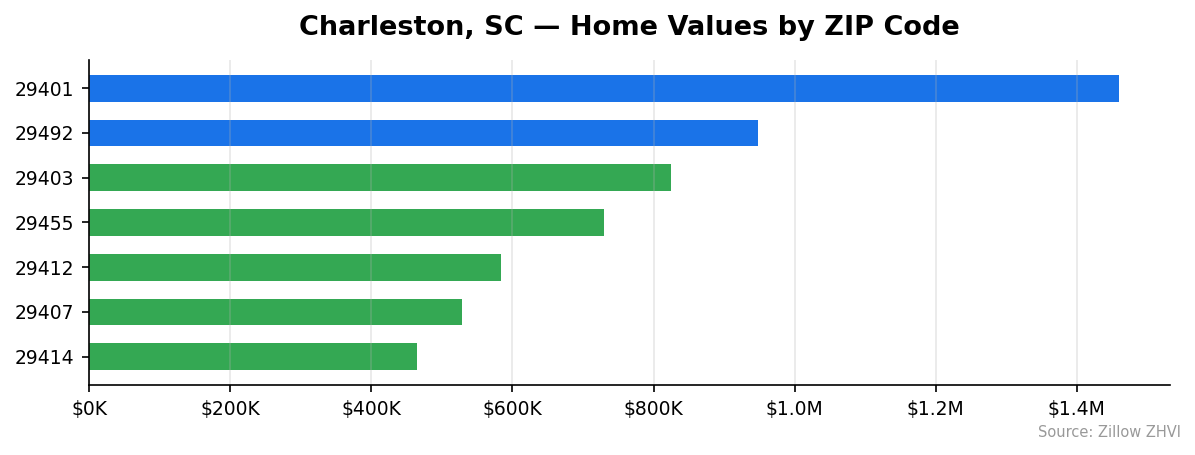
The ceiling tells a different story. ZIP 29401, the historic peninsula, runs at $1,459,339 — roughly 84% above the citywide median and more than triple the cheapest ZIP. Charleston isn’t one market. It’s at least three: peninsula luxury, suburban mid-tier, and a handful of West Ashley corridors that still trade below $600K.
Charleston Home Prices by Neighborhood
Seven ZIPs in the city of Charleston. Here’s the full picture from cheapest to most expensive.
| ZIP | Median Price | Median Rent | Area |
|---|---|---|---|
| 29414 | $464,605 | $1,819 | West Ashley |
| 29407 | $528,306 | $1,616 | West Ashley/Byrnes Down |
| 29412 | $583,477 | $2,157 | James Island |
| 29455 | $729,916 | $2,428 | Johns Island/Kiawah |
| 29403 | $825,318 | $2,613 | Upper peninsula |
| 29492 | $947,932 | $2,039 | Daniel Island |
| 29401 | $1,459,339 | $3,549 | Historic peninsula |
Most Expensive
29401 — $1,459,339. The historic downtown peninsula. Rents average $3,549 a month, the highest in the city by nearly a thousand dollars.
29492 — $947,932. Daniel Island carries premium prices but rents at $2,039 are surprisingly close to the West Ashley middle. Buyers pay for ownership; renters get a relative bargain.
29403 — $825,318. The upper peninsula, just above the city median. Rents at $2,613 reflect the proximity to downtown without the historic-district premium.
Most Affordable
29414 — $464,605. West Ashley’s outer reaches, the only Charleston ZIP under $500K. Rent at $1,819 is also the second cheapest.
29407 — $528,306. Older West Ashley with the lowest rents in the city at $1,616.
29412 — $583,477. James Island. Higher rents ($2,157) than its price tier suggests, indicating tight rental supply.
Rent vs Buy in Charleston
Renting is the cheaper path month-to-month, and it isn’t close.
The average ZIP-level rent across Charleston runs from $1,616 in the cheapest neighborhood to $3,549 on the peninsula, with a citywide weighted middle around $2,300. A typical Charleston home at $791,270 — assuming 20% down on a 30-year mortgage at recent rates — generates a monthly principal-and-interest payment well above $4,000 before taxes, insurance, and maintenance. Add Charleston County property taxes and homeowner’s insurance (which carries flood and wind premiums in coastal ZIPs) and the gap widens.
| ZIP | Monthly Rent | Home Price | Annual Rent | Price-to-Rent Ratio |
|---|---|---|---|---|
| 29401 | $3,549 | $1,459,339 | $42,584 | 34.3 |
| 29403 | $2,613 | $825,318 | $31,353 | 26.3 |
| 29455 | $2,428 | $729,916 | $29,138 | 25.1 |
| 29412 | $2,157 | $583,477 | $25,888 | 22.5 |
| 29492 | $2,039 | $947,932 | $24,473 | 38.7 |
| 29414 | $1,819 | $464,605 | $21,825 | 21.3 |
| 29407 | $1,616 | $528,306 | $19,390 | 27.2 |
Price-to-rent ratios above 20 typically favor renting. Every Charleston ZIP clears that line. ZIP 29492 (Daniel Island) hits 38.7 — one of the most rent-friendly ratios you’ll find in any growing Southern metro. ZIP 29414 in West Ashley is the closest thing to a buyer-friendly neighborhood at 21.3, and even that tilts toward rent on a pure cash-flow basis.
If you plan to stay under five years, the math says rent. If you plan to stay 10+ years and want price appreciation, owning starts to compete — but only if you can absorb the upfront costs.
Population Growth and Migration
Charleston is growing, and the suburbs around it are growing faster.
| Year | Population |
|---|---|
| 2020 | 151,065 |
| 2021 | 152,116 |
| 2022 | 154,291 |
| 2023 | 156,263 |
| 2024 | 157,665 |
The city added 6,600 residents from 2020 to 2024, a 4.4% gain. That’s steady growth — not a boom, but not a slowdown either. Each year since 2020 has been larger than the one before.
The bigger story sits next door.
| Nearby City | 2024 Population | 4-Year Growth |
|---|---|---|
| North Charleston | 126,005 | 9.0% |
| Goose Creek | 50,352 | 8.8% |
| Columbia | 144,788 | 6.3% |
| Mount Pleasant town | 95,604 | 4.8% |
| Greenville | 74,371 | 4.1% |
North Charleston grew at more than double Charleston’s pace. Goose Creek nearly matched it. Buyers priced out of the city are landing in the surrounding metro, which is exactly what you’d expect when the cheapest in-city ZIP starts at $464K. Mount Pleasant grew 4.8% — slightly above Charleston — while charging similar premium prices.
For housing demand, this matters. Population is still flowing into the metro. The 2.4% annual price gain reflects that ongoing pressure, even as supply has loosened nationally.
Charleston Housing Market Trends
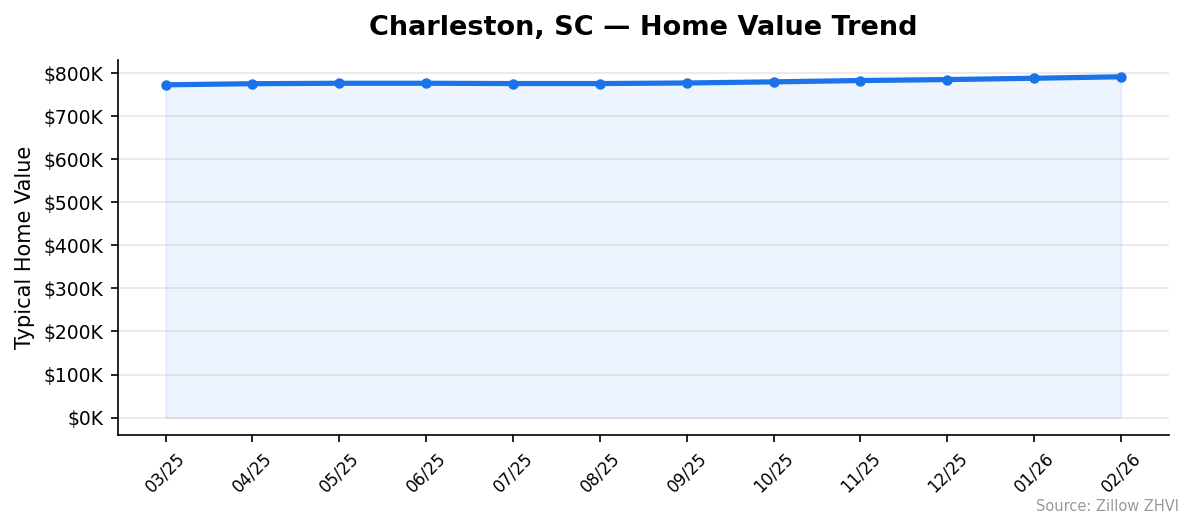
Twelve straight months of price data show a market that bottomed in summer 2025 and has climbed since.
| Month | Median |
|---|---|
| Mar 2025 | $772,646 |
| Apr 2025 | $775,223 |
| May 2025 | $776,220 |
| Jun 2025 | $776,248 |
| Jul 2025 | $775,550 |
| Aug 2025 | $775,570 |
| Sep 2025 | $776,888 |
| Oct 2025 | $779,484 |
| Nov 2025 | $782,550 |
| Dec 2025 | $784,802 |
| Jan 2026 | $787,895 |
| Feb 2026 | $791,270 |
The trough was July 2025 at $775,550. From there, prices have ticked up every month for seven months running. The eight-month gain is about $15,720, or 2.0%.
Recent months are accelerating. November to February alone added $8,720 — more than half the eight-month total. A market that had stalled for the spring and summer is now moving again.
The upper end is leading. ZIP 29401 alone went from $1,375,070 in March 2025 to $1,459,339 in February 2026, a $84,269 swing. The bottom moved less: the cheapest ZIP went from about $463,782 to $464,605, essentially flat.
Translation: peninsula luxury is doing the heavy lifting. The middle of the market is treading water.
Is Charleston a Good Place to Buy in 2026?
The data points to a seller’s market with cracks at the bottom.
Prices are rising — eight straight months — and population growth keeps demand in place. Inventory pressure isn’t easing. The 2.4% YoY gain undershoots the 5%+ moves Charleston posted earlier in the decade, but it’s positive territory while many Sun Belt metros have flipped negative.
That said, the market is split. If you’re shopping under $600K, your pool is just two ZIPs (29414 and 29407), and prices there have barely moved in a year. That’s a buyer’s window, narrow but real. Above $1 million on the peninsula, you’re competing with appreciation that’s outpacing the city as a whole — sellers there have pricing power.
Rent-vs-buy math favors renting in every ZIP. If you’re not committed to a long hold and willing to accept high carrying costs, waiting is defensible. The market isn’t crashing, but it isn’t running away from you either.
Charleston Housing Market Outlook for 2026-2027
The 3-month trend (December through February) shows prices adding roughly $2,200 per month. If the current pace continues into spring, Charleston would clear $800,000 by mid-2026.
The trajectory has been steady and gradually accelerating. Recent months are moving faster than the summer months. That’s consistent with a market regaining momentum, not one preparing to roll over.
Two things could change the picture. The bottom-tier ZIPs (29414, 29407) are essentially flat year over year. If that softness spreads, the citywide gain narrows. Conversely, the peninsula’s $84K annual jump in 29401 is doing disproportionate work in the average — any pullback at the top would weigh on the headline number.
For the next 3 to 6 months, expect modest gains in line with the recent monthly pace. Faster moves up or down would require a break from the current trend, which the data doesn’t show yet.
Similar Markets in SC
If Charleston prices are out of reach, South Carolina has cheaper coastal and metro alternatives.
- Summerville — Charleston’s main commuter suburb, typically priced well below the city.
- Mount Pleasant area buyers might also consider Bluffton, another fast-growing coastal market near Hilton Head.
- Myrtle Beach — beachfront market with very different price dynamics from Charleston.
- Columbia — the state capital, an inland market with prices typically far below Charleston levels.
- Greenville — Upstate SC’s largest metro, growing fast with a different price profile.
Frequently Asked Questions
What is the average home price in Charleston?
The average home price in Charleston, SC is $791,270 as of February 2026. That figure is based on Zillow’s Home Value Index across 7 city ZIP codes, ranging from $464,605 in West Ashley to $1,459,339 on the historic peninsula.
Are home prices going up or down in Charleston?
Up. Charleston home prices rose 2.4% over the past year and have increased every month for the past eight months. The recent pace has been accelerating, with three of the last four months adding more than $3,000 each.
Is it cheaper to rent or buy in Charleston?
Cheaper to rent, by a wide margin. Average rents range from $1,616 in 29407 to $3,549 in 29401, while the monthly carrying cost on a typical $791,270 home runs well above $4,000 in principal and interest alone — before taxes, insurance, and maintenance. Every Charleston ZIP has a price-to-rent ratio above 20, the standard threshold favoring renters.
What is the most affordable neighborhood in Charleston?
ZIP 29414 in West Ashley at $464,605 — the only Charleston ZIP under $500,000. It’s about 41% below the citywide median and has barely budged in price over the past year, making it the closest thing to a buyer-friendly window in the city.
Methodology
Home values are based on the Zillow Home Value Index (ZHVI), a smoothed measure of typical home values in the 35th to 65th percentile range. Rent estimates use the Zillow Observed Rent Index (ZORI). Population figures come from the U.S. Census Bureau Population Estimates Program (2020-2024 vintage). All datasets are publicly available. Housing data updated 2026-02-28.