Waukesha Home Prices: $415K, Up 4.9% — 3 ZIPs Analyzed (2026)
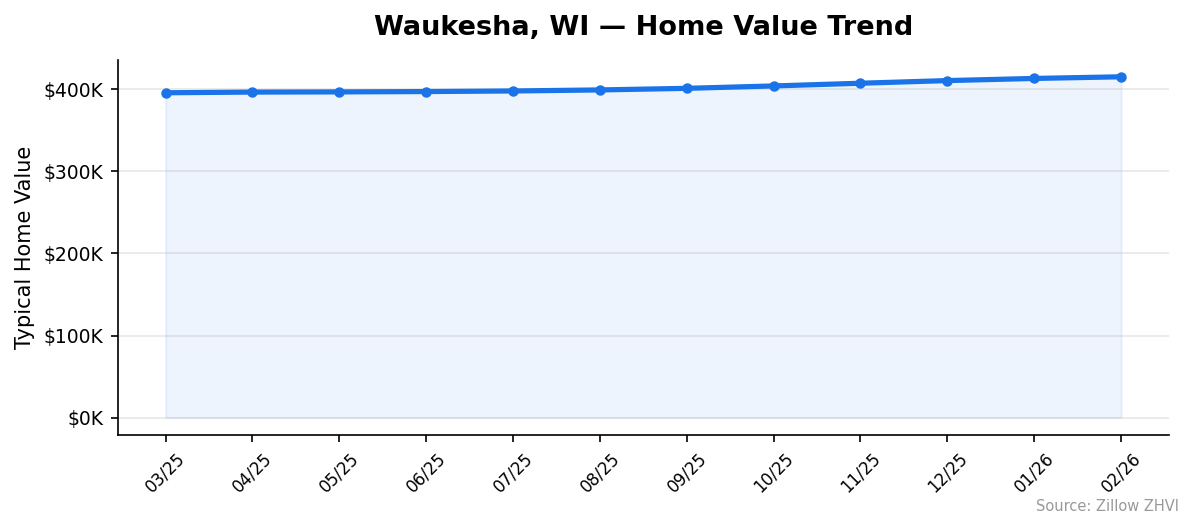
$415,260. That is the typical home value in Waukesha, WI as of February 2026. Prices are up 4.9% from a year ago, and the climb has been steady — every single month in the past 12 has set a new high.
Quick answer: The average home price in Waukesha, WI is $415,260 as of February 2026, up 4.9% year over year according to Zillow.
Current Home Prices in Waukesha
The median home in Waukesha sits at $415,260. Twelve months ago that number was $395,791. The gap is $19,469 — money that would-be buyers either earned in equity or paid out in higher offers, depending on which side of the closing table you sat on.
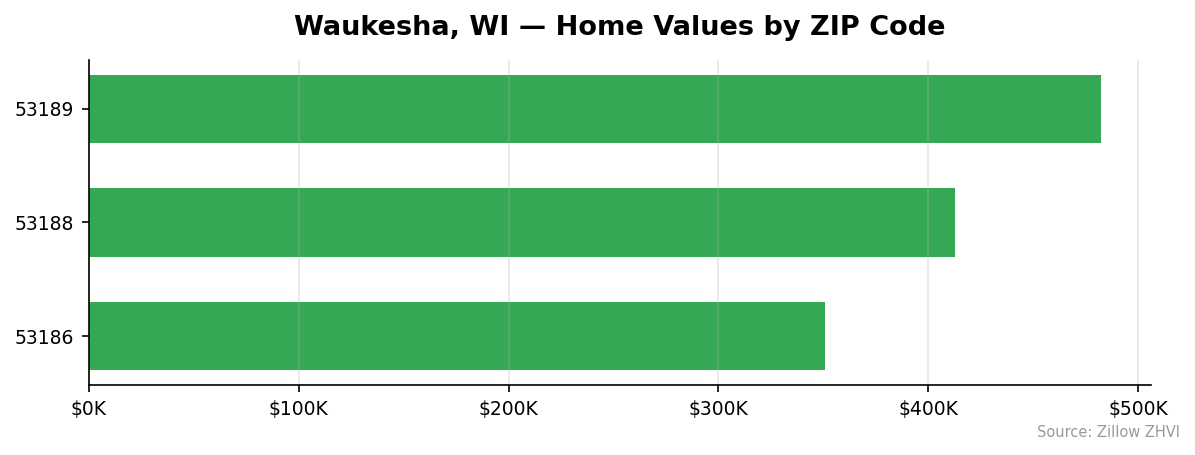
Prices range from $350,617 in the cheapest ZIP to $482,313 in the priciest. That spread of about $132,000 between the lowest and highest ZIP tells you Waukesha is not a single market. It is three distinct ones.
| Metric | Value |
|---|---|
| Median home value | $415,260 |
| Year-over-year change | +4.9% |
| 12-month price gain | +$19,469 |
| Lowest ZIP value | $350,617 |
| Highest ZIP value | $482,313 |
| ZIPs analyzed | 3 |
| Data through | February 2026 |
The 4.9% annual gain puts Waukesha ahead of inflation and ahead of wage growth in most of Wisconsin. For sellers, that is good news. For first-time buyers, it means waiting another year cost roughly $20,000 in price alone, before factoring in interest rates.
What stands out in the data is the lack of any pause. There is no single month over the past year where the median dipped, even slightly. That kind of straight-line appreciation is unusual.
Waukesha Home Prices by Neighborhood
Three ZIP codes cover Waukesha. Here they are, ranked from cheapest to priciest.
| ZIP | Median Value | Median Rent |
|---|---|---|
| 53186 | $350,617 | $1,380 |
| 53188 | $412,851 | $1,600 |
| 53189 | $482,313 | Not available |
The gap between the cheapest and most expensive ZIP is $131,696. That is more than double the down payment most buyers bring to the table. Where you draw the line on a map matters a lot here.
Most Expensive
- 53189 — $482,313. This ZIP runs about $67,000 above the city average. It is the only Waukesha ZIP without rent data, which suggests fewer rental units and a more owner-occupied profile.
- 53188 — $412,851. This is the middle ZIP, almost exactly at the city median. Rent here averages $1,600 per month.
- 53186 — $350,617. Even the cheapest ZIP in Waukesha clears the $350K mark.
Most Affordable
- 53186 — $350,617. This ZIP is the entry point. It is $65,000 below the city average and the most realistic option for buyers stretching their budget.
- 53188 — $412,851. Mid-priced and the lone ZIP with both home value and rent data, so renters can run the math directly here.
- 53189 — $482,313. Not affordable by Waukesha standards, but listed for completeness.
Rent vs Buy in Waukesha
Renting wins on monthly cost. It is not close.
| Buy (median home) | Rent (53188) | |
|---|---|---|
| Monthly housing cost | ~$2,800 | $1,600 |
| Down payment required | ~$83,000 | $0 |
| Building equity | Yes | No |
The buy estimate assumes 20% down on the $415,260 median, a 7% mortgage rate on a 30-year fixed loan, and roughly $590 a month for property taxes and insurance. That works out to about $2,800 a month all in.
Median rent in ZIP 53188 is $1,600. In ZIP 53186, the cheapest neighborhood, it is $1,379. Renting in either ZIP saves you between $1,200 and $1,400 per month versus buying the median home.
That gap matters. A renter saving the difference would cover a 20% down payment in just under six years, assuming no return on those savings. With a 4% return, the timeline shrinks further.
But rent does not build equity. Waukesha home values rose 4.9% last year — about $20,000 on the median home. A buyer who held through that period gained that equity. A renter did not.
The math favors renting in the short term. The math favors buying if you stay long enough for appreciation to outpace the monthly premium. In Waukesha, with prices climbing every month for a year, that calculation is shifting toward buying for anyone with a 5-plus year horizon.
Population Growth and Migration
Waukesha is growing, barely. The city had 71,138 residents in 2020 and 71,461 in 2024 — a gain of 323 people over four years, or 0.5%.
| Year | Population |
|---|---|
| 2020 | 71,138 |
| 2021 | 71,039 |
| 2022 | 71,088 |
| 2023 | 71,349 |
| 2024 | 71,461 |
The city dipped slightly in 2021 before recovering. Growth has been steady since 2022.
Compare that to other Wisconsin cities:
| City | Population (2024) | 4-year growth |
|---|---|---|
| Madison | 285,300 | +3.8% |
| Eau Claire | 72,331 | +4.1% |
| Janesville | 66,428 | +1.2% |
| Waukesha | 71,461 | +0.5% |
| Oshkosh | 67,242 | +0.5% |
| Racine | 78,057 | -0.1% |
Waukesha grew faster than Racine and matched Oshkosh. It trailed Madison and Eau Claire by a wide margin. Both of those cities have strong university and employment drivers that Waukesha does not match at the same scale.
For housing, slow population growth combined with 4.9% price gains is unusual. It suggests demand is being driven by something other than headcount — likely a mix of regional migration from Milwaukee, limited new construction, and households trading up rather than new arrivals.
Waukesha Housing Market Trends
Twelve consecutive months of price gains. No pauses, no dips.
| Month | Median Value | Min ZIP | Max ZIP |
|---|---|---|---|
| Feb 2026 | $415,260 | $350,617 | $482,313 |
| Jan 2026 | $413,245 | $349,007 | $479,733 |
| Dec 2025 | $410,626 | $346,600 | $476,571 |
| Nov 2025 | $407,412 | $343,757 | $472,585 |
| Oct 2025 | $404,099 | $340,907 | $468,291 |
| Sep 2025 | $401,192 | $338,734 | $464,187 |
| Aug 2025 | $399,246 | $337,246 | $461,632 |
| Jul 2025 | $397,992 | $336,280 | $459,965 |
| Jun 2025 | $397,273 | $335,728 | $458,860 |
| May 2025 | $396,848 | $335,476 | $458,032 |
| Apr 2025 | $396,627 | $335,459 | $457,343 |
| Mar 2025 | $395,791 | $334,990 | $455,788 |
The pace accelerated. From March through July 2025, the median moved just $2,201 — basically flat. From August onward, the climb steepened. October to February alone added more than $11,000 to the typical home.
The cheapest ZIP rose from $334,990 to $350,617 over the same window, a 4.7% gain. The priciest ZIP went from $455,788 to $482,313, up 5.8%. Higher-end homes appreciated faster than entry-level homes — a pattern that pushes affordability further out of reach for first-time buyers.
Is Waukesha a Good Place to Buy in 2026?
The data points to a seller’s market, but a measured one.
Prices have risen 12 months in a row. The 3-month gain is over $4,600, which annualizes to roughly 4.5% — close to the 4.9% trailing-year figure, meaning momentum has not slowed. Inventory is presumably tight given the steady climb, though the data here does not include listing counts.
For buyers, the case for waiting weakens with each month of gains. A buyer who waited from March 2025 to February 2026 paid an extra $19,469 for the same median home.
For sellers, the conditions are about as favorable as they get. Sustained appreciation, no monthly pullbacks, and a high-end ZIP outpacing the rest.
The catch: at $415,260, Waukesha is no longer cheap. The cheapest ZIP starts at $350,617 — well above the median home price across most of Wisconsin. Buyers priced out of Madison may find Waukesha more attainable; buyers from Milwaukee or Racine may find it expensive.
Waukesha Housing Market Outlook for 2026-2027
If the current pace continues, Waukesha could push past $425,000 by mid-2026. The 3-month trend shows the median gaining roughly $1,545 per month. Project that out and you reach the mid-$420Ks by July or August.
The acceleration matters more than the absolute numbers. Six months of slow gains followed by six months of faster gains usually signals tightening supply or returning buyer demand, not a coincidence.
The risk to this trend is rates. Waukesha buyers are stretching to clear $400K. If mortgage rates climb meaningfully, the monthly payment math breaks down for a chunk of demand. That would slow the pace, though probably not reverse it given how thin the supply has been.
The most likely path through late 2026: continued gains, but at a slower rate as affordability bites.
Similar Markets in WI
Waukesha buyers comparing options across Wisconsin have several places to look:
- Milwaukee — The closest major city and the metro anchor. Lower prices, more inventory.
- Madison — Higher prices but stronger population growth at 3.8% over four years.
- Racine — A cheaper alternative for buyers willing to commute.
- Kenosha — South of Milwaukee, often more affordable than Waukesha.
- Appleton — Northern Wisconsin option with different demographics.
Frequently Asked Questions
What is the average home price in Waukesha?
The average home price in Waukesha, WI is $415,260 as of February 2026. That value covers the city’s three ZIP codes and reflects the typical home in the 35th to 65th percentile range. Individual ZIPs span from $350,617 to $482,313.
Are home prices going up or down in Waukesha?
Prices are up 4.9% year over year. More telling: the median has risen every single month for the past 12 months, with no pauses or dips. The 3-month pace suggests the trend has not slowed.
Is it cheaper to rent or buy in Waukesha?
Renting is cheaper monthly. Median rent in ZIP 53188 is $1,600, while buying the median $415,260 home with 20% down costs roughly $2,800 per month including taxes and insurance. The $1,200 monthly gap favors renters in the short term, but buyers gain equity from appreciation.
What is the most affordable neighborhood in Waukesha?
ZIP 53186 is the cheapest at $350,617. That is about $65,000 below the city average and $132,000 less than the priciest ZIP, 53189. Rent in 53186 also runs lower at $1,379 per month.
Methodology
Home values are based on the Zillow Home Value Index (ZHVI), a smoothed measure of typical home values in the 35th to 65th percentile range. Rent estimates use the Zillow Observed Rent Index (ZORI). Population figures come from the U.S. Census Bureau Population Estimates Program (2020-2024 vintage). All datasets are publicly available. Housing data updated 2026-02-28.