Milwaukee Home Prices: $219K, Up 2.4% — 20 ZIPs Analyzed (2026)
$219,120. That’s the price tag on a typical home in Milwaukee right now. Prices climbed 2.4% over the past year — modest but steady. In a city where nearly half the ZIP codes sit below $200K, Milwaukee remains one of the more affordable large metros in the Midwest.
Quick answer: The average home price in Milwaukee, WI is $219,120 as of February 2026, up 2.4% year over year according to Zillow.
Current Home Prices in Milwaukee
The Milwaukee-Waukesha metro area shows stable price growth heading into spring 2026. Here’s where things stand:
| Metric | Value |
|---|---|
| Median Home Price | $219,120 |
| Year-over-Year Change | +2.4% |
| Lowest ZIP Median | $88,887 |
| Highest ZIP Median | $373,295 |
| ZIP Codes Tracked | 20 |
| Data As Of | February 2026 |
A 2.4% annual gain puts Milwaukee in the slow-and-steady category. You’re not looking at the wild swings of Sun Belt markets. The gap between the cheapest and most expensive neighborhoods is striking — a fourfold difference from bottom to top.
That $219K median sits well below the national figure. For buyers priced out of Chicago or Minneapolis, Milwaukee keeps showing up as a viable alternative. The price floor is especially notable: several ZIPs offer homes under $160K.
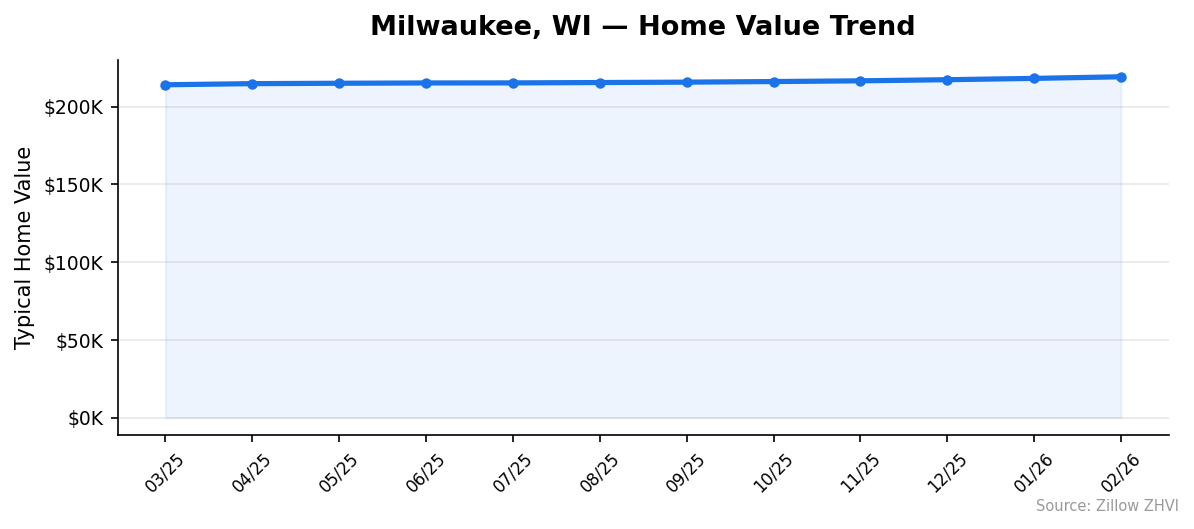
Month over month, prices moved from $218,093 in January to $219,120 in February — a small but consistent push upward. The market hasn’t shown a single monthly decline in the past 12 months of data.
Milwaukee Home Prices by Neighborhood
Twenty ZIP codes. Wide spread. Here’s every tracked neighborhood:
| ZIP Code | Median Home Value | Median Rent |
|---|---|---|
| 53203 | $373,295 | $1,626 |
| 53202 | $365,359 | $1,658 |
| 53207 | $295,204 | $1,563 |
| 53221 | $281,719 | $1,462 |
| 53219 | $260,398 | $1,233 |
| 53222 | $252,886 | $1,540 |
| 53224 | $231,008 | $1,439 |
| 53225 | $228,756 | $1,199 |
| 53208 | $224,871 | $1,072 |
| 53223 | $223,541 | $1,576 |
| 53215 | $212,709 | $961 |
| 53212 | $208,629 | $1,245 |
| 53233 | $177,894 | $883 |
| 53216 | $169,481 | $1,052 |
| 53210 | $162,125 | $1,114 |
| 53209 | $159,730 | $1,375 |
| 53218 | $159,325 | $1,338 |
| 53204 | $155,825 | $1,440 |
| 53205 | $150,753 | $1,569 |
| 53206 | $88,887 | $995 |
Most Expensive ZIPs
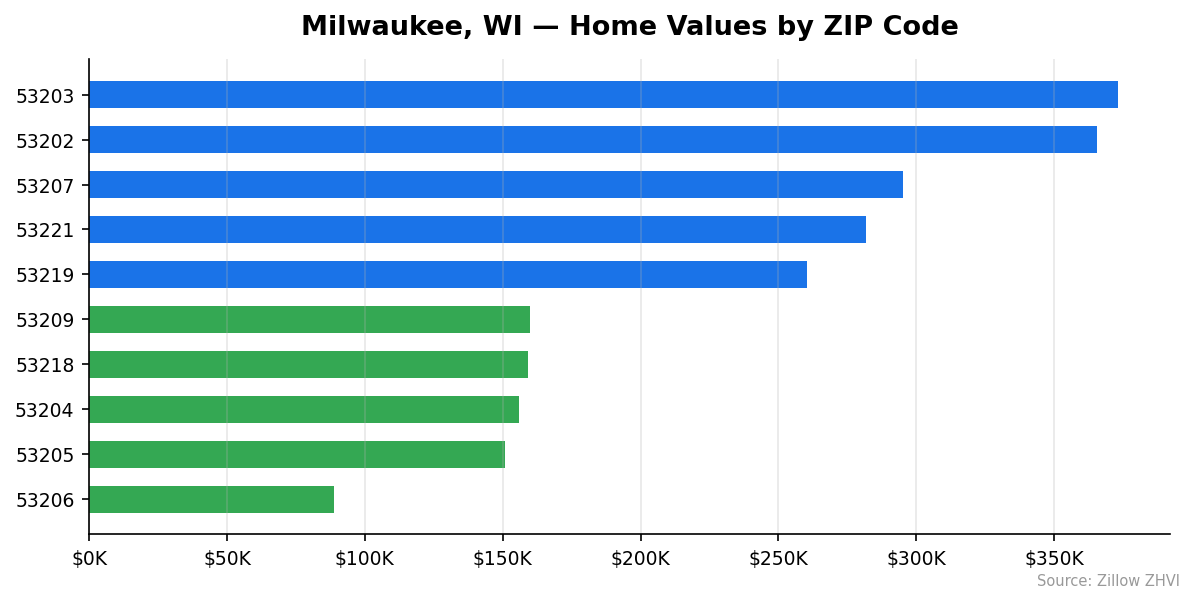
53203 leads at $373,295 — nearly double the city median, covering parts of the Historic Third Ward and downtown lakefront with rents around $1,626/month. 53202 follows closely at $365,359, another east side neighborhood where rents top the city at $1,658/month. 53207 rounds out the top three at $295,204, covering the Bay View area with a solid rent-to-price ratio.
Most Affordable ZIPs
53206 is the clear outlier at $88,887 — less than half of any other ZIP in the city and just 41% of the citywide median. Rents here run $995/month, meaning landlords pay a premium relative to property values. 53205 comes in at $150,753 with surprisingly high rents of $1,569. 53204 sits at $155,825, a near-south side area where rents of $1,440 far outpace what the home values might suggest.
Rent vs Buy in Milwaukee
Renting and buying are surprisingly close in Milwaukee. The citywide median rent across all 20 tracked ZIPs lands around $1,270/month.
| Scenario | Monthly Cost |
|---|---|
| Median Rent (citywide avg) | ~$1,270 |
| Mortgage on $219K (20% down, 6.5%) | ~$1,108 |
| Mortgage on $219K (10% down, 6.5%) | ~$1,252 |
| Mortgage on $219K (5% down, 6.5%) | ~$1,370 |
With 20% down, buying beats renting by roughly $160/month before you factor in taxes and insurance. Add those in and the gap narrows or flips depending on your ZIP.
The rent-to-price ratio tells a different story in certain neighborhoods. In 53205, you’d pay $1,569/month in rent for a home worth $150,753. That’s a price-to-rent ratio under 8 — heavily favoring buyers. In 53215, rent is just $961 for a $212,709 home, making renting the better short-term deal.
If you’re planning to stay five-plus years, buying in most Milwaukee ZIPs makes financial sense at current prices. Short-term? Renting gives you flexibility without much cost penalty.
Population Growth and Migration
Milwaukee is losing people, but the bleeding has slowed.
| Year | Population |
|---|---|
| 2020 | 577,157 |
| 2021 | 566,415 |
| 2022 | 564,614 |
| 2023 | 563,052 |
| 2024 | 563,531 |
The city shed 13,626 residents between 2020 and 2024 — a 2.4% decline. The sharpest drop came in 2021, when over 10,700 people left. Since then, losses have tapered. In 2024, Milwaukee actually gained about 479 residents — the first uptick in the dataset.
How does that compare to the rest of Wisconsin?
| City | 2024 Population | 4-Year Growth |
|---|---|---|
| Eau Claire | 72,331 | +4.1% |
| Madison | 285,300 | +3.8% |
| Janesville | 66,428 | +1.2% |
| Waukesha | 71,461 | +0.5% |
| Oshkosh | 67,242 | +0.5% |
Every comparable city in the state is growing. Madison added nearly 3.8% in four years. Even small-city Eau Claire outpaced the pack at 4.1%. Milwaukee is the state’s population outlier.
For housing, population loss normally depresses prices. Yet Milwaukee prices keep rising. That suggests housing supply remains tight enough to offset the demand drop — or that buyers from outside the city limits are entering the market.
Milwaukee Housing Market Trends
Twelve consecutive months of gains. No dips.
| Month | Median Price | Low (ZIP) | High (ZIP) |
|---|---|---|---|
| Feb 2026 | $219,120 | $88,887 | $373,295 |
| Jan 2026 | $218,093 | $87,256 | $374,809 |
| Dec 2025 | $217,240 | $85,590 | $376,996 |
| Nov 2025 | $216,525 | $83,765 | $379,434 |
| Oct 2025 | $216,063 | $82,138 | $381,207 |
| Sep 2025 | $215,671 | $80,620 | $381,520 |
| Aug 2025 | $215,424 | $79,529 | $381,847 |
| Jul 2025 | $215,192 | $78,692 | $382,133 |
| Jun 2025 | $215,149 | $78,658 | $383,012 |
| May 2025 | $214,962 | $79,151 | $383,327 |
| Apr 2025 | $214,713 | $79,613 | $383,380 |
| Mar 2025 | $213,990 | $79,747 | $382,427 |
The median climbed $5,130 over 12 months — about $427 per month. Slow but relentless.
Something interesting is happening at the extremes. The cheapest ZIP bottomed out around $78,658 in June 2025 and has since climbed to $88,887 — a 13% jump in eight months. Meanwhile, the most expensive ZIP peaked near $383,380 in April 2025 and has since dropped to $373,295. The gap between top and bottom is compressing.
That compression means affordable neighborhoods are appreciating faster than premium ones. If you bought in 53206 last summer, you’re already up over 10%.
Is Milwaukee a Good Place to Buy in 2026?
The numbers point to a balanced-to-buyer-friendly market. Prices are rising, but at 2.4% annually — barely above inflation. You’re not chasing runaway appreciation.
Here’s what works in your favor: the median sits at $219K in a city with a metro population over half a million. That’s genuine affordability for a major Midwestern city. Several ZIPs still offer homes under $160K.
The risk: Milwaukee is losing population. Fewer residents could eventually drag on demand. But the 2024 data hints at stabilization, and prices haven’t responded to the population decline yet.
For investors, the rent-to-price ratios in certain ZIPs are hard to ignore. Several neighborhoods show rents that seem high relative to purchase prices, which could mean positive cash flow from day one.
If you’re buying to live in, the math works. Mortgage payments compete with rent. Appreciation, while modest, has been consistent. Milwaukee won’t double your money in five years, but it probably won’t leave you underwater either.
Milwaukee Housing Market Outlook for 2026-2027
The 12-month trend shows acceleration. Prices gained about $150/month in the first half of 2025, then picked up to $500-$1,000/month in late 2025 and early 2026.
If the current pace continues, you could see the median approach $225K-$228K by the end of 2026. That would put the annual gain around 3-4%, a slight uptick from the current 2.4%.
The narrowing gap between cheap and expensive ZIPs suggests broad-based demand rather than a top-heavy market. When entry-level homes appreciate fastest, it usually signals strong buyer activity at the lower end — first-time buyers or investors.
The 3-month trend from December to February shows monthly gains of roughly $850-$1,000. That rhythm would need to hold through summer — traditionally the strongest season — for any acceleration to stick.
Similar Markets in WI
If you’re considering Milwaukee, these Wisconsin cities offer different price points and growth profiles:
- Madison — The state capital is growing fast at 3.8% and draws a younger, university-linked population.
- Waukesha — Right next door in the same metro, offering a suburban alternative with modest population growth.
- Green Bay — A smaller market in the northeast part of the state with a distinct economic base.
- Racine — South of Milwaukee along the lakefront, typically at a lower price point.
- Kenosha — Positioned between Milwaukee and Chicago, appealing to commuters priced out of both.
Frequently Asked Questions
What is the average home price in Milwaukee?
The average home price in Milwaukee is $219,120 as of February 2026. That figure represents the median across 20 tracked ZIP codes, where values range from $88,887 in ZIP 53206 to $373,295 in ZIP 53203.
Are home prices going up or down in Milwaukee?
Prices are going up. Milwaukee’s median home value increased 2.4% year over year. The market has posted 12 consecutive months of gains with no monthly declines since at least March 2025.
Is it cheaper to rent or buy in Milwaukee?
It depends on your down payment. The citywide average rent is roughly $1,270/month. A mortgage on the $219K median with 20% down runs about $1,108/month before taxes and insurance. With 10% down, you’re looking at approximately $1,252/month — nearly identical to renting.
What is the most affordable neighborhood in Milwaukee?
ZIP code 53206 has the lowest median home value at $88,887 — less than half of any other Milwaukee ZIP. The next most affordable areas are 53205 at $150,753 and 53204 at $155,825.
Methodology
Home values are based on the Zillow Home Value Index (ZHVI), a smoothed measure of typical home values in the 35th to 65th percentile range. Rent estimates use the Zillow Observed Rent Index (ZORI). Population figures come from the U.S. Census Bureau Population Estimates Program (2020-2024 vintage). All datasets are publicly available. Housing data updated 2026-02-28.