Roseville Home Prices: $628K, Down 1.2% — 3 ZIPs Analyzed (2026)
$627,777. That’s what a typical home costs in Roseville right now — and it’s actually less than it was a year ago. Prices slipped 1.2% year over year, a small but notable shift for a city that has been one of Sacramento metro’s fastest-growing suburbs. For buyers who’ve been priced out for years, the question is whether this dip has legs.
Quick answer: The average home price in Roseville, CA is $627,777 as of February 2026, down 1.2% year over year according to Zillow.
Current Home Prices in Roseville
Here’s where things stand in Roseville as of February 2026:
| Metric | Value |
|---|---|
| Median Home Value | $627,777 |
| Year-over-Year Change | -1.2% |
| Lowest ZIP Median | $539,995 |
| Highest ZIP Median | $682,692 |
| Number of ZIP Codes | 3 |
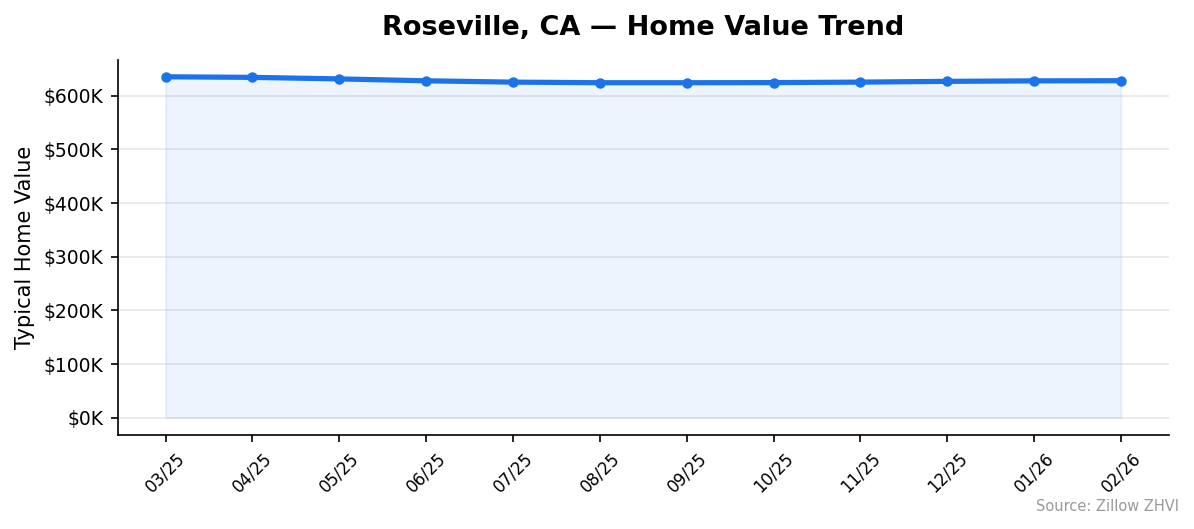
The 1.2% annual decline translates to roughly $7,600 in lost value on the median home. That’s not a crash by any measure, but it marks a change in direction. A year ago, in March 2025, the citywide average sat at $635,083. The drop has been gradual — a slow bleed rather than a sudden correction.
The spread between the cheapest and most expensive ZIP codes is $142,697. That’s a meaningful gap for a city of Roseville’s size, and it means your experience of the market depends heavily on which part of the city you’re shopping in.
For context, the Sacramento-Roseville-Folsom metro area has seen uneven price movement across its cities. Roseville’s slight pullback puts it in a different position than neighborhoods that are still appreciating.
Roseville Home Prices by Neighborhood
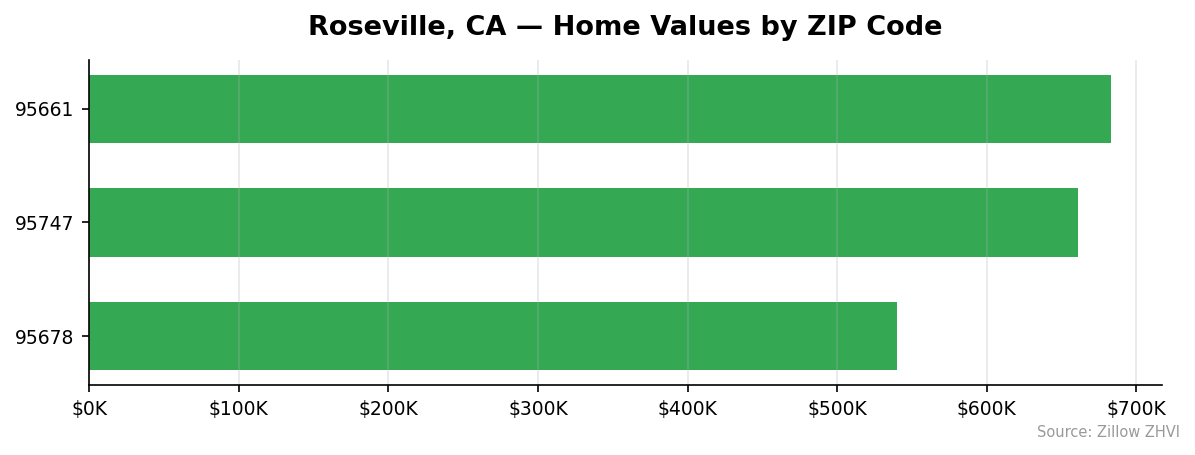
Roseville has three ZIP codes tracked by Zillow, and prices vary significantly across them.
| ZIP Code | Median Home Value | Median Rent |
|---|---|---|
| 95661 | $682,692 | $2,131 |
| 95747 | $660,642 | $2,796 |
| 95678 | $539,995 | $2,286 |
Most Expensive
95661 leads at $682,692 — roughly $55,000 above the city average. Interestingly, it has the lowest rent of all three ZIPs at $2,131 per month, which suggests a higher concentration of owner-occupied homes.
95747 comes in at $660,642, about $33,000 above average. This ZIP has the highest rents in the city at $2,796, pointing to strong rental demand in the area.
Most Affordable
95678 is the entry point into Roseville’s housing market at $539,995. That’s $87,782 below the citywide median. Rent here is $2,286 per month — middle of the pack. If you’re looking for the most affordable way into Roseville, this is the ZIP code to watch.
Rent vs Buy in Roseville
Renting is significantly cheaper than buying in Roseville right now. Here’s the math.
The average rent across Roseville’s three ZIP codes is approximately $2,404 per month. To buy the median home at $627,777 with 20% down ($125,555), you’d finance $502,222. At a 7% mortgage rate over 30 years, your principal and interest payment alone would run about $3,341 per month.
| Monthly Cost | Amount |
|---|---|
| Average Rent | ~$2,404 |
| Estimated Mortgage (P&I) | ~$3,341 |
| Difference | ~$937 |
That’s nearly $940 per month more to buy, before you add property taxes, insurance, and maintenance. In California, property taxes typically add another 1% to 1.25% of the home’s value annually — call it $520 to $650 per month on the median home.
The rent-vs-buy gap is wide enough that renting makes financial sense for anyone not committed to staying long-term. But if you plan to hold for 7+ years, building equity could offset the higher monthly cost — especially if prices stabilize or recover.
One oddity in the data: ZIP 95661 has the highest home prices but the lowest rents. That means the price-to-rent ratio there is especially stretched. Buyers in 95661 are paying a premium that the rental market doesn’t fully reflect.
Population Growth and Migration
Roseville is one of the fastest-growing cities in California. The numbers tell the story clearly.
| Year | Population |
|---|---|
| 2020 | 148,520 |
| 2021 | 152,515 |
| 2022 | 156,070 |
| 2023 | 159,230 |
| 2024 | 163,304 |
From 2020 to 2024, Roseville added 14,784 residents — a 10% increase in four years. That growth has been remarkably steady, averaging about 3,700 new residents per year.
How does that compare to other California cities?
| City | 2024 Population | 4-Year Growth |
|---|---|---|
| Roseville | 163,304 | 10.0% |
| Bakersfield | 417,468 | 3.0% |
| Sacramento | 535,798 | 1.9% |
| San Diego | 1,404,452 | 1.4% |
| Fresno | 550,105 | 1.4% |
| Oakland | 443,554 | 0.6% |
Roseville’s 10% growth rate dwarfs every city on this list. Sacramento, the nearest major city, grew just 1.9% over the same period. Oakland barely moved at 0.6%.
This population pressure should support housing demand over time. More people means more competition for a limited housing stock. The fact that prices still dipped 1.2% despite this growth suggests affordability constraints are real — buyers want to be here, but many can’t stretch to current price levels.
Roseville Housing Market Trends
The 12-month trend tells a story of decline followed by a quiet recovery.
| Month | Average Value | Low | High |
|---|---|---|---|
| Mar 2025 | $635,083 | $549,748 | $687,221 |
| Apr 2025 | $634,010 | $548,127 | $686,497 |
| May 2025 | $631,153 | $545,384 | $683,842 |
| Jun 2025 | $627,614 | $542,211 | $680,085 |
| Jul 2025 | $625,142 | $539,927 | $677,405 |
| Aug 2025 | $624,021 | $538,820 | $676,097 |
| Sep 2025 | $624,016 | $538,739 | $676,119 |
| Oct 2025 | $624,236 | $538,483 | $676,675 |
| Nov 2025 | $625,153 | $538,750 | $678,456 |
| Dec 2025 | $626,578 | $539,487 | $680,559 |
| Jan 2026 | $627,479 | $539,925 | $682,067 |
| Feb 2026 | $627,777 | $539,995 | $682,692 |
Prices fell steadily from March through September 2025 — a $11,067 drop over six months. September marked the bottom at $624,016. Since then, values have crept back up for five consecutive months, gaining $3,761.
The recovery is real but slow. February’s $627,777 is still $7,306 below the March 2025 peak. The high end of the market (95661) has bounced back more strongly, reaching $682,692 after bottoming at $676,097 in August. The affordable end (95678) has barely moved, hovering near $540,000 throughout.
Is Roseville a Good Place to Buy in 2026?
The data points in different directions, which means the answer depends on your situation.
In favor of buying: Prices have stabilized and are ticking up. Population growth of 10% in four years shows sustained demand. The city sits in the Sacramento metro, which benefits from Bay Area migration. If you’re buying a home to live in for the long haul, the slight year-over-year decline gives you a marginally better entry point than 2025.
Against buying now: The rent-vs-buy gap is wide. You’d pay roughly $940 more per month to own than to rent, plus taxes and insurance. The year-over-year price decline, even at just 1.2%, means appreciation isn’t guaranteed in the short term. And at $628K, the median home requires substantial income to qualify.
For a buyer earning enough to afford the mortgage and planning to stay 5+ years, Roseville’s growth trajectory and the recent price stabilization make it a reasonable bet. Short-term investors or those stretched thin on monthly payments should think twice.
Roseville Housing Market Outlook for 2026-2027
The five-month upward trend from September 2025 through February 2026 suggests prices have found a floor. The gains have been modest — about $750 per month on average — but consistent.
If the current pace continues, Roseville home values could reach the $630,000 to $635,000 range by mid-2026, potentially retesting the March 2025 high of $635,083. But the gains are so gradual that any disruption — a rate hike, a local employment shift — could stall the recovery.
The population trend is the strongest bullish signal. Adding nearly 3,700 residents per year creates ongoing demand. The 3-month trend from December through February shows acceleration: values gained $1,199 in three months compared to $1,137 in the prior three months.
Don’t expect a breakout. The data points to a sideways-to-slightly-up market through 2027, not a boom.
Similar Markets in CA
If you’re considering Roseville, these California cities offer different price points and market conditions:
- Bakersfield — A far more affordable option with slower population growth at 3%.
- Sacramento — Roseville’s neighbor and metro anchor, with a much larger housing stock to choose from.
- Fresno — Central Valley alternative with lower price points and 1.4% population growth.
- San Diego — Higher price bracket, but offers coastal living and a massive metro economy.
- Riverside — Inland Empire market that draws buyers priced out of coastal Southern California.
Frequently Asked Questions
What is the average home price in Roseville?
The average home price in Roseville is $627,777 as of February 2026. Prices range from $539,995 in ZIP code 95678 to $682,692 in ZIP code 95661. The citywide median is down 1.2% compared to a year ago.
Are home prices going up or down in Roseville?
Year over year, Roseville home prices are down 1.2%. However, the monthly data shows a five-month upward trend since September 2025, when prices bottomed at $624,016. The market appears to be in a slow recovery after a mid-2025 dip.
Is it cheaper to rent or buy in Roseville?
Renting is cheaper. Average rent in Roseville is about $2,404 per month. A mortgage payment on the median home with 20% down at a 7% rate would cost roughly $3,341 per month — nearly $940 more before taxes and insurance. Buying only makes sense if you plan to stay long enough to build meaningful equity.
What is the most affordable neighborhood in Roseville?
ZIP code 95678 is the most affordable area in Roseville with a median home value of $539,995. That’s $87,782 below the citywide average and about $143,000 less than the most expensive ZIP (95661). Rent in 95678 runs $2,286 per month.
Methodology
Home values are based on the Zillow Home Value Index (ZHVI), a smoothed measure of typical home values in the 35th to 65th percentile range. Rent estimates use the Zillow Observed Rent Index (ZORI). Population figures come from the U.S. Census Bureau Population Estimates Program (2020-2024 vintage). All datasets are publicly available. Housing data updated 2026-02-28.