Baltimore Home Prices: $222K, Up 0.3% — 20 ZIPs Analyzed (2026)
$222,031. That’s what a typical home costs in Baltimore right now — and it’s barely moved in a year. While cities across the Sun Belt swing up and down by double digits, Baltimore sits almost perfectly flat, up just 0.3% year over year. Whether that’s stability or stagnation depends on which side of the transaction you’re on.
Quick answer: The average home price in Baltimore, MD is $222,031 as of February 2026, up 0.3% year over year according to Zillow.
Current Home Prices in Baltimore
Baltimore’s housing market is doing something unusual in 2026: almost nothing. The 0.3% annual gain barely keeps pace with inflation, and the month-to-month numbers tell a similar story of a market treading water.
| Metric | Value |
|---|---|
| Median Home Value | $222,031 |
| Year-over-Year Change | +0.3% |
| Lowest ZIP Median | $72,780 |
| Highest ZIP Median | $471,761 |
| Number of ZIPs Tracked | 20 |
| Data As Of | February 2026 |
The spread between Baltimore’s cheapest and most expensive neighborhoods is massive. A home in the priciest ZIP costs more than six times what you’d pay in the least expensive one. That $399,000 gap within a single city is something you won’t find in most mid-size markets.
For buyers, the flat trajectory means no urgency. You’re not racing against a price surge. For sellers, the lack of appreciation means your equity gains are minimal unless you’ve held the property for several years.
The metro area — Baltimore-Columbia-Towson — provides a broader context. Baltimore city itself sits well below the typical suburban price point, which makes it one of the more accessible entry points in the region.
Baltimore Home Prices by Neighborhood
Not all Baltimore neighborhoods are created equal. The data across 20 ZIP codes shows a city with extreme price variation.
| ZIP Code | Median Home Value | Median Rent |
|---|---|---|
| 21210 | $471,761 | $1,804 |
| 21209 | $439,179 | $1,746 |
| 21212 | $333,721 | $1,767 |
| 21231 | $291,632 | $2,253 |
| 21211 | $278,403 | $1,947 |
| 21230 | $270,107 | $2,022 |
| 21214 | $249,593 | $2,088 |
| 21224 | $235,019 | $1,996 |
| 21206 | $218,935 | $1,755 |
| 21201 | $216,874 | $1,472 |
| 21239 | $214,983 | $1,487 |
| 21202 | $191,513 | $1,616 |
| 21218 | $186,142 | $1,599 |
| 21229 | $172,629 | $1,561 |
| 21215 | $162,532 | $1,294 |
| 21213 | $115,818 | $1,722 |
| 21216 | $112,395 | $1,511 |
| 21205 | $106,855 | $1,739 |
| 21217 | $99,744 | $1,534 |
| 21223 | $72,780 | $1,447 |
Most Expensive ZIPs
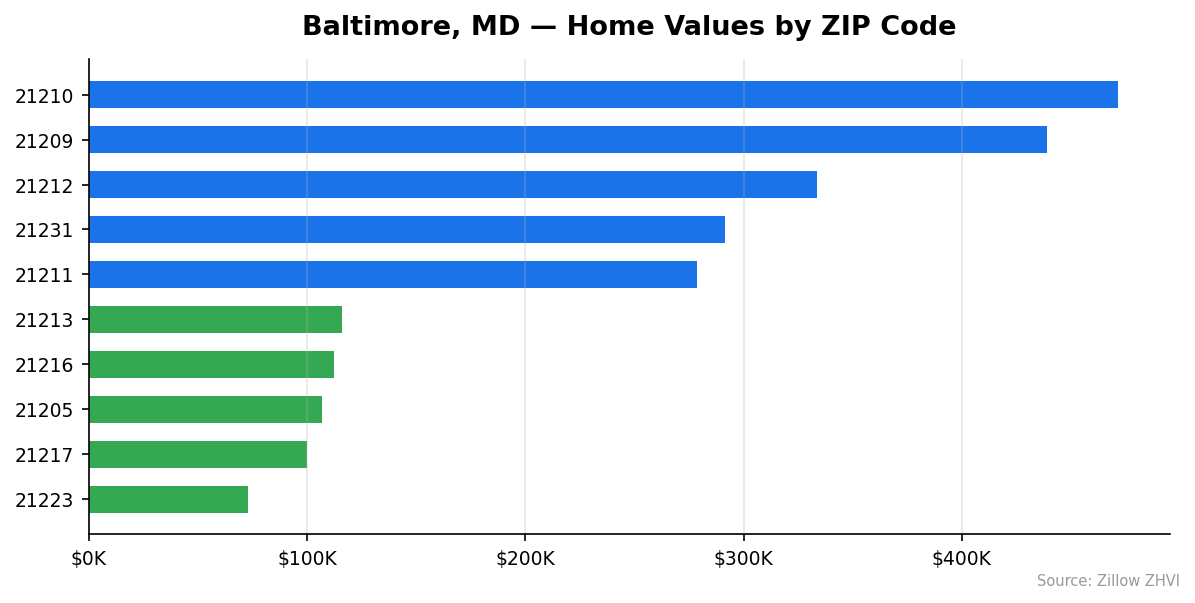
21210 leads Baltimore at $471,761, more than double the city median — a north Baltimore area where rents run a moderate $1,804, suggesting strong owner-occupancy. 21209 follows closely at $439,179 with similar rent levels of $1,746. 21212 rounds out the top three at $333,721, still 50% above the city-wide median.
Most Affordable ZIPs
21223 is Baltimore’s cheapest ZIP at $72,780, yet rents there still hit $1,447/month — a striking disconnect between purchase price and rental cost. 21217 comes in at $99,744, one of only two ZIPs under $100K. 21205 sits at $106,855 but carries a $1,739 monthly rent, meaning landlord returns in this area are proportionally high relative to property values.
Rent vs Buy in Baltimore
Rent data is available across all 20 Baltimore ZIPs, and the comparison with buying is revealing.
The city-wide average rent comes to approximately $1,718 per month. On the buy side, a home at the $222,031 median with 20% down ($44,406) leaves a mortgage of about $177,625. At a 7% rate on a 30-year fixed loan, that’s roughly $1,182 in principal and interest per month.
Add property taxes and insurance — Baltimore’s property tax rate is among the highest in Maryland — and you’re looking at total monthly costs closer to $1,500-$1,700. That puts buying and renting in a similar range at the city-wide level.
But the math shifts dramatically by neighborhood. In 21223, where homes cost $72,780 but rent runs $1,447, buying is far cheaper. A mortgage on that price would run under $400/month for principal and interest. In 21210, where homes hit $471,761, the monthly mortgage payment would exceed $2,500 — well above the $1,804 rent.
| ZIP | Monthly Rent | Estimated P&I (20% Down, 7%) |
|---|---|---|
| 21223 | $1,447 | ~$387 |
| 21217 | $1,534 | ~$531 |
| 21210 | $1,804 | ~$2,511 |
| 21209 | $1,746 | ~$2,338 |
The takeaway: in Baltimore’s affordable ZIPs, buying beats renting by a wide margin. In the premium areas, renting looks more attractive on a pure monthly cost basis.
Population Growth and Migration
Baltimore is shrinking — but the bleeding may have stopped.
The city’s population fell from 583,189 in 2020 to 568,271 in 2024, a loss of 14,918 residents or 2.6% over four years. That’s a meaningful decline for a city already well below its mid-century peak.
| Year | Population | Change |
|---|---|---|
| 2020 | 583,189 | — |
| 2021 | 576,575 | -6,614 |
| 2022 | 570,663 | -5,912 |
| 2023 | 567,517 | -3,146 |
| 2024 | 568,271 | +754 |
The trend line is worth studying. Annual losses shrank each year, and 2024 actually showed a small gain of 754 people. It’s too early to call it a reversal, but the pace of decline has clearly slowed.
Meanwhile, other Maryland cities tell a different story:
| City | 2024 Population | 4-Year Growth |
|---|---|---|
| Frederick | 89,537 | +14.2% |
| Gaithersburg | 70,686 | +1.7% |
| Rockville | 68,417 | +1.6% |
| Bowie | 58,421 | +0.3% |
Frederick’s 14.2% growth stands out. People are moving to smaller Maryland cities — possibly priced out of the D.C. suburbs or choosing lower density. Baltimore’s population loss keeps housing demand in check, which helps explain why prices have barely budged.
Baltimore Housing Market Trends
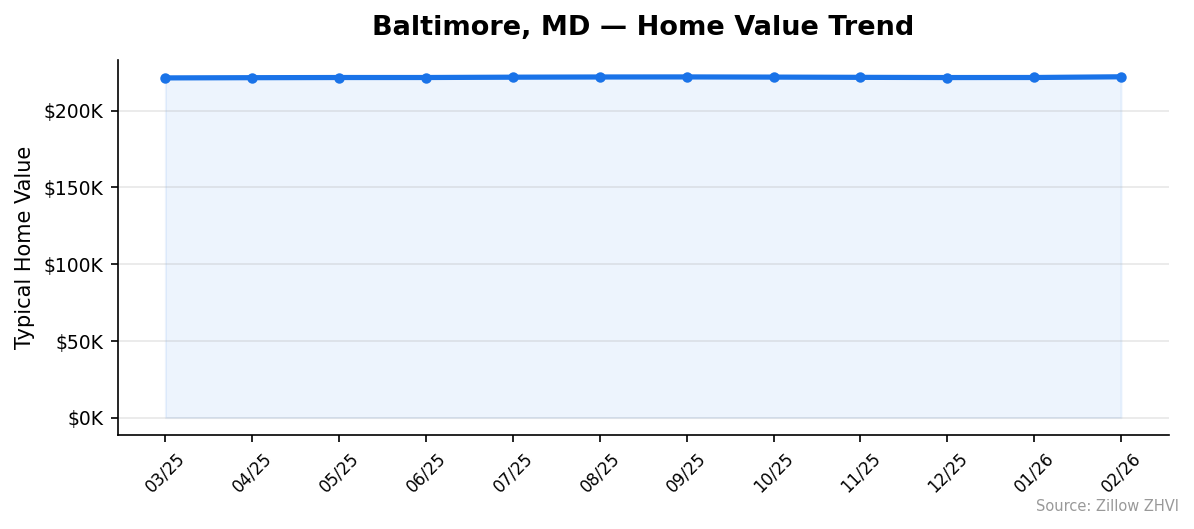
Month-by-month data over the past year shows a market that’s essentially flat with a slight upward drift in late winter.
| Month | Average Value | Low | High |
|---|---|---|---|
| Feb 2026 | $222,031 | $72,780 | $471,761 |
| Jan 2026 | $221,569 | $71,787 | $470,019 |
| Dec 2025 | $221,539 | $71,101 | $468,546 |
| Nov 2025 | $221,670 | $71,109 | $466,013 |
| Oct 2025 | $221,829 | $71,644 | $463,171 |
| Sep 2025 | $221,942 | $72,496 | $460,094 |
| Aug 2025 | $221,903 | $73,082 | $457,240 |
| Jul 2025 | $221,776 | $73,065 | $455,502 |
| Jun 2025 | $221,561 | $72,563 | $454,707 |
| May 2025 | $221,555 | $72,004 | $455,328 |
| Apr 2025 | $221,449 | $71,715 | $455,049 |
| Mar 2025 | $221,309 | $71,715 | $453,465 |
Over 12 months, the city-wide average moved from $221,309 to $222,031 — a gain of $722. That’s less than $100 per month in appreciation.
The floor of the market (the cheapest ZIP) actually dipped from $71,715 in March 2025 to $71,101 in December before recovering to $72,780 in February. The ceiling (most expensive ZIP) climbed steadily from $453,465 to $471,761 — a gain of $18,296 or about 4%. The expensive areas are pulling away from the affordable ones.
Is Baltimore a Good Place to Buy in 2026?
The numbers paint Baltimore as a buyer-friendly market. Flat prices mean no bidding pressure. A 0.3% annual increase gives you time to shop without worrying about getting priced out next month.
The math strongly favors buyers in the sub-$150K ZIPs, where purchase costs are far below renting. If you have $15,000-$20,000 for a down payment, several Baltimore neighborhoods offer homes under $115,000 with rents in those same areas running $1,500+.
The risks are real, though. Population decline — even as it slows — means softer demand long-term. Baltimore’s high property tax rate eats into the buy-vs-rent advantage. And the flat appreciation means you shouldn’t expect your home to be a wealth-building engine here. You’re buying shelter, not a growth asset.
For investors, the rent-to-price ratios in affordable ZIPs are some of the strongest in any East Coast city. A $100K property pulling $1,500/month in rent is hard to find outside of Baltimore.
Baltimore Housing Market Outlook for 2026-2027
The 12-month trend suggests more of the same: minimal movement. The average value has hovered within a $722 range over the past year, and nothing in the data points to a breakout in either direction.
If the current pace continues, expect Baltimore’s median to land somewhere between $222,000 and $225,000 by early 2027. The 3-month trend from December to February shows a modest uptick — $221,539 to $222,031 — which could signal the start of a spring bump, but the gains are small enough that they may flatten out by summer as they did in 2025.
The widening gap between the high end ($471,761) and low end ($72,780) is worth watching. Premium neighborhoods are appreciating while affordable areas stagnate. That divergence could accelerate.
Similar Markets in MD
If you’re considering Baltimore, these nearby Maryland cities offer different price points and growth profiles:
- Frederick — Maryland’s fastest-growing city at 14.2%, a popular alternative for buyers seeking smaller-city living.
- Columbia — A planned community between Baltimore and D.C. with strong schools and higher price points.
- Annapolis — The state capital on the Chesapeake Bay, typically priced well above Baltimore’s median.
- Rockville — A D.C. suburb with 1.6% growth and Metro access.
- Silver Spring — Another D.C.-adjacent market with a different price structure than Baltimore.
Frequently Asked Questions
What is the average home price in Baltimore?
The average home price in Baltimore is $222,031 as of February 2026. Prices across the city’s 20 tracked ZIP codes range from $72,780 in 21223 to $471,761 in 21210. The city-wide median sits well below many other East Coast metros of comparable size.
Are home prices going up or down in Baltimore?
Prices are technically up, but just barely. The 0.3% year-over-year increase translates to about $722 in actual dollar gains over 12 months. Month to month, values have moved within a narrow band, making Baltimore one of the flattest markets in the mid-Atlantic.
Is it cheaper to rent or buy in Baltimore?
It depends on the neighborhood. At the city-wide median of $222,031, a mortgage with 20% down at 7% costs roughly $1,182/month in principal and interest — below the average rent of $1,718. In affordable ZIPs like 21223, buying is dramatically cheaper: a mortgage would cost under $400/month versus $1,447 in rent. In premium ZIPs like 21210, renting is the cheaper option on a monthly basis.
What is the most affordable neighborhood in Baltimore?
ZIP code 21223 has the lowest median home value at $72,780. That’s about one-third of the city-wide average. Two other ZIPs — 21217 ($99,744) and 21205 ($106,855) — also offer homes under $110,000.
Methodology
Home values are based on the Zillow Home Value Index (ZHVI), a smoothed measure of typical home values in the 35th to 65th percentile range. Rent estimates use the Zillow Observed Rent Index (ZORI). Population figures come from the U.S. Census Bureau Population Estimates Program (2020-2024 vintage). All datasets are publicly available. Housing data updated 2026-02-28.