Cleveland Home Prices: $133K, Down 3.2% — 15 ZIPs Analyzed (2026)
$133,051. That’s what a typical home costs in Cleveland, OH right now. Prices are down 3.2% from a year ago, and the city has been losing value almost every month for the past year.
Quick answer: The average home price in Cleveland, OH is $133,051 as of February 2026, down 3.2% year over year according to Zillow.
Current Home Prices in Cleveland
Cleveland sits well below the national median. The typical home here costs less than the down payment on a house in San Francisco. Across 15 ZIP codes tracked, values range from $61,501 in the city’s cheapest neighborhood to $294,576 in its priciest.
| Metric | Value |
|---|---|
| Median home value | $133,051 |
| Year-over-year change | -3.2% |
| Cheapest ZIP | $61,501 (44127) |
| Most expensive ZIP | $294,576 (44113) |
| ZIP codes tracked | 15 |
| Data as of | February 2026 |
The price spread tells you something about Cleveland: it’s a city of distinct neighborhoods, not a uniform market. The top ZIP is nearly 5x the bottom one. That kind of gap is unusual for a mid-sized city.
A year ago the median sat at $137,517. The market has slipped roughly $4,500 since then. That’s a slow bleed, not a crash. But it’s also the opposite direction from most of the country.
For buyers, the entry point matters here. With $30,000 saved, you can put 20% down on plenty of homes in Cleveland. That math doesn’t work in most metro areas anymore.
Cleveland Home Prices by Neighborhood
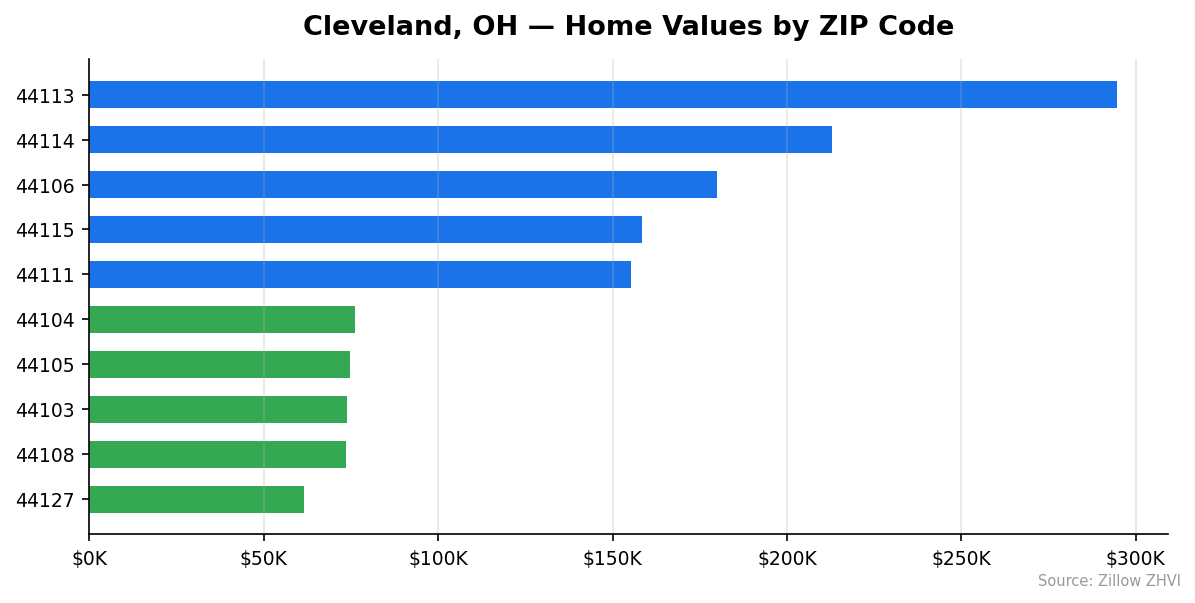
Cleveland’s ZIP codes split into two clear groups: the higher-priced lakefront and downtown areas, and the much cheaper east and southeast neighborhoods.
| ZIP Code | Home Value | Avg Rent |
|---|---|---|
| 44113 | $294,576 | $1,660 |
| 44114 | $212,922 | $1,321 |
| 44106 | $180,056 | $1,762 |
| 44115 | $158,483 | $1,645 |
| 44111 | $155,261 | $1,291 |
| 44135 | $152,282 | $1,372 |
| 44109 | $140,489 | $1,154 |
| 44119 | $131,676 | $1,233 |
| 44102 | $127,505 | $1,306 |
| 44110 | $82,740 | $1,148 |
| 44104 | $76,054 | $1,217 |
| 44105 | $74,722 | $1,179 |
| 44103 | $73,890 | $1,133 |
| 44108 | $73,606 | $1,337 |
| 44127 | $61,501 | Data not available |
Most Expensive
44113 ($294,576) — More than 2x the city median. This is the priciest ZIP by a wide margin. Rent here averages $1,660.
44114 ($212,922) — The downtown core. Values run about 60% above the city average, with rents at $1,321.
44106 ($180,056) — Notable for the highest average rent in Cleveland at $1,762, even though it’s not the most expensive to buy.
Most Affordable
44127 ($61,501) — The cheapest ZIP in Cleveland. Less than half the city median. No rent data is available for this ZIP.
44108 ($73,606) — Home values run about 55% of the city average, while rent at $1,337 is actually above the city’s typical rent.
44103 ($73,890) — Similar profile to 44108. Buying is cheap, but rents at $1,133 are still close to the city baseline.
Rent vs Buy in Cleveland
Average rent across Cleveland ZIPs runs about $1,340 a month. The cheapest neighborhoods rent for $1,130-$1,180. The priciest top out around $1,760.
Now the buy side. On the $133,051 median home with 20% down ($26,610), you’d finance $106,440. At 7% over 30 years, principal and interest comes to roughly $708 a month. Add property taxes (Cleveland’s effective rate is among the highest in Ohio) and insurance, and you’re likely looking at $1,100-$1,300 all-in.
That makes the math close. In most cities, buying costs significantly more than renting on a monthly basis. In Cleveland, the gap is small, and in many ZIPs buying is cheaper.
The lower the home price, the better the buy math gets. In ZIPs like 44127, 44108, and 44103, where homes run $61K-$74K, monthly carrying costs drop sharply. Rent in those areas is $1,130-$1,340.
For renters paying $1,200+ in cheaper Cleveland neighborhoods, ownership math often wins, assuming you can handle the down payment and have the credit. The catch is that these are also the ZIPs losing the most value.
Population Growth and Migration
Cleveland is shrinking. Slowly, but consistently.
| Year | Population |
|---|---|
| 2020 | 371,853 |
| 2021 | 365,432 |
| 2022 | 363,622 |
| 2023 | 364,276 |
| 2024 | 365,379 |
The four-year change is -1.7%. The city lost about 6,500 people between 2020 and 2024. There’s a small uptick in the last two years — population grew by roughly 1,750 between 2022 and 2024 — but it hasn’t recovered to 2020 levels.
Compare that to other Ohio cities:
| City | 2024 Population | 4-Year Growth |
|---|---|---|
| Columbus | 933,263 | +3.0% |
| Cincinnati | 314,915 | +1.7% |
| Lorain | 65,751 | +0.8% |
| Hamilton | 63,953 | +0.8% |
| Akron | 189,664 | -0.3% |
| Cleveland | 365,379 | -1.7% |
Cleveland and Akron are the only major Ohio cities losing residents at any pace. Columbus added almost as many people in four years as Akron’s entire population grew. That demographic gap helps explain why Columbus home values are climbing while Cleveland’s keep slipping.
A shrinking population means weaker buyer demand. That puts a soft ceiling on price growth, which the data confirms.
Cleveland Housing Market Trends
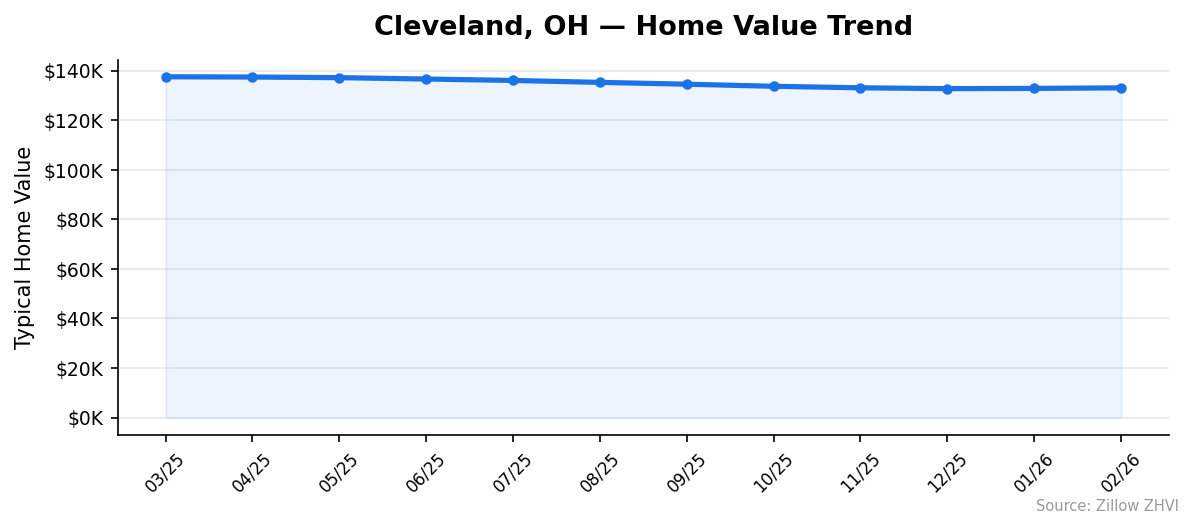
Twelve straight months of decline, broken only by the last two readings.
| Month | Median Value |
|---|---|
| March 2025 | $137,517 |
| April 2025 | $137,423 |
| May 2025 | $137,172 |
| June 2025 | $136,614 |
| July 2025 | $136,043 |
| August 2025 | $135,261 |
| September 2025 | $134,529 |
| October 2025 | $133,681 |
| November 2025 | $133,068 |
| December 2025 | $132,737 |
| January 2026 | $132,834 |
| February 2026 | $133,051 |
Prices fell every month from March 2025 through December 2025, dropping a total of $4,780. Then January and February ticked up — small gains of $97 and $217. The market may have bottomed in December.
The peak-to-trough decline was 3.5%. The recovery so far is 0.2%. So while there’s a glimmer of stabilization, calling it a turnaround would be premature.
Is Cleveland a Good Place to Buy in 2026?
This is a buyer’s market by most measures. Prices are down. The city is losing population. Inventory in lower-cost ZIPs has been sitting longer.
For owner-occupants, the math holds up. You can buy a livable house in Cleveland for under $80,000 in several ZIPs. Monthly costs in those areas can run below $700 all-in with a 20% down payment. That’s real affordability that doesn’t exist in most US cities.
For investors, the rental yield numbers look strong on paper. A $74,000 home in 44105 renting at $1,179 is a gross yield north of 19%. But low-priced markets carry risks — vacancy, maintenance, property taxes that can eat into that yield.
For appreciation buyers, this isn’t your market. Cleveland values have moved sideways or down for years, and the demographic data doesn’t suggest a sharp reversal. If you’re buying, plan to hold for use, not flip for profit.
Cleveland Housing Market Outlook for 2026-2027
The 3-month trend is the most important signal in the data. After 10 consecutive months of declines, prices rose modestly in January and February. The cumulative gain is small — about $314 — but the direction has changed.
If the current pace continues, Cleveland may finish 2026 close to flat or with low single-digit growth. The 12-month decline could narrow as worse months roll off the comparison.
But the underlying conditions haven’t changed. Cleveland is still losing population. Demand pressure remains weak. A real recovery would need either a population reversal or a sharp shift in mortgage rates that pulls in out-of-state buyers chasing affordability.
The most likely scenario over the next 6-12 months is stability around the $130K-$135K range, with the higher-end ZIPs holding their value better than the lowest-priced ones.
Similar Markets in OH
- Columbus — Ohio’s largest and fastest-growing city, with home prices well above Cleveland.
- Cincinnati — Similar size to Cleveland but with positive population growth and stronger price trends.
- Toledo — Another Lake Erie city with affordability comparable to Cleveland.
- Dayton — Mid-sized Ohio market for buyers comparing affordable options.
- Akron — Cleveland’s closest neighbor, with a similar pattern of mild population decline.
Frequently Asked Questions
What is the average home price in Cleveland?
The average home price in Cleveland is $133,051 as of February 2026. That figure represents the typical home value across 15 ZIP codes in the city, with individual neighborhoods ranging from $61,501 to $294,576.
Are home prices going up or down in Cleveland?
Down. Cleveland home values fell 3.2% year over year, dropping from roughly $137,517 in March 2025 to $133,051 in February 2026. The decline ran for 10 consecutive months before a small uptick in January and February 2026.
Is it cheaper to rent or buy in Cleveland?
Buying is often cheaper. The average rent across Cleveland ZIPs is around $1,340 a month. A mortgage on the $133K median home with 20% down runs about $700 in principal and interest, with total monthly costs of roughly $1,100-$1,300 once taxes and insurance are added.
What is the most affordable neighborhood in Cleveland?
ZIP code 44127 is the cheapest in Cleveland at $61,501. The next two most affordable areas are 44108 at $73,606 and 44103 at $73,890. All three sit at less than 60% of the city’s median home value.
Methodology
Home values are based on the Zillow Home Value Index (ZHVI), a smoothed measure of typical home values in the 35th to 65th percentile range. Rent estimates use the Zillow Observed Rent Index (ZORI). Population figures come from the U.S. Census Bureau Population Estimates Program (2020-2024 vintage). All datasets are publicly available. Housing data updated 2026-02-28.