Jupiter Home Prices: $712K, Down 3.5% — 3 ZIPs Analyzed (2026)
$712,400. That’s what a typical home costs in Jupiter, FL right now — and it’s moving in the wrong direction for sellers. Prices have fallen 3.5% over the past year, erasing gains made during the post-pandemic run-up.
Quick answer: The average home price in Jupiter, FL is $712,400 as of February 2026, down 3.5% year over year according to Zillow.
Current Home Prices in Jupiter
Jupiter sits in the Miami-Fort Lauderdale-Pompano Beach metro area, but its price tag puts it well above what most of South Florida’s suburbs command. Here’s the snapshot:
| Metric | Value |
|---|---|
| Median Home Price | $712,400 |
| Year-over-Year Change | -3.5% |
| Lowest ZIP Median | $612,887 |
| Highest ZIP Median | $852,675 |
| Price Range (spread) | $239,788 |
| Data as of | February 2026 |
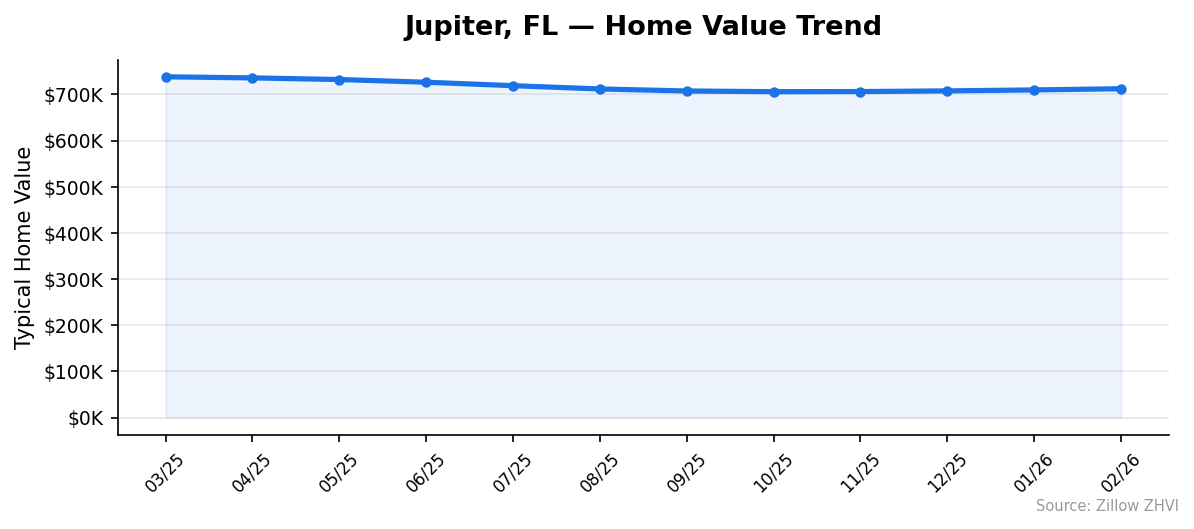
That 3.5% decline translates to roughly $25,000 lost in home value over 12 months. For a homeowner who bought at the peak in March 2025 — when the median hit $738,238 — the paper loss is even steeper.
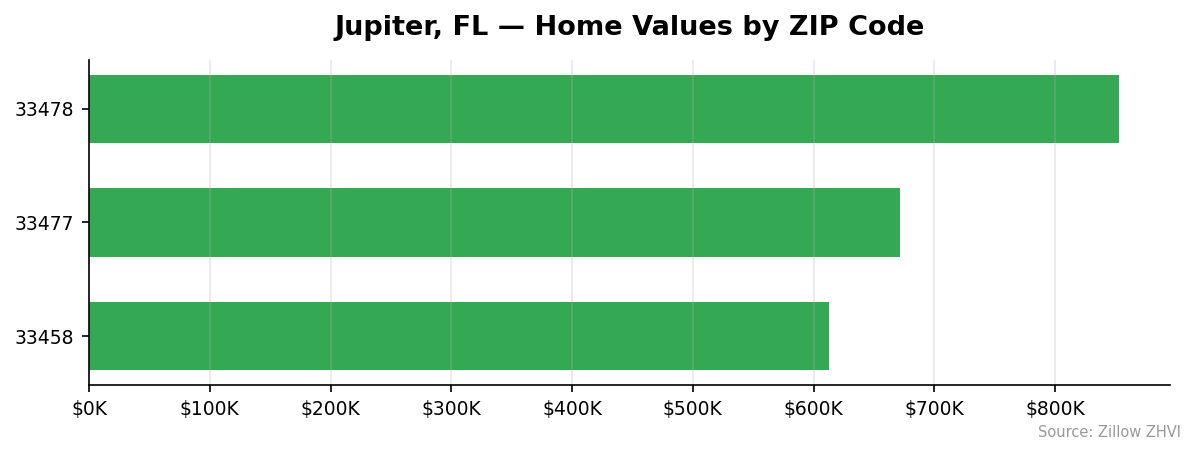
The gap between Jupiter’s cheapest and priciest ZIP codes is nearly $240,000. Where you buy within town limits matters a lot.
Jupiter Home Prices by Neighborhood
Jupiter has three ZIP codes tracked by Zillow. The price differences between them are stark.
| ZIP Code | Median Home Value | Median Rent | vs. City Average |
|---|---|---|---|
| 33458 | $612,887 | $2,894/mo | -14.0% |
| 33477 | $671,638 | $3,863/mo | -5.7% |
| 33478 | $852,675 | N/A | +19.7% |
Most Expensive
33478 leads at $852,675 — nearly 20% above the city average. No rental data is available for this ZIP, which suggests it skews toward owner-occupied, larger-lot properties.
Most Affordable
33458 is the entry point into Jupiter at $612,887, sitting 14% below the city average. Rent here runs $2,894 per month, the lowest in town. If you’re trying to get into Jupiter without clearing $700K, this is where to look.
33477 falls in the middle at $671,638 but carries the highest rents at $3,863 per month — a sign of strong rental demand in that area.
Rent vs Buy in Jupiter
Two of Jupiter’s three ZIP codes have rental data. Here’s how the numbers stack up.
| ZIP Code | Monthly Rent | Est. Mortgage (20% down, 6.5%) | Difference |
|---|---|---|---|
| 33458 | $2,894 | ~$3,100 | Mortgage costs ~$206 more |
| 33477 | $3,863 | ~$3,395 | Rent costs ~$468 more |
The mortgage estimates assume 20% down and a 6.5% interest rate on a 30-year fixed loan, covering only principal and interest. Add property taxes, insurance (Florida’s insurance costs are among the highest in the country), HOA fees, and maintenance, and the true cost of ownership climbs well past these figures.
In 33458, renting is slightly cheaper than buying. In 33477, the math flips — renting actually costs more than a mortgage payment alone, though total ownership costs would likely exceed rent once you factor in taxes and insurance.
With prices falling 3.5% year over year, buyers face a tricky calculation. You’re building equity with a purchase, but that equity can shrink if prices keep sliding.
Population Growth and Migration
Jupiter’s population grew 2.9% between 2020 and 2024, adding about 1,800 residents.
| Year | Population |
|---|---|
| 2020 | 61,183 |
| 2021 | 61,147 |
| 2022 | 61,697 |
| 2023 | 62,360 |
| 2024 | 62,987 |
Growth was flat in 2021 — the town actually lost a few dozen people — before picking up in 2022-2024. The recent pace is steady but modest.
Compared to other Florida cities, Jupiter’s growth rate is on the low end:
| City | 2024 Population | Growth (2020-2024) |
|---|---|---|
| Port St. Lucie | 258,575 | +25.0% |
| Cape Coral | 233,025 | +19.2% |
| Miami | 487,014 | +10.0% |
| Orlando | 334,854 | +8.8% |
| Tampa | 414,547 | +6.7% |
| Jupiter | 62,987 | +2.9% |
Jupiter isn’t booming the way Port St. Lucie or Cape Coral are. That slower growth may actually benefit buyers — less demand pressure means less competition for homes. It also partly explains why prices are softening here while some faster-growing Florida markets hold up better.
Jupiter Housing Market Trends
Here’s how Jupiter’s median home price has moved over the past 12 months:
| Month | Median Price | Month-over-Month |
|---|---|---|
| Mar 2025 | $738,238 | — |
| Apr 2025 | $735,860 | -$2,378 |
| May 2025 | $732,270 | -$3,590 |
| Jun 2025 | $726,467 | -$5,803 |
| Jul 2025 | $718,992 | -$7,475 |
| Aug 2025 | $711,891 | -$7,101 |
| Sep 2025 | $707,496 | -$4,395 |
| Oct 2025 | $705,987 | -$1,509 |
| Nov 2025 | $706,235 | +$248 |
| Dec 2025 | $707,690 | +$1,455 |
| Jan 2026 | $709,800 | +$2,110 |
| Feb 2026 | $712,400 | +$2,600 |
The pattern tells two stories. From March through October 2025, prices dropped every single month, shedding $32,251 — a 4.4% decline in seven months. The steepest drops came in June and July, when prices fell over $7,000 per month.
Then something shifted. Starting in November 2025, prices began ticking back up. The last four months show consecutive gains, with the pace of recovery accelerating from $248 in November to $2,600 in February.
Is Jupiter a Good Place to Buy in 2026?
The data points to a market in transition. Sellers lost their edge through most of 2025, but the recent uptick suggests the floor may already be in.
At $712,400, Jupiter is not a bargain by any national measure. But relative to its own peak of $738,238 last March, prices are about $26,000 lower. That’s real savings on a purchase.
The 3.5% year-over-year decline favors buyers who have been waiting on the sidelines. If you can handle the monthly costs — and Florida’s insurance premiums, which keep climbing — you’re buying at the lowest point in over a year.
Watch the ZIP-level data closely. The $240,000 spread between the cheapest and priciest neighborhoods means your experience of “the Jupiter market” depends entirely on where you buy.
Jupiter Housing Market Outlook for 2026-2027
The last four months of data show a clear reversal. After bottoming near $706,000 in October 2025, prices have climbed in each subsequent month, gaining about $6,400 total.
If the current pace continues — roughly $2,000 to $2,600 per month — Jupiter could recover to the low $720,000s by mid-2026. That would still leave prices below the March 2025 peak.
The three-month trend suggests momentum is building. Monthly gains have accelerated from November through February, which is consistent with seasonal buying patterns in South Florida. Spring typically brings more buyer activity.
A return to the $738,000+ range by late 2026 is possible but would require gains to hold through summer — the same period when prices dropped sharply in 2025. That’s the key test.
Similar Markets in FL
If you’re shopping in Jupiter, these Florida cities offer different price points:
- Port Saint Lucie — a fast-growing neighbor just north of Jupiter with more inventory and lower price points.
- Fort Lauderdale — closer to Miami’s job centers with a denser urban feel.
- Pembroke Pines — a suburban alternative in Broward County worth comparing for value.
- Tampa — Florida’s west coast option for buyers priced out of the Palm Beach area.
- Miami — the metro anchor, with wide price variation across its neighborhoods.
Frequently Asked Questions
What is the average home price in Jupiter?
The average home price in Jupiter is $712,400 as of February 2026. Prices across Jupiter’s three tracked ZIP codes range from $612,887 in 33458 to $852,675 in 33478. The city-wide median has declined 3.5% over the past year.
Are home prices going up or down in Jupiter?
Year over year, prices are down 3.5%. But the recent trend is more nuanced. Prices fell steadily from March through October 2025, then reversed course. The last four months have shown consecutive gains, suggesting the decline may be ending.
Is it cheaper to rent or buy in Jupiter?
It depends on the neighborhood. In 33458, renting at $2,894 per month is slightly cheaper than a mortgage payment of roughly $3,100 (20% down, 6.5% rate). In 33477, rent is $3,863 — actually more than the estimated mortgage of $3,395. Either way, true ownership costs including taxes, insurance, and maintenance push buying costs higher than the mortgage alone.
What is the most affordable neighborhood in Jupiter?
ZIP code 33458 has the lowest median home value at $612,887, which is 14% below the Jupiter average. It also has the lowest tracked rent at $2,894 per month. This is Jupiter’s most accessible entry point for buyers on a tighter budget.
Methodology
Home values are based on the Zillow Home Value Index (ZHVI), a smoothed measure of typical home values in the 35th to 65th percentile range. Rent estimates use the Zillow Observed Rent Index (ZORI). Population figures come from the U.S. Census Bureau Population Estimates Program (2020-2024 vintage). All datasets are publicly available. Housing data updated 2026-02-28.