Kissimmee Home Prices: $352K, Down 5% — 4 ZIPs Analyzed (2026)
Prices dropped for the tenth straight month in Kissimmee. The typical home here now costs $351,606 — down 5.0% from a year ago. That slide has erased roughly $18,600 in value over 12 months, putting Kissimmee among the softening markets in the Orlando metro.
Quick answer: The average home price in Kissimmee, FL is $351,606 as of February 2026, down 5.0% year over year according to Zillow.
Current Home Prices in Kissimmee
| Metric | Value |
|---|---|
| Median Home Value | $351,606 |
| Year-over-Year Change | -5.0% |
| Lowest ZIP Value | $285,288 |
| Highest ZIP Value | $402,548 |
| Number of ZIPs Tracked | 4 |
| Data as of | February 2026 |
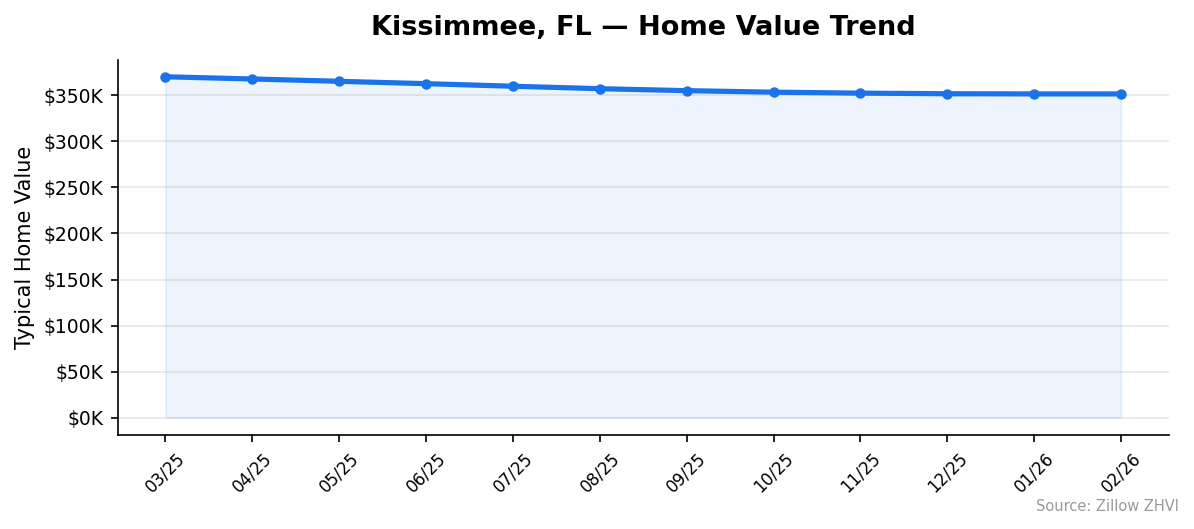
A 5% annual decline is significant. For context, Kissimmee peaked near $370K in March 2025 and has fallen steadily since. The gap between the cheapest and most expensive ZIP is about $117,000, so where you buy within city limits matters a lot.
The current median sits well below the $402,548 ceiling seen in the priciest ZIP. Buyers who were priced out a year ago may find more room now, especially in the southern parts of the city.
Kissimmee Home Prices by Neighborhood
| ZIP Code | Median Home Value | Median Rent |
|---|---|---|
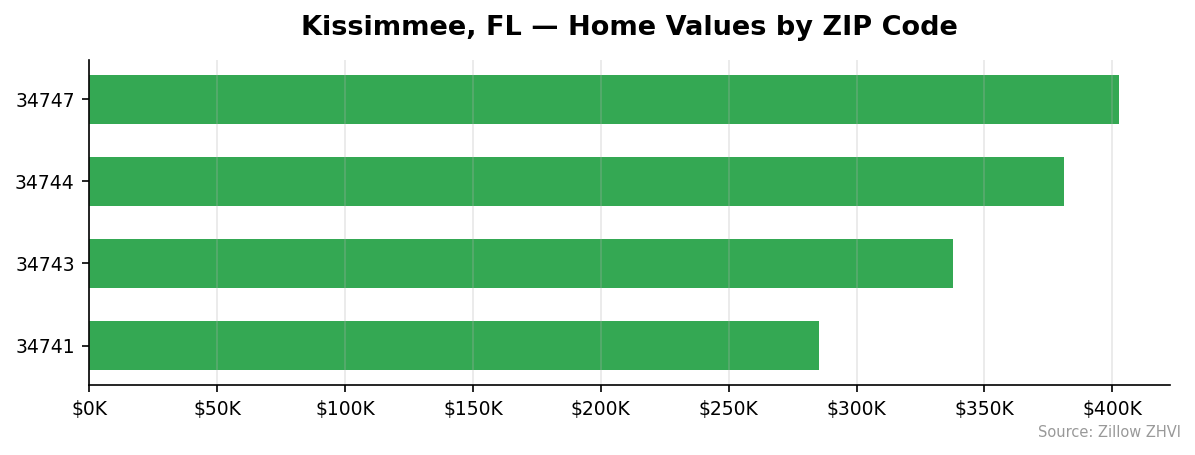
| 34747 | $402,548 | $1,990/mo |
| 34744 | $381,020 | $2,108/mo |
| 34743 | $337,569 | $2,166/mo |
| 34741 | $285,288 | $1,782/mo |
Most Expensive
34747 leads at $402,548 — roughly 14% above the city median. This ZIP covers the resort corridor near Walt Disney World, where short-term rental properties push values higher despite relatively moderate rents of $1,990 per month.
34744 comes in at $381,020, about 8% above the city average. Rents here run $2,108, making it the second-priciest ZIP for both buying and renting.
Most Affordable
34741 is the clear winner for budget-conscious buyers at $285,288 — nearly 19% below the city median. Rents are also the lowest in Kissimmee at $1,782 per month.
34743 sits in the middle at $337,569, roughly 4% below the citywide figure. Interestingly, it has the highest rents of any Kissimmee ZIP at $2,166, suggesting strong rental demand relative to home values.
Rent vs Buy in Kissimmee
Rents in Kissimmee range from $1,782 to $2,166 per month depending on the ZIP code.
| ZIP Code | Median Rent | Est. Mortgage (5% down, 6.8%) | Difference |
|---|---|---|---|
| 34747 | $1,990/mo | ~$2,495/mo | Rent saves $505 |
| 34744 | $2,108/mo | ~$2,362/mo | Rent saves $254 |
| 34743 | $2,166/mo | ~$2,093/mo | Buy saves $73 |
| 34741 | $1,782/mo | ~$1,768/mo | Buy saves $14 |
Mortgage estimates assume 5% down and a 6.8% rate on a 30-year fixed loan, covering principal and interest only. Property taxes, insurance, and HOA fees would add to the monthly cost of owning.
In the two most expensive ZIPs — 34747 and 34744 — renting is clearly cheaper on a monthly basis. In 34743 and 34741, the math is close to a wash. But owning builds equity, so if you plan to stay five or more years, buying in the affordable ZIPs could make sense even at similar monthly costs.
With prices still falling, renters have the advantage of waiting for further declines.
Population Growth and Migration
Kissimmee’s population reached 84,756 in 2024, up 7.0% from 79,179 in 2020. That’s roughly 5,577 new residents in four years.
| Year | Population |
|---|---|
| 2020 | 79,179 |
| 2021 | 79,578 |
| 2022 | 80,798 |
| 2023 | 83,028 |
| 2024 | 84,756 |
Growth accelerated starting in 2022. The city added just 399 people in 2021 but gained 2,230 in 2023 alone. The pace has steadied around 1,700-2,200 new residents per year.
How does that compare to other Florida cities?
| City | 2024 Population | 4-Year Growth |
|---|---|---|
| Port St. Lucie | 258,575 | 25.0% |
| Cape Coral | 233,025 | 19.2% |
| Miami | 487,014 | 10.0% |
| Orlando | 334,854 | 8.8% |
| Kissimmee | 84,756 | 7.0% |
| Tampa | 414,547 | 6.7% |
Kissimmee’s 7% growth is solid but trails several Florida peers. Port St. Lucie and Cape Coral are growing three times faster. Still, a growing population means sustained housing demand — which makes the current price decline more likely a correction than a collapse.
Kissimmee Housing Market Trends
Here’s how the median home value has moved over the past 12 months.
| Month | Median Value | Change from Peak |
|---|---|---|
| Mar 2025 | $370,226 | — (Peak) |
| Apr 2025 | $367,850 | -$2,376 |
| May 2025 | $365,318 | -$4,908 |
| Jun 2025 | $362,758 | -$7,468 |
| Jul 2025 | $359,958 | -$10,268 |
| Aug 2025 | $357,289 | -$12,937 |
| Sep 2025 | $355,169 | -$15,057 |
| Oct 2025 | $353,494 | -$16,732 |
| Nov 2025 | $352,459 | -$17,767 |
| Dec 2025 | $351,800 | -$18,426 |
| Jan 2026 | $351,610 | -$18,616 |
| Feb 2026 | $351,606 | -$18,620 |
The trend is unmistakable: ten consecutive months of decline. But the pace is slowing. The city lost $2,376 between March and April 2025, but only $4 between January and February 2026. The slide is flattening out.
That deceleration suggests prices may be approaching a floor. The steepest drops happened in mid-2025, and the last three months have been nearly flat.
Is Kissimmee a Good Place to Buy in 2026?
The numbers favor buyers right now. A 5% annual decline, slowing monthly losses, and a rent-vs-buy gap that’s narrowing in affordable ZIPs — that’s a textbook buyer’s market.
ZIP 34741 stands out. At $285,288, it’s the cheapest option in Kissimmee, and the monthly mortgage roughly matches rent. If you plan to hold the property, you’d build equity at a price point that’s already well below the city peak.
The risk? Prices could keep falling. The 12-month trend shows no reversal yet, just a slowdown. If you need to sell within two or three years, you could take a loss.
For long-term buyers — especially those moving from pricier Orlando — Kissimmee offers a cheaper entry point in the same metro area with a growing population. The data supports a careful buy, not a rush.
Kissimmee Housing Market Outlook for 2026-2027
The 3-month trend tells the story: prices dropped just $194 total from December 2025 to February 2026. Compare that to the $7,468 drop from March to June 2025. The decline is running out of steam.
If the current pace continues, Kissimmee could see prices stabilize in the $348K-$352K range through mid-2026. A spring bounce is possible — Florida markets often see seasonal upticks as snowbirds and investors return — but the data doesn’t show one yet.
The 7% population growth supports long-term demand. If mortgage rates ease, even slightly, the combination of lower prices and lower rates could draw buyers back and push values upward by late 2026 or early 2027.
Similar Markets in FL
If you’re shopping in Kissimmee, these Florida cities offer useful comparisons:
- Orlando — The neighboring metro core, larger and typically pricier than Kissimmee.
- Tampa — A major Gulf Coast market with similar population growth at 6.7%.
- Jacksonville — North Florida’s largest city, often more affordable than Central Florida.
- Homestead — South Florida’s budget option near Miami.
- Fort Lauderdale — Coastal living at a higher price point for those willing to pay more.
Frequently Asked Questions
What is the average home price in Kissimmee?
The average home price in Kissimmee is $351,606 as of February 2026. Prices range from $285,288 in ZIP 34741 to $402,548 in ZIP 34747. The citywide median has been falling since March 2025.
Are home prices going up or down in Kissimmee?
Down. Kissimmee home prices dropped 5.0% year over year. The median peaked at $370,226 in March 2025 and has declined every month since. However, the rate of decline slowed sharply in late 2025 and early 2026.
Is it cheaper to rent or buy in Kissimmee?
It depends on the ZIP code. In the two most expensive ZIPs (34747 and 34744), renting saves you $250-$500 per month compared to a mortgage. In the cheaper ZIPs (34741 and 34743), buying and renting cost roughly the same each month, making ownership viable if you plan to stay long-term.
What is the most affordable neighborhood in Kissimmee?
ZIP code 34741 is the most affordable at $285,288 — about 19% below the city median. Rent there averages $1,782 per month, also the lowest in Kissimmee. It’s the best entry point for first-time buyers in the area.
Methodology
Home values are based on the Zillow Home Value Index (ZHVI), a smoothed measure of typical home values in the 35th to 65th percentile range. Rent estimates use the Zillow Observed Rent Index (ZORI). Population figures come from the U.S. Census Bureau Population Estimates Program (2020-2024 vintage). All datasets are publicly available. Housing data updated 2026-02-28.