Washington Home Prices: $628K, Down 1.6% — 22 ZIPs Analyzed (2026)
$628,066. That’s what a typical home costs in Washington, DC right now. Prices have slipped 1.6% from a year ago, marking a slow but steady decline from the city’s early 2025 peak. For buyers who sat out the last few years, the numbers are finally moving in the right direction.
Quick answer: The average home price in Washington, DC is $628,066 as of February 2026, down 1.6% year over year according to Zillow.
Current Home Prices in Washington
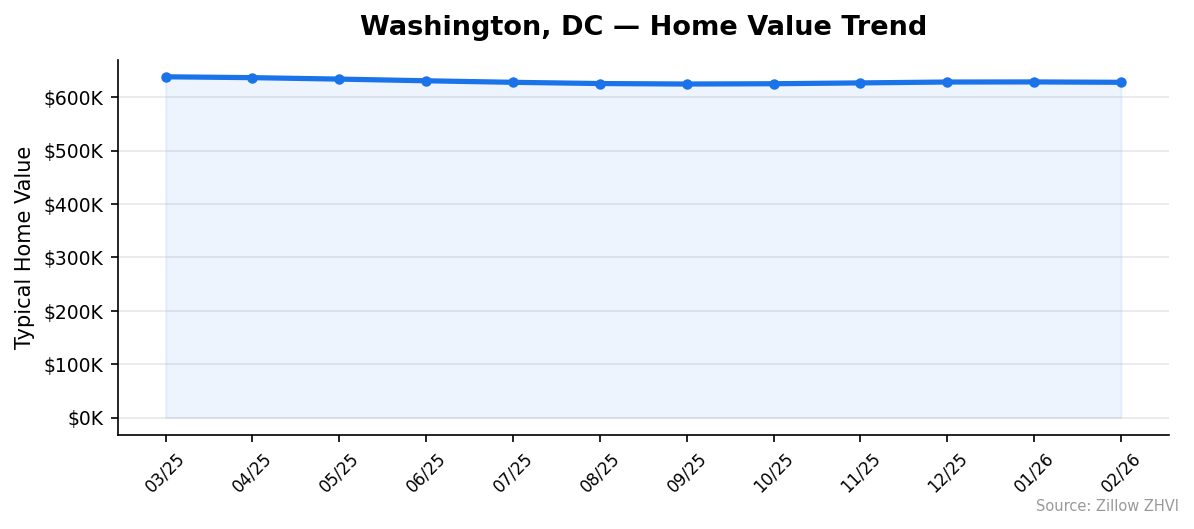
The Washington housing market has cooled from its March 2025 high of $638,388. The decline hasn’t been dramatic — about $10,000 off the peak — but the trend is clear. Prices have dropped in 10 of the last 12 months.
| Metric | Value |
|---|---|
| Median Home Value | $628,066 |
| Year-over-Year Change | -1.6% |
| Lowest ZIP Code Value | $228,948 |
| Highest ZIP Code Value | $1,363,552 |
| Number of ZIP Codes | 22 |
| Data as of | February 2026 |
The gap between the cheapest and most expensive neighborhoods is enormous. A home in the priciest ZIP costs nearly six times what you’d pay in the most affordable one. That $1.1 million spread means Washington isn’t one market — it’s several, stacked on top of each other.
The 1.6% annual decline may not sound like much. On a $628,000 home, that’s roughly $10,000 in lost value. But compared to the rapid appreciation of 2021–2023, this is a meaningful shift. Sellers are no longer setting the terms.
Washington Home Prices by Neighborhood
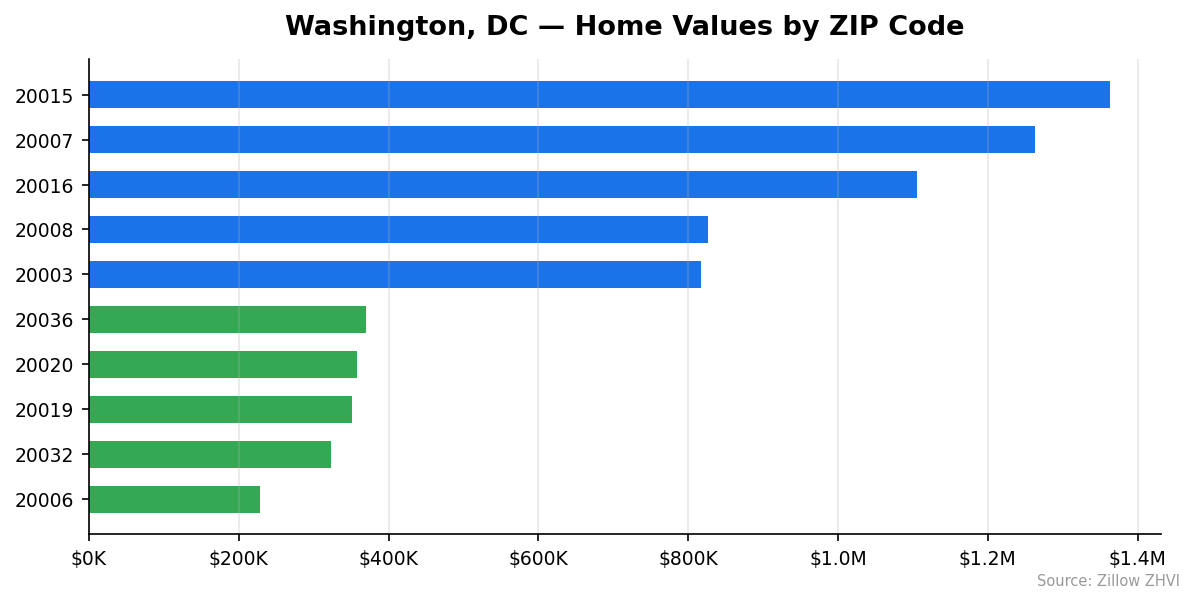
Washington’s 22 ZIP codes tell very different stories. Georgetown and upper Northwest command seven-figure prices. Southeast neighborhoods remain under $400,000.
| ZIP Code | Median Home Value | Typical Rent |
|---|---|---|
| 20001 | $633,441 | $2,595 |
| 20002 | $608,620 | $2,260 |
| 20003 | $816,771 | $2,487 |
| 20004 | $427,646 | $2,659 |
| 20005 | $498,399 | $2,540 |
| 20006 | $228,948 | $1,950 |
| 20007 | $1,263,709 | $2,770 |
| 20008 | $826,602 | $2,146 |
| 20009 | $569,131 | $2,575 |
| 20010 | $688,830 | $2,407 |
| 20011 | $609,659 | $2,083 |
| 20012 | $782,261 | $2,295 |
| 20015 | $1,363,552 | $2,059 |
| 20016 | $1,105,037 | $2,976 |
| 20017 | $530,924 | $2,232 |
| 20018 | $540,834 | $2,105 |
| 20019 | $351,447 | $1,981 |
| 20020 | $357,779 | $2,013 |
| 20024 | $383,910 | $2,366 |
| 20032 | $322,687 | $1,677 |
| 20036 | $369,914 | $2,281 |
| 20037 | $537,358 | $3,154 |
Most Expensive Neighborhoods
20015 leads Washington at $1,363,552 — more than double the citywide median — covering the Chevy Chase area in upper Northwest, where rents are a modest $2,059 relative to home values. 20007 in Georgetown comes in at $1,263,709 with rents of $2,770, reflecting the neighborhood’s mix of historic rowhouses and high demand. 20016 rounds out the top three at $1,105,037 with the city’s second-highest rents at $2,976.
Most Affordable Neighborhoods
20006 near the White House sits at just $228,948, likely reflecting a market dominated by condos and co-ops rather than single-family homes. 20032 in far Southeast comes in at $322,687 with the lowest rents in the city at $1,677 per month. 20019 in Northeast is the third most affordable at $351,447 with rents just under $2,000.
Rent vs Buy in Washington
Renting is cheaper than buying in nearly every Washington neighborhood right now.
Take the citywide median of $628,066. Put 20% down — that’s $125,613 — and finance the remaining $502,453 at a 6.5% rate over 30 years. Your monthly mortgage payment alone would be roughly $3,175. Add property taxes, insurance, and maintenance, and you’re looking at $3,800 or more each month.
Meanwhile, typical rents across the city range from $1,677 in ZIP 20032 to $3,154 in ZIP 20037.
| Scenario | Monthly Cost |
|---|---|
| Mortgage (median home, 20% down, 6.5%) | ~$3,175 |
| Lowest Typical Rent (20032) | $1,677 |
| Highest Typical Rent (20037) | $3,154 |
| Citywide Rent Midrange | ~$2,300 |
The math favors renters at current interest rates. Even in the most expensive rental ZIP (20037 at $3,154), you’d pay less than a mortgage on a median-priced home before taxes and insurance.
That calculus shifts if you’re buying in one of the more affordable ZIPs. A home in 20006 at $229K would carry a mortgage around $1,158 per month — below the rent in every single ZIP code. The question is whether those lower-priced areas match what you’re looking for.
Population Growth and Migration
Washington added over 31,000 residents between 2020 and 2024. The city’s population hit 702,250, a 4.7% increase in four years.
| Year | Population |
|---|---|
| 2020 | 670,917 |
| 2021 | 669,256 |
| 2022 | 676,725 |
| 2023 | 687,324 |
| 2024 | 702,250 |
The timeline is worth noting. Washington actually lost about 1,600 residents between 2020 and 2021 — the pandemic exodus was real. But the rebound was swift. The city has added people every year since, with the pace accelerating: 7,500 new residents in 2022, 10,600 in 2023, and nearly 15,000 in 2024.
That growth rate matters for housing. More people means more demand for a housing stock that doesn’t expand quickly in a city with strict building height limits and long permitting timelines. Yet prices are still drifting lower. That tension between rising population and falling prices suggests the market correction is being driven by affordability limits and higher interest rates rather than a lack of demand.
Washington Housing Market Trends
The 12-month trend shows a market that peaked in spring 2025 and has been easing since.
| Month | Median Value | Change from Prior Month |
|---|---|---|
| March 2025 | $638,388 | — |
| April 2025 | $636,770 | -$1,618 |
| May 2025 | $634,075 | -$2,695 |
| June 2025 | $630,897 | -$3,178 |
| July 2025 | $628,041 | -$2,856 |
| August 2025 | $625,744 | -$2,297 |
| September 2025 | $624,851 | -$893 |
| October 2025 | $625,372 | +$521 |
| November 2025 | $626,932 | +$1,560 |
| December 2025 | $628,579 | +$1,647 |
| January 2026 | $628,754 | +$175 |
| February 2026 | $628,066 | -$688 |
Two patterns stand out. First, the steepest declines happened in spring and summer 2025, with the market losing over $3,000 per month in June. Second, prices stabilized in the fall. October through December saw three consecutive months of small gains.
Then February 2026 dipped again. The $688 decline is minor, but it broke a four-month streak of flat-to-rising values. Whether this is seasonal noise or a renewed slide will become clearer by spring.
Is Washington a Good Place to Buy in 2026?
The data points to a buyer-friendly market — the friendliest Washington has seen in years.
Prices are 1.6% below last year. The monthly trend shows a market that has flattened after declining for most of 2025. Population growth of 4.7% over four years means demand isn’t disappearing. And the price spread across ZIP codes gives you options at many budget levels.
If you’re buying in the $300K–$400K range, neighborhoods like 20019, 20020, 20032, and 20036 have options. If you’re stretching toward the median, 20005, 20017, and 20009 offer homes below or near $570K.
The risk? Interest rates. At 6.5%, monthly payments on a $628K home are steep. If rates drop, you can refinance. If they rise, today’s prices may look like a relative bargain.
For investors, the rent-to-price ratio is worth watching. ZIP 20004 stands out: a $428K home value paired with $2,659 rent is a better yield than most Washington neighborhoods.
Washington Housing Market Outlook for 2026-2027
The three-month trend from December 2025 through February 2026 shows a market that has stalled. After recovering modestly in the fall, prices moved sideways — up $175 in January, down $688 in February.
If this pace continues, expect Washington home values to hover in the $625,000–$630,000 range through mid-2026. The steep monthly drops of spring 2025 (when the market shed $2,000–$3,000 per month) appear to be over.
Spring typically brings more inventory and buyer activity. The 2025 spring season brought price declines, so watch whether 2026 follows the same pattern. The momentum data suggests the market is searching for a floor rather than preparing for another leg down.
Population growth of nearly 15,000 new residents in 2024 alone provides a demand cushion. A significant price crash looks unlikely given that trajectory. But meaningful appreciation also seems off the table while mortgage rates stay elevated.
Frequently Asked Questions
What is the average home price in Washington?
The average home price in Washington, DC is $628,066 as of February 2026. This figure represents the citywide median across all 22 ZIP codes, where values range from $228,948 to $1,363,552.
Are home prices going up or down in Washington?
Home prices in Washington are down 1.6% compared to a year ago. The market peaked at $638,388 in March 2025 and has declined about $10,000 since. The pace of decline has slowed significantly in recent months, with prices roughly flat since October 2025.
Is it cheaper to rent or buy in Washington?
Renting is cheaper in most cases. A mortgage on a median-priced home ($628,066 with 20% down at 6.5%) runs about $3,175 per month before taxes and insurance. Typical rents range from $1,677 to $3,154 depending on the neighborhood. Only in the lowest-priced ZIPs does buying undercut renting on a monthly basis.
What is the most affordable neighborhood in Washington?
ZIP code 20006 near the White House is the most affordable at $228,948, followed by 20032 in Southeast at $322,687 and 20019 in Northeast at $351,447. All three are well below the citywide median of $628,066.
Methodology
Home values are based on the Zillow Home Value Index (ZHVI), a smoothed measure of typical home values in the 35th to 65th percentile range. Rent estimates use the Zillow Observed Rent Index (ZORI). Population figures come from the U.S. Census Bureau Population Estimates Program (2020-2024 vintage). All datasets are publicly available. Housing data updated 2026-02-28.