Iowa City Home Prices: $291K, Up 4.3% — 3 ZIPs Analyzed (2026)
$290,840. That’s the typical home value in Iowa City, IA as of February 2026. Prices have climbed 4.3% over the past year, and the trend has not reversed for a single month.
Quick answer: The average home price in Iowa City, IA is $290,840 as of February 2026, up 4.3% year over year according to Zillow.
Current Home Prices in Iowa City
The Iowa City housing market has been moving in one direction. Up.
| Metric | Value |
|---|---|
| Median home value | $290,840 |
| Year-over-year change | +4.3% |
| Lowest ZIP value | $272,585 |
| Highest ZIP value | $316,183 |
| Spread (high vs low) | $43,598 |
| Data month | February 2026 |
| ZIP codes analyzed | 3 |
The gap between the cheapest and priciest ZIP is about $44,000. That’s a tighter spread than you’ll see in larger metros, where the cheapest and most expensive ZIPs can differ by hundreds of thousands. In Iowa City, your dollar buys roughly the same square footage no matter where you land. The difference comes down to school district lines and how close you sit to the University of Iowa campus.
For context, the city median sits below the national figure. Iowa City remains an entry point for buyers priced out of bigger Midwestern markets like Minneapolis or Chicago suburbs. A first-time buyer with a $60,000 down payment can target the median home without stretching beyond a 30-year fixed mortgage at conforming-loan limits.
The 4.3% annual gain matches the kind of steady appreciation that mortgage underwriters like to see. No spike. No crash. Just a slow climb through college-town demand and a tight inventory of single-family homes near downtown.
Iowa City Home Prices by Neighborhood
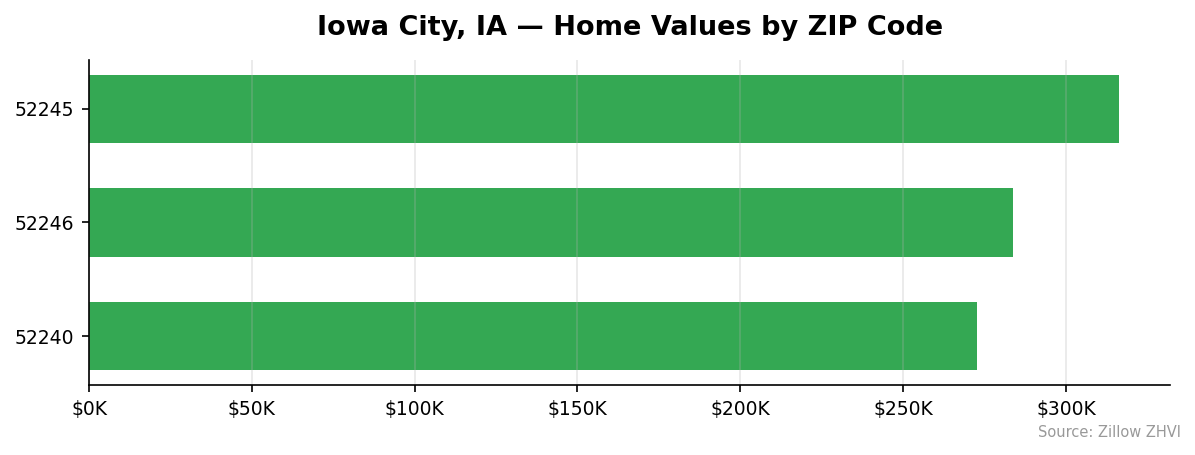
Three ZIP codes cover the city. Here’s how they stack up.
| ZIP | Typical Home Value | Avg. Rent | Premium/Discount vs City |
|---|---|---|---|
| 52245 | $316,183 | $1,458 | +8.7% |
| 52246 | $283,752 | $1,322 | -2.4% |
| 52240 | $272,585 | $1,181 | -6.3% |
Most Expensive
52245 leads at $316,183, sitting nearly 9% above the city average. Higher rents — $1,458 a month — confirm strong demand, likely tied to its proximity to the university and hospital district.
Most Affordable
52240 is the cheapest at $272,585, with rent at $1,181 a month. That’s the lowest entry point in the city for both buyers and renters. 52246 lands in the middle at $283,752, slightly under the city average and a sensible target for buyers who want a balance between price and amenities.
With only three ZIPs, the choice is simple. Pay the premium for 52245, save in 52240, or split the difference in 52246.
Rent vs Buy in Iowa City
The average rent across Iowa City’s three ZIPs works out to roughly $1,320 per month. Now run the buying math.
A median-priced home at $290,840 with 20% down ($58,168) leaves a loan of $232,672. At a 7% rate on a 30-year fixed mortgage, principal and interest comes to about $1,548 monthly. Add property tax (Iowa runs roughly 1.5% of assessed value annually, or about $364/month) and insurance (around $100/month), and your total monthly housing cost lands near $2,012.
| Cost | Renting | Buying |
|---|---|---|
| Monthly housing payment | ~$1,320 | ~$2,012 |
| Upfront cash needed | ~$1,320 (deposit) | ~$58,168 (20% down) |
| Builds equity | No | Yes |
Renting saves about $692 per month in cash flow. But the buyer captures appreciation. At the current 4.3% pace, a $290,840 home gains roughly $12,500 in value per year — more than enough to offset the cost gap if you stay put for five years or longer.
If you’re a graduate student or short-term resident, rent. If you’re a faculty hire, hospital staffer, or anyone planning to stay past 2030, buying makes more sense given the consistent price trend.
Population Growth and Migration
Iowa City is gaining residents, just not quickly.
| Year | Population |
|---|---|
| 2020 | 74,914 |
| 2021 | 75,180 |
| 2022 | 75,867 |
| 2023 | 76,111 |
| 2024 | 76,710 |
That’s a 2.4% gain over four years. Steady, but modest. Compare it to other Iowa cities:
| City | 2024 Population | 4-Year Growth |
|---|---|---|
| Ankeny | 76,727 | +11.9% |
| West Des Moines | 73,664 | +6.9% |
| Ames | 69,026 | +3.8% |
| Iowa City | 76,710 | +2.4% |
| Sioux City | 86,875 | +1.1% |
| Waterloo | 67,477 | +0.3% |
Ankeny and West Des Moines are pulling ahead. They’re absorbing Des Moines metro spillover. Iowa City’s growth is anchored by the university and University of Iowa Hospitals — a stable population pipeline rather than a boom.
For housing, slow growth means predictable demand. You won’t see Phoenix-style price spikes here, but you also won’t see the kind of vacancy collapse that hits cities losing population. The 2.4% gain is enough to keep absorbing new construction without flooding the market.
Iowa City Housing Market Trends
Here’s what the past 12 months looked like.
| Month | Median Value | Monthly Change |
|---|---|---|
| March 2025 | $278,765 | — |
| April 2025 | $279,176 | +0.1% |
| May 2025 | $279,332 | +0.1% |
| June 2025 | $279,879 | +0.2% |
| July 2025 | $281,190 | +0.5% |
| August 2025 | $282,790 | +0.6% |
| September 2025 | $284,355 | +0.6% |
| October 2025 | $285,582 | +0.4% |
| November 2025 | $287,099 | +0.5% |
| December 2025 | $288,552 | +0.5% |
| January 2026 | $289,906 | +0.5% |
| February 2026 | $290,840 | +0.3% |
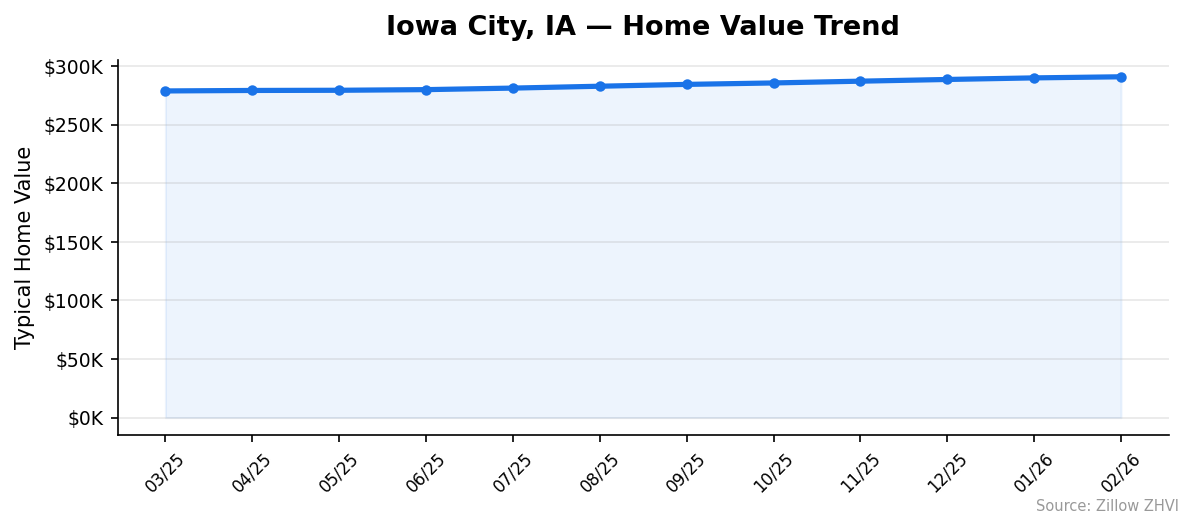
Twelve consecutive months of gains. No down months. No flat months.
The pace accelerated in mid-2025, peaking around August through November when monthly gains held at 0.5% to 0.6%. The most recent two months show the rate cooling slightly to 0.3%-0.5%. That’s still appreciation, just at a slower clip. The total move from March 2025 to February 2026 — a $12,075 gain — adds up to the 4.3% YoY figure.
Is Iowa City a Good Place to Buy in 2026?
It’s a seller’s market, but a polite one.
Twelve straight months of gains tells you sellers have had pricing power. The 4.3% appreciation rate keeps pace with wage growth and beats inflation, which means homeowners are building real equity. That’s the seller side.
For buyers, the news isn’t terrible. Prices haven’t blown out — Iowa City sits well below national medians, and the YoY gain is moderate compared to coastal markets that swing 8% to 15%. With three ZIPs in play, your choice set is simple, and 52240 still offers entry-level pricing under $275,000.
The catch: you’re buying into a trend that’s been running for a year without interruption. There’s no obvious correction signal in the data. If you wait for prices to drop, you may wait through another year of gains. If you buy now, you’re paying near-peak — but the peak may keep moving.
A two-income household earning $90,000+ can afford the median with a standard down payment. Below that, focus on 52240.
Iowa City Housing Market Outlook for 2026-2027
The 3-month trend suggests momentum is cooling. Monthly gains have eased from the 0.5%-0.6% range last fall to 0.3%-0.5% in the first two months of 2026. That’s still positive, but the rate of change is slowing.
If the current pace continues, prices would land somewhere in the $295,000 to $300,000 range by mid-2026. A full reversal would require a sharp economic shock — something the steady 12-month chart shows no sign of. A flattening, on the other hand, is plausible. Mortgage rate moves and University of Iowa enrollment trends are the variables to watch.
For sellers thinking about listing, the next two quarters should still favor your side. For buyers, locking in now beats waiting if the trend holds at even half its current pace.
Similar Markets in IA
- Cedar Rapids — the closest large neighbor, often considered alongside Iowa City for buyers wanting more inventory.
- Des Moines — the state capital, with a deeper job market beyond healthcare and academia.
- Davenport — Quad Cities buyers seeking comparable mid-state pricing should check Davenport.
- Dubuque — a smaller market for buyers who like Iowa City’s scale but want lower competition.
- Waterloo — typically priced below Iowa City, worth comparing if budget is the main constraint.
Frequently Asked Questions
What is the average home price in Iowa City?
The average home price in Iowa City, IA is $290,840 as of February 2026. The figure is the median Zillow Home Value Index across the city’s three ZIP codes.
Are home prices going up or down in Iowa City?
Up. Prices have risen 4.3% year over year and posted gains in every one of the last 12 months. The pace has eased recently but remains positive.
Is it cheaper to rent or buy in Iowa City?
Renting saves about $692 per month in cash flow at current rates. Buying makes more sense if you plan to stay 5+ years, since the 4.3% annual price growth more than covers the gap through equity gains.
What is the most affordable neighborhood in Iowa City?
ZIP 52240 is the cheapest at $272,585 — about 6.3% below the city average. Average rent there runs $1,181 per month, the lowest of the three Iowa City ZIPs.
Methodology
Home values are based on the Zillow Home Value Index (ZHVI), a smoothed measure of typical home values in the 35th to 65th percentile range. Rent estimates use the Zillow Observed Rent Index (ZORI). Population figures come from the U.S. Census Bureau Population Estimates Program (2020-2024 vintage). All datasets are publicly available. Housing data updated 2026-02-28.