Saint Paul Home Prices: $295K, Up 0.5% — 12 ZIPs Analyzed (2026)
$295K. That’s what a typical home costs in Saint Paul right now — and prices are barely moving. A 0.5% year-over-year gain means the market is essentially flat, giving buyers rare breathing room in the Twin Cities metro.
Quick answer: The average home price in Saint Paul, MN is $294,857 as of February 2026, up 0.5% year over year according to Zillow.
Current Home Prices in Saint Paul
The Saint Paul housing market sits in a holding pattern. Prices edged up just half a percent over the past year, one of the slowest appreciation rates in recent memory for the Minneapolis-St. Paul metro.
| Metric | Value |
|---|---|
| Median Home Value | $294,857 |
| Year-over-Year Change | +0.5% |
| Lowest ZIP Value | $178,300 |
| Highest ZIP Value | $462,118 |
| ZIP Codes Tracked | 12 |
| Data as of | February 2026 |
The spread between the cheapest and most expensive neighborhoods is $283,818. That gap tells you Saint Paul is not one market — it’s at least a dozen. A buyer priced out of the $460K neighborhoods along the river can find homes for under $250K just a few miles away.
The 0.5% annual gain barely keeps pace with inflation. If you bought a year ago at the city median, your home gained roughly $1,500 in value. That’s a rounding error on a $295K asset.
Saint Paul Home Prices by Neighborhood
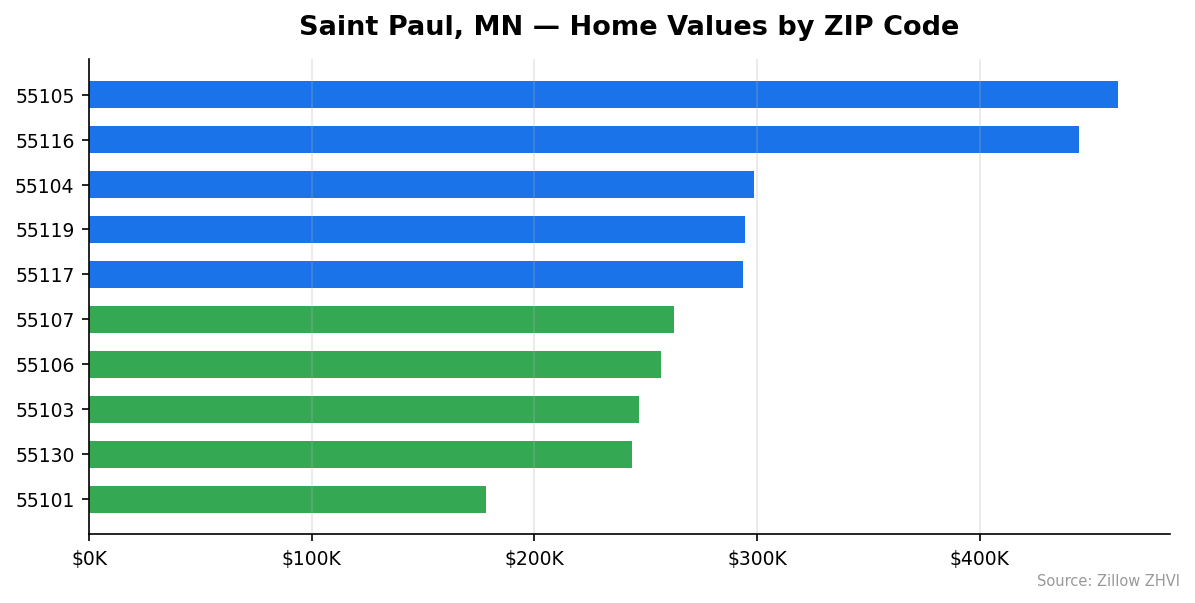
Every ZIP code in Saint Paul tells a different story. Here’s how they stack up.
| ZIP Code | Median Home Value | Typical Rent |
|---|---|---|
| 55105 | $462,118 | $1,414 |
| 55116 | $444,523 | $1,574 |
| 55104 | $298,348 | $1,534 |
| 55119 | $294,730 | $1,332 |
| 55117 | $293,774 | $1,315 |
| 55114 | $278,810 | $1,501 |
| 55102 | $277,102 | $1,566 |
| 55107 | $262,661 | $1,592 |
| 55106 | $256,889 | $1,392 |
| 55103 | $247,091 | $1,160 |
| 55130 | $243,926 | $1,324 |
| 55101 | $178,300 | $1,561 |
Most Expensive ZIPs
55105 leads at $462,118, sitting 57% above the city median — this area commands a premium while offering relatively moderate rents at $1,414. 55116 follows closely at $444,523, pairing high home values with the second-highest rents in the city at $1,574. 55104 rounds out the top three at $298,348, just above the city average.
Most Affordable ZIPs
55101 is the clear bargain at $178,300, a full 40% below the city median — though rents here run $1,561, creating an unusual gap between ownership and rental costs. 55130 comes in at $243,926, about 17% below average with rents of $1,324. 55103 at $247,091 offers the lowest rents in the city at just $1,160 per month.
Rent vs Buy in Saint Paul
Rent data is available across all 12 ZIP codes, and the numbers favor renters in the short term.
The citywide average rent falls around $1,439 per month. A mortgage on the median-priced home of $294,857 — assuming 7% interest, 30-year fixed, and 20% down — runs approximately $1,569 per month for principal and interest alone. Add property taxes and insurance and you’re looking at closer to $1,960.
That’s a $500+ monthly gap between renting and owning.
| ZIP Code | Typical Rent | Est. Mortgage (P&I) |
|---|---|---|
| 55101 | $1,561 | $1,187 |
| 55103 | $1,160 | $1,644 |
| 55107 | $1,592 | $1,749 |
| 55105 | $1,414 | $3,077 |
The math gets interesting in 55101, where a $178K home produces a lower mortgage payment than the local rent. That’s one of the few ZIPs where buying could save you money from day one. In 55105, the opposite holds — a $462K purchase price means your mortgage would be double the local rent.
Buying makes financial sense if you plan to stay at least 5-7 years and can stomach the upfront costs. For shorter timelines, renting wins.
Saint Paul Housing Market Trends
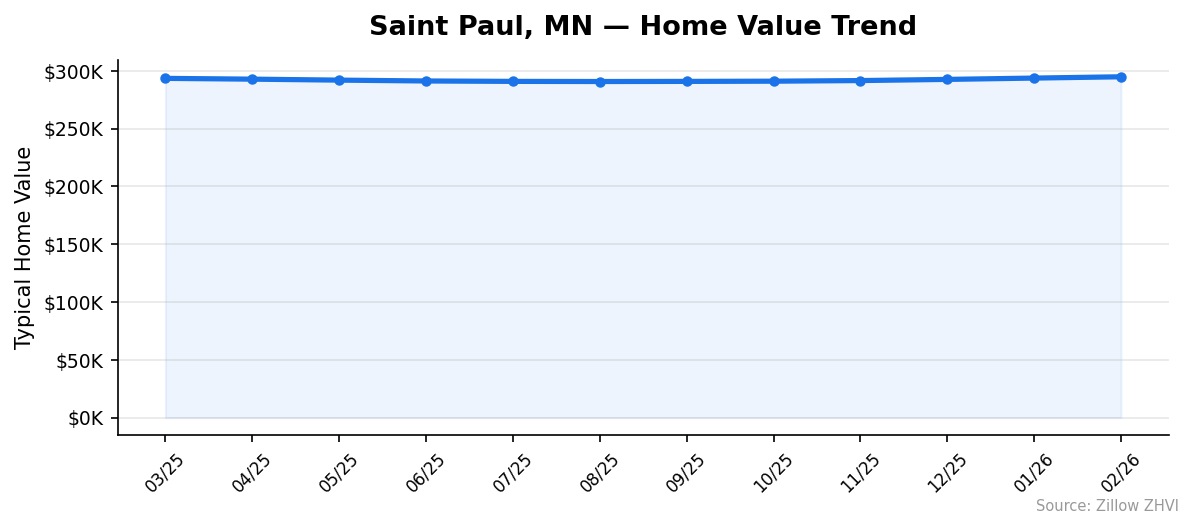
Here’s how the city median moved over the past 12 months.
| Month | Average Value | Low | High |
|---|---|---|---|
| Feb 2026 | $294,857 | $178,300 | $462,118 |
| Jan 2026 | $293,743 | $179,500 | $459,454 |
| Dec 2025 | $292,597 | $181,990 | $456,929 |
| Nov 2025 | $291,583 | $185,420 | $454,361 |
| Oct 2025 | $291,053 | $188,172 | $452,606 |
| Sep 2025 | $290,870 | $190,410 | $451,086 |
| Aug 2025 | $290,770 | $191,678 | $449,825 |
| Jul 2025 | $290,880 | $191,910 | $449,072 |
| Jun 2025 | $291,232 | $191,660 | $448,921 |
| May 2025 | $291,970 | $191,333 | $449,583 |
| Apr 2025 | $292,805 | $191,866 | $450,481 |
| Mar 2025 | $293,490 | $192,402 | $450,686 |
The pattern is clear: prices dipped from March through August 2025, then reversed. The city average fell from $293,490 in March to a low of $290,770 in August — a drop of less than 1%. Since then, prices have climbed steadily for six consecutive months, gaining $4,087.
What’s notable is the divergence at the extremes. The cheapest ZIP fell from $192,402 to $178,300 over the year — a 7.3% drop. The most expensive ZIP rose from $450,686 to $462,118 — a 2.5% gain. The gap between rich and poor neighborhoods is widening.
Is Saint Paul a Good Place to Buy in 2026?
The numbers paint a neutral market. A 0.5% annual gain is neither hot nor cold. You won’t get crushed by rapid appreciation if you wait, but you also won’t see prices crater.
For buyers, the math depends entirely on your target ZIP code. At $178K, the 55101 area is attainable for first-time buyers with modest incomes. The $460K neighborhoods require household income north of $120K to stay within lending guidelines.
The rent-vs-buy gap in most ZIPs favors renting on a monthly cash flow basis. But if you have a 5+ year horizon and can lock in a rate below 7%, buying builds equity that renting never will.
Saint Paul’s flat market is a buyer’s friend. There’s no bidding frenzy here, and the data shows no signs of one forming.
Saint Paul Housing Market Outlook for 2026-2027
The six-month upward trend from August 2025 through February 2026 is steady but slow — roughly $680 per month in average gains. If that pace continues, expect the city median to hover between $298K and $302K by mid-2026.
Don’t expect a breakout. The 3-month acceleration is mild: $1,113 per month from December to February versus $594 per month from September to November. Prices are gaining momentum, but not at a rate that suggests overheating.
The widening gap between the cheapest and most expensive ZIPs may continue. Budget-friendly areas like 55101 have been declining while premium neighborhoods climb. Buyers targeting affordability should act sooner rather than later if the floor keeps dropping.
Similar Markets in MN
If you’re shopping the Twin Cities metro and beyond, these Minnesota markets are worth comparing.
- Minneapolis — Saint Paul’s twin across the river, typically priced higher with a larger inventory pool.
- Brooklyn Park — A northwest suburb offering more space for the money.
- Eagan — South metro suburb with strong schools and highway access.
- Bloomington — Home to the Mall of America, this suburb draws buyers wanting urban conveniences.
- Rochester — The Mayo Clinic city, 90 minutes southeast, with its own distinct housing market.
Frequently Asked Questions
What is the average home price in Saint Paul?
The average home price in Saint Paul is $294,857 as of February 2026. That figure represents the Zillow Home Value Index across the city. Prices vary widely by ZIP code, from $178,300 in 55101 to $462,118 in 55105.
Are home prices going up or down in Saint Paul?
Prices are up 0.5% year over year — essentially flat. After a slight dip from March to August 2025, the market has posted six consecutive months of gains. The trend is positive but modest.
Is it cheaper to rent or buy in Saint Paul?
Renting is cheaper on a monthly basis in most ZIP codes. Average rent runs about $1,439 while a mortgage on the median home costs roughly $1,960 including taxes and insurance. The exception is 55101, where a $178K purchase price can produce a mortgage payment below local rents.
What is the most affordable neighborhood in Saint Paul?
ZIP code 55101 is the most affordable at $178,300 — about 40% below the city average. The next cheapest options are 55130 at $243,926 and 55103 at $247,091. These three ZIPs offer entry points well below $250K.
Methodology
Home values are based on the Zillow Home Value Index (ZHVI), a smoothed measure of typical home values in the 35th to 65th percentile range. Rent estimates use the Zillow Observed Rent Index (ZORI). Population figures come from the U.S. Census Bureau Population Estimates Program (2020-2024 vintage). All datasets are publicly available. Housing data updated 2026-02-28.