Sioux Falls Home Prices: $344K, Up 1.6% — 8 ZIPs Analyzed (2026)
$344,158. That’s what a typical home costs in Sioux Falls right now. Prices are up 1.6% from a year ago, and the city has added nearly 16,000 residents since 2020. The market is still moving — slowly, but upward.
Quick answer: The average home price in Sioux Falls, SD is $344,158 as of February 2026, up 1.6% year over year according to Zillow.
Current Home Prices in Sioux Falls
The Sioux Falls housing market sits at $344,158 for a typical home. That 1.6% annual gain is modest — not the kind of runaway appreciation that prices out buyers overnight, but enough to show sustained demand.
| Metric | Value |
|---|---|
| Median Home Value | $344,158 |
| Year-over-Year Change | +1.6% |
| Lowest ZIP Value | $218,016 (57104) |
| Highest ZIP Value | $472,881 (57055) |
| Number of ZIPs Tracked | 8 |
| Data as of | February 2026 |
The spread between the cheapest and most expensive ZIP code is $254,865. That gap tells you Sioux Falls isn’t one market — it’s several. A buyer in 57104 faces a completely different price reality than one shopping in 57055.
Compared to national medians, Sioux Falls remains below the U.S. average. The 1.6% growth rate is also below the national pace, which means the city isn’t overheating. Buyers here still have room.
Sioux Falls Home Prices by Neighborhood
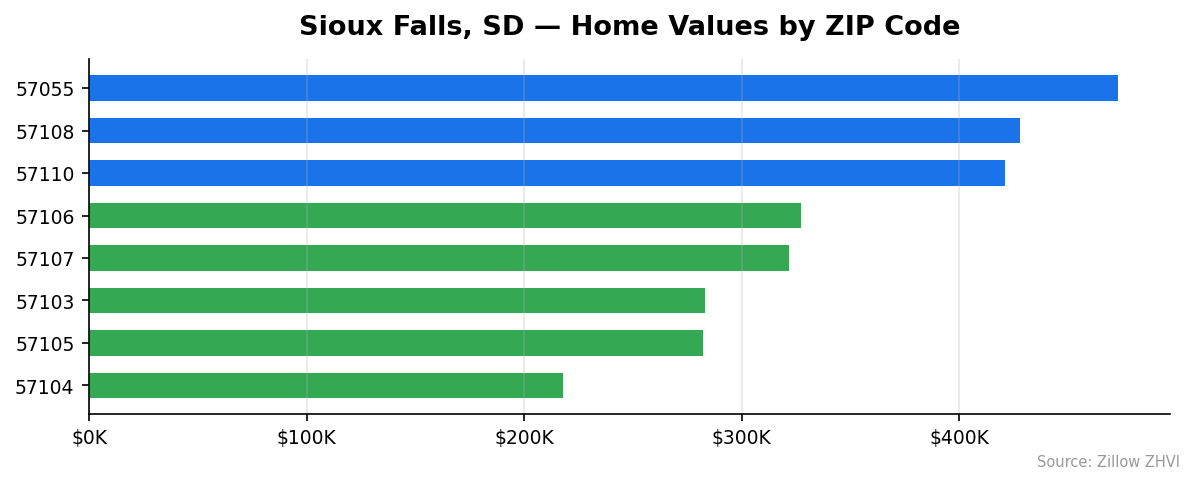
Eight ZIP codes cover the Sioux Falls market. Here’s how they compare:
| ZIP Code | Median Home Value | Avg. Monthly Rent |
|---|---|---|
| 57055 | $472,881 | N/A |
| 57108 | $428,040 | $1,222 |
| 57110 | $420,783 | $1,263 |
| 57106 | $327,135 | $1,423 |
| 57107 | $321,442 | $1,366 |
| 57103 | $283,035 | $1,278 |
| 57105 | $281,928 | $1,299 |
| 57104 | $218,016 | $1,152 |
Most Expensive ZIPs
57055 leads at $472,881, sitting 37% above the city median — rent data isn’t tracked for this ZIP, suggesting it may be a newer or more suburban development area. 57108 follows at $428,040 with relatively low rent of $1,222, making it a market where ownership dominates. 57110 rounds out the top three at $420,783 with rent at $1,263.
Most Affordable ZIPs
57104 is the entry point at $218,016 — that’s 37% below the city median and the only ZIP under $250K. Rent here is also the lowest at $1,152. 57105 at $281,928 and 57103 at $283,035 both sit around $60K below the city average, offering a middle ground for buyers who want to stay under $300K.
Rent vs Buy in Sioux Falls
The average rent across the seven Sioux Falls ZIPs with rent data is approximately $1,286 per month.
Now compare that to buying. On a $344,158 home with 20% down ($68,832), you’d finance $275,326. At a 7% mortgage rate over 30 years, the principal and interest payment is roughly $1,833 per month. Add property taxes and insurance, and you’re looking at $2,100–$2,300 depending on the ZIP.
| Cost | Monthly |
|---|---|
| Average Rent (ZORI) | $1,286 |
| Mortgage Payment (P&I, 20% down, 7%) | ~$1,833 |
| Est. Total Ownership Cost | ~$2,100–$2,300 |
Renting saves you $800+ per month on a cash-flow basis. But that math doesn’t account for equity. With prices rising 1.6% annually, you’d gain roughly $5,500 in home value per year on the median home.
For buyers in the cheapest ZIP (57104 at $218,016), the numbers tilt more favorably. A mortgage on that home runs about $1,158 in principal and interest — almost even with the $1,152 average rent in that ZIP.
Population Growth and Migration
Sioux Falls is one of the fastest-growing cities in South Dakota. The population hit 209,289 in 2024, up 8.2% from 193,448 in 2020.
| Year | Population |
|---|---|
| 2020 | 193,448 |
| 2021 | 196,833 |
| 2022 | 201,936 |
| 2023 | 205,968 |
| 2024 | 209,289 |
That’s roughly 3,960 new residents per year. Growth has been consistent — no single year spiked or dipped, which points to steady in-migration rather than a one-time boom.
| City | 2024 Population | 4-Year Growth |
|---|---|---|
| Sioux Falls | 209,289 | 8.2% |
| Rapid City | 79,894 | 6.6% |
Sioux Falls is growing faster than Rapid City in both absolute and percentage terms. More people means more housing demand. With home prices rising only 1.6% annually despite 8.2% population growth, supply has mostly kept pace — but that balance may not hold if construction slows.
Sioux Falls Housing Market Trends
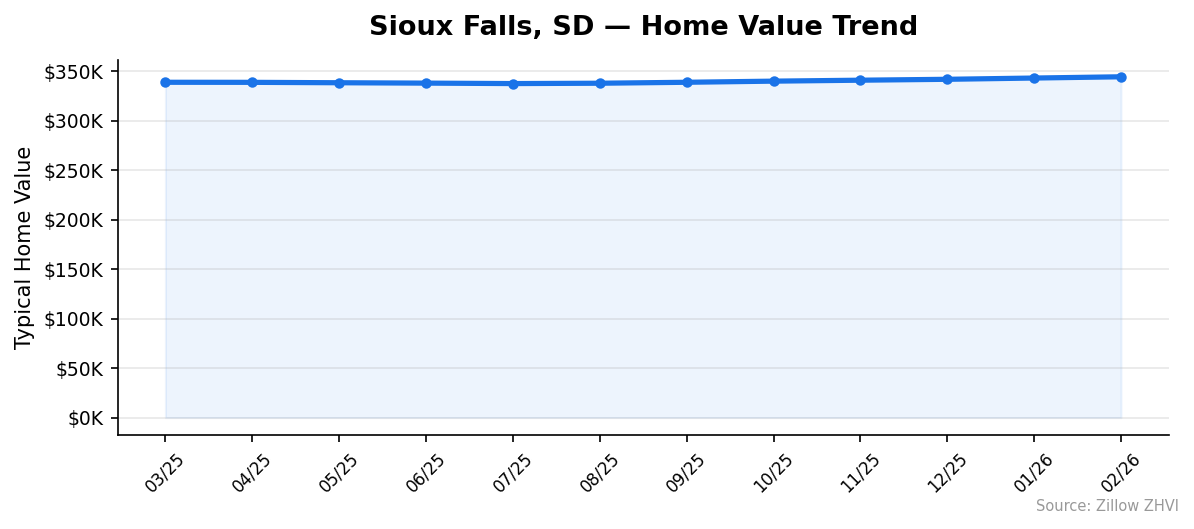
Here’s the 12-month price trajectory from March 2025 through February 2026:
| Month | Avg. Home Value | Low | High |
|---|---|---|---|
| Feb 2026 | $344,158 | $218,016 | $472,881 |
| Jan 2026 | $342,898 | $217,132 | $470,629 |
| Dec 2025 | $341,625 | $216,456 | $467,585 |
| Nov 2025 | $340,714 | $216,273 | $464,549 |
| Oct 2025 | $339,757 | $216,383 | $460,634 |
| Sep 2025 | $338,613 | $216,438 | $456,161 |
| Aug 2025 | $337,651 | $216,464 | $451,954 |
| Jul 2025 | $337,309 | $216,696 | $449,394 |
| Jun 2025 | $337,760 | $217,290 | $448,929 |
| May 2025 | $338,143 | $217,681 | $449,618 |
| Apr 2025 | $338,550 | $217,766 | $450,696 |
| Mar 2025 | $338,618 | $217,358 | $451,540 |
The pattern is clear. Prices dipped slightly from March through July 2025, bottoming at $337,309. Then they climbed every single month from August onward — seven consecutive months of gains.
The floor prices (cheapest ZIP) barely moved all year, staying within a $1,750 range. The ceiling prices (most expensive ZIP) drove most of the gains, jumping from $448,929 in June to $472,881 in February — a $23,952 increase in eight months. The premium end of the market is pulling away from the affordable end.
Is Sioux Falls a Good Place to Buy in 2026?
The numbers point to a stable market with a slight lean toward sellers. Prices are rising, but at 1.6% per year — well below inflation. That makes Sioux Falls a market where buyers aren’t penalized for taking their time.
Key signals from the data:
- Population growing 8.2% over four years means sustained demand
- Price gains of 1.6% suggest supply is keeping up — for now
- Entry point under $220K in ZIP 57104 keeps the market accessible
- Rents averaging $1,286 create a reasonable fallback if you’re not ready to buy
If you’re buying to live in the home for 5+ years, the slow appreciation and affordable entry prices work in your favor. If you’re looking for quick equity gains, this isn’t that market.
Sioux Falls Housing Market Outlook for 2026-2027
The three-month trend from December 2025 through February 2026 shows acceleration. Prices gained $1,260 between January and February after gaining $1,273 between December and January. The monthly pace is holding steady at roughly $1,200–$1,300 per month.
If the current pace continues through 2026, you’d expect the median to reach somewhere around $356,000–$358,000 by year’s end. The high end of the market is moving faster — the most expensive ZIP gained $5,296 in the last two months alone.
Nothing in the data suggests a reversal. Population is still growing. Month-over-month gains have been positive for seven straight months. Barring a significant economic shock or a surge in new construction, Sioux Falls prices will likely continue their slow, steady climb into 2027.
Similar Markets in SD
If you’re considering Sioux Falls, these other South Dakota cities may be worth a look:
- Rapid City — South Dakota’s second-largest city at 79,894 residents, with a slightly slower population growth rate of 6.6% over four years.
Frequently Asked Questions
What is the average home price in Sioux Falls?
The average home price in Sioux Falls is $344,158 as of February 2026. That figure represents the typical home value across all eight tracked ZIP codes. Prices range from $218,016 in the most affordable ZIP (57104) to $472,881 in the most expensive (57055).
Are home prices going up or down in Sioux Falls?
Prices are going up. The year-over-year change is +1.6% as of February 2026. The market bottomed briefly in mid-2025 around $337,309 before climbing for seven consecutive months. The trend is upward but moderate.
Is it cheaper to rent or buy in Sioux Falls?
Renting is cheaper on a monthly basis. The average rent across Sioux Falls is about $1,286 per month, while a mortgage on the median home costs roughly $1,833 in principal and interest alone (assuming 20% down at 7%). In the most affordable ZIP (57104), though, mortgage payments nearly match the local rent of $1,152.
What is the most affordable neighborhood in Sioux Falls?
ZIP code 57104 is the most affordable area in Sioux Falls at $218,016 — that’s 37% below the city median. It also has the lowest rent at $1,152 per month. The next most affordable options are 57105 ($281,928) and 57103 ($283,035).
Is Sioux Falls growing or shrinking?
Sioux Falls is growing. The city’s population reached 209,289 in 2024, up 8.2% from 193,448 in 2020. That works out to roughly 3,960 new residents per year, outpacing Rapid City’s 6.6% growth rate over the same period.
Methodology
Home values are based on the Zillow Home Value Index (ZHVI), a smoothed measure of typical home values in the 35th to 65th percentile range. Rent estimates use the Zillow Observed Rent Index (ZORI). Population figures come from the U.S. Census Bureau Population Estimates Program (2020-2024 vintage). All datasets are publicly available. Housing data updated 2026-02-28.