West Jordan Home Prices: $552K, Up 2% — 3 ZIPs Analyzed (2026)
$552,426. That’s what a typical home in West Jordan costs right now — and it’s climbing. Prices are up 2.0% year over year as of February 2026, part of a slow but steady climb that started mid-2025. For buyers watching the Salt Lake City metro, West Jordan sits in a middle ground: not cheap, not the most expensive suburb either.
Quick answer: The average home price in West Jordan, UT is $552,426 as of February 2026, up 2.0% year over year according to Zillow.
Current Home Prices in West Jordan
Here’s where the market stands right now:
| Metric | Value |
|---|---|
| Median Home Price | $552,426 |
| Year-over-Year Change | +2.0% |
| Lowest ZIP Price | $511,280 |
| Highest ZIP Price | $574,420 |
| Price Spread | $63,140 |
| Number of ZIPs Tracked | 3 |
A 2% annual gain is modest. It won’t make anyone rich, but it signals a market that isn’t overheating. The $63,140 gap between the cheapest and most expensive ZIP codes means your neighborhood choice matters — that’s an 12% price difference within the same city.
West Jordan sits inside the Salt Lake City metro, where competition from remote workers and local demand has kept prices elevated since 2021. But the gains here are cooling compared to peak pandemic years.
For context, the median has only moved about $822 in the last month — from $551,604 in January to $552,426 in February. That’s a 0.15% monthly increase. Not the kind of runaway growth that prices out buyers overnight, but consistent enough to reward those already in the market.
West Jordan Home Prices by Neighborhood
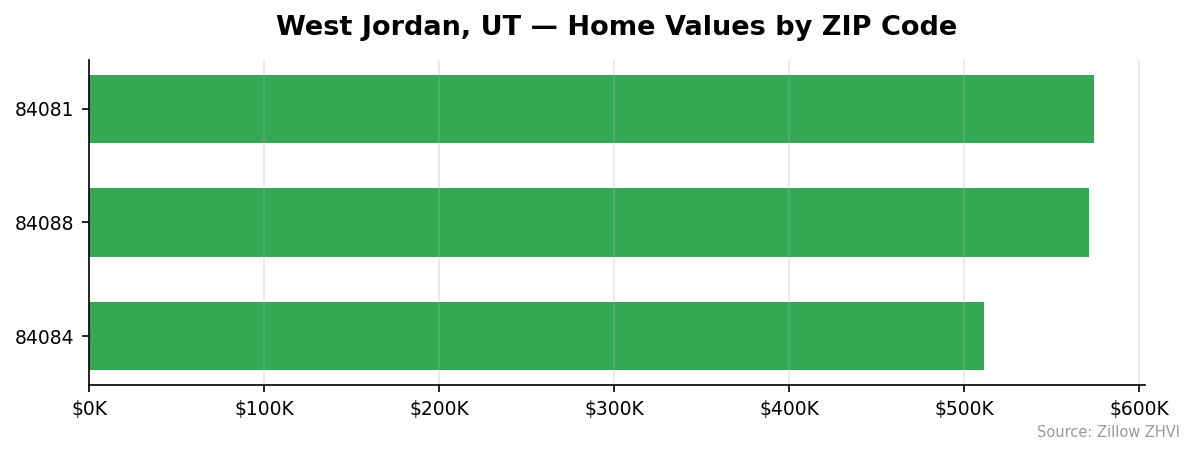
All three tracked ZIP codes in West Jordan show prices above $500,000, but the gap between them tells a story.
| ZIP Code | Median Home Price | Avg Monthly Rent |
|---|---|---|
| 84081 | $574,420 | $1,716 |
| 84088 | $571,579 | $1,597 |
| 84084 | $511,280 | $1,881 |
Most Expensive
84081 tops the list at $574,420, about $22,000 above the city average, with rents sitting at $1,716 per month.
84088 is nearly as expensive at $571,579, though it offers the lowest rents of any West Jordan ZIP at $1,597 — a potential sweet spot for investors.
Most Affordable
84084 is the clear budget pick at $511,280. That’s $41,146 below the city median. Interestingly, this ZIP has the highest rents at $1,881 per month. Renters are paying a premium here, which suggests strong rental demand despite lower purchase prices.
That rent-price mismatch in 84084 is worth watching. High rents relative to home values can signal an area where buying makes more financial sense than renting — or where rental stock is limited.
Rent vs Buy in West Jordan
The math here isn’t close right now. Renting wins on monthly cost.
| ZIP | Monthly Rent | Est. Mortgage Payment* |
|---|---|---|
| 84081 | $1,716 | $2,904 |
| 84088 | $1,597 | $2,889 |
| 84084 | $1,881 | $2,584 |
| City Average | $1,731 | $2,793 |
Estimated mortgage assumes 20% down, 6.5% rate, 30-year fixed. Does not include property taxes, insurance, or HOA.
On a city-wide average, you’d pay about $1,062 more per month to own versus rent. That’s a 61% premium for ownership.
But the calculus changes if you factor in equity. At 2% annual appreciation, a $552,426 home gains roughly $11,049 in value per year. That doesn’t close the monthly gap, but it means some of your higher payment is building wealth rather than disappearing.
ZIP 84084 offers the smallest ownership premium — $703 per month more than renting. If you’re set on buying, that neighborhood gives you the best rent-to-own ratio.
Population Growth and Migration
West Jordan isn’t growing. The city had 117,034 residents in 2020 and 116,688 in 2024 — a 0.3% decline over four years.
| Year | Population |
|---|---|
| 2020 | 117,034 |
| 2021 | 116,549 |
| 2022 | 117,150 |
| 2023 | 116,197 |
| 2024 | 116,688 |
The pattern is a sideways shuffle. A small dip in 2021, a slight recovery in 2022, another dip in 2023, partial bounce-back in 2024. No clear direction.
Compare that to other Utah cities:
| City | 2024 Population | 4-Year Growth |
|---|---|---|
| Salt Lake City | 217,783 | +8.5% |
| West Jordan | 116,688 | -0.3% |
| St. George | 106,288 | +10.7% |
| Lehi | 93,446 | +21.6% |
| South Jordan | 86,156 | +10.5% |
| Layton | 84,348 | +2.8% |
Every comparable Utah city is growing — some rapidly. Lehi added over a fifth of its population. South Jordan (West Jordan’s neighbor to the south) grew 10.5%. West Jordan is the only city on this list losing residents.
Flat population with rising home prices means demand isn’t being driven by new residents. It’s likely driven by broader Salt Lake metro appreciation and limited inventory rather than an influx of buyers specifically targeting West Jordan.
West Jordan Housing Market Trends
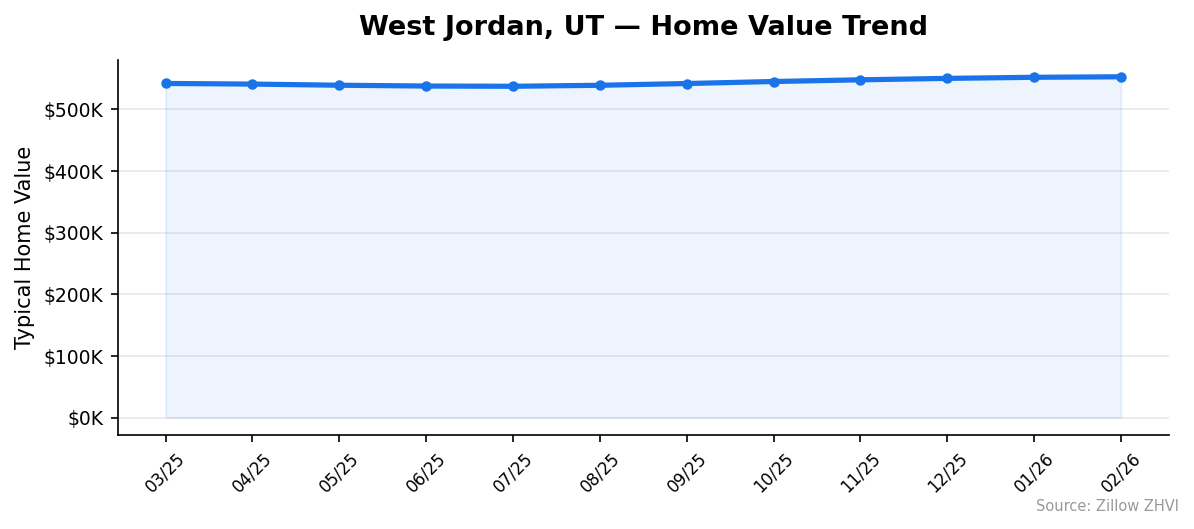
The 12-month trend tells a clear story: prices bottomed in mid-2025 and have been climbing since.
| Month | Avg Price | Low (84084) | High (84081) |
|---|---|---|---|
| Feb 2026 | $552,426 | $511,280 | $574,420 |
| Jan 2026 | $551,604 | $510,794 | $573,168 |
| Dec 2025 | $549,841 | $509,521 | $571,001 |
| Nov 2025 | $547,525 | $508,024 | $568,241 |
| Oct 2025 | $544,766 | $506,094 | $565,278 |
| Sep 2025 | $541,502 | $503,451 | $562,113 |
| Aug 2025 | $538,665 | $500,686 | $559,755 |
| Jul 2025 | $537,053 | $498,909 | $558,640 |
| Jun 2025 | $537,427 | $498,896 | $559,508 |
| May 2025 | $538,755 | $499,940 | $561,071 |
| Apr 2025 | $540,594 | $501,431 | $563,036 |
| Mar 2025 | $541,624 | $502,170 | $564,148 |
Prices dipped from March through July 2025, losing about $4,571 from peak to trough. Then they reversed. From July 2025 to February 2026, the city median gained $15,373 — a 2.9% increase in seven months.
The rebound has been consistent. Every single month since July 2025 posted a gain. No pullbacks, no stalls. That kind of momentum doesn’t guarantee continued growth, but it shows the market has found its footing after the mid-year softness.
Is West Jordan a Good Place to Buy in 2026?
The data paints a mixed picture.
In favor of buying: Prices are rising at a manageable 2% per year. You’re not chasing a runaway market. The cheapest ZIP (84084) sits below the Salt Lake metro average, and mortgage rates have room to influence affordability if they move lower.
Against buying: Population is flat, so you’re betting on metro-wide demand rather than local growth. The rent-vs-buy gap is wide — over $1,000 per month in most ZIP codes. And 2% appreciation barely outpaces inflation.
West Jordan makes sense for buyers who want to live in the Salt Lake metro without paying Salt Lake City or South Jordan prices. It’s a utility pick, not a growth bet. If you need a home and plan to stay 5+ years, the math works. If you’re looking for rapid appreciation, the data doesn’t support that expectation here.
West Jordan Housing Market Outlook for 2026-2027
The seven-month upward streak from July 2025 through February 2026 shows no signs of reversing. Monthly gains have been small but consistent — averaging about $2,196 per month during that stretch.
If the current pace continues through 2026, the median could reach the $560,000–$565,000 range by late summer. That assumes no major disruption from mortgage rate changes or broader economic shifts.
The seasonal pattern in the data is worth noting. Prices softened from March through July 2025 before recovering. A similar mid-year plateau in 2026 wouldn’t be surprising. The 3-month trend from December through February shows acceleration — $2,585 in gains versus $1,823 in the prior three months — which suggests spring 2026 could see continued strength before any seasonal cooling.
Similar Markets in UT
If you’re shopping in Utah, these cities offer different price points and growth profiles:
- Salt Lake City — the metro anchor with 8.5% population growth and likely higher price points than West Jordan
- West Valley City — West Jordan’s immediate neighbor, often more affordable with a similar suburban feel
- Sandy — southeast of West Jordan, typically carries a premium for its proximity to the Wasatch canyons
- Ogden — 35 miles north with a lower cost of living and growing arts scene
- Provo — university town 45 minutes south, popular with younger buyers and families
Frequently Asked Questions
What is the average home price in West Jordan?
The average home price in West Jordan is $552,426 as of February 2026. Across the city’s three tracked ZIP codes, prices range from $511,280 in the 84084 area to $574,420 in 84081. That puts West Jordan in the middle tier of Salt Lake City metro suburbs.
Are home prices going up or down in West Jordan?
Prices are going up. The median increased 2.0% year over year and has risen every month since July 2025. The trend is upward but moderate — this isn’t the kind of double-digit growth Utah saw during the pandemic years.
Is it cheaper to rent or buy in West Jordan?
Renting is cheaper on a monthly basis. The average rent across West Jordan ZIPs is about $1,731, while an estimated mortgage payment on the median home runs around $2,793 — a gap of over $1,000 per month. Buying only wins if you factor in long-term equity building and plan to stay several years.
What is the most affordable neighborhood in West Jordan?
ZIP code 84084 is the most affordable at $511,280, roughly $41,000 below the city median. Despite lower home prices, this area actually has the highest average rent at $1,881 per month, making it a particularly interesting option for buyers looking at the rent-to-own math.
Methodology
Home values are based on the Zillow Home Value Index (ZHVI), a smoothed measure of typical home values in the 35th to 65th percentile range. Rent estimates use the Zillow Observed Rent Index (ZORI). Population figures come from the U.S. Census Bureau Population Estimates Program (2020-2024 vintage). All datasets are publicly available. Housing data updated 2026-02-28.