Aurora Home Prices: $468K, Down 3.5% — 9 ZIPs Analyzed (2026)
$468,154. That’s what a typical home costs in Aurora right now — and it’s less than what buyers paid a year ago.
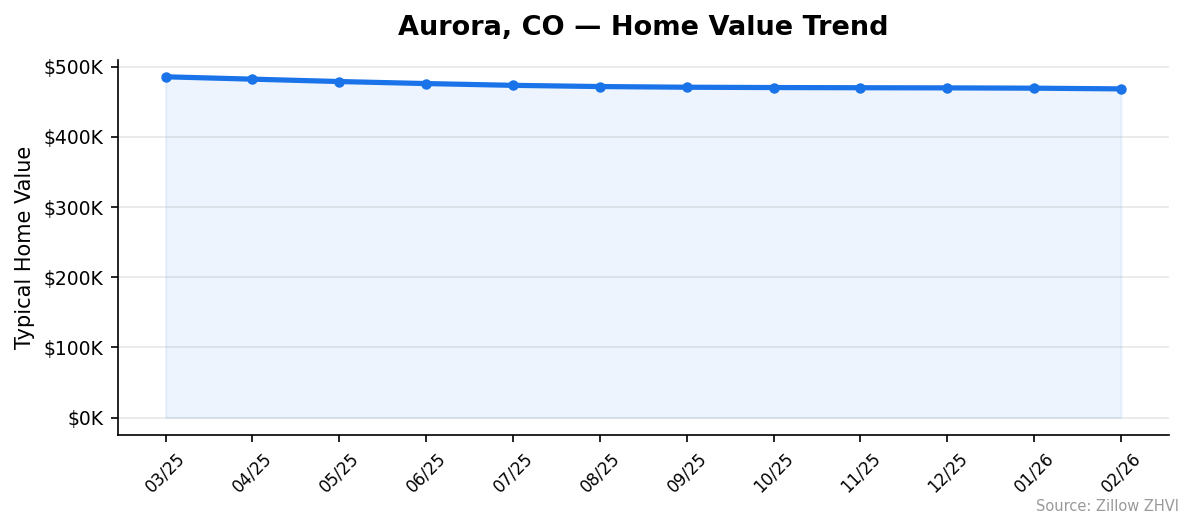
The Denver metro’s third-largest city has seen prices slide 3.5% over the past twelve months. Every single month since March 2025 has posted a lower median than the one before it. For buyers who’ve been priced out of Denver proper, that downward pressure changes the math.
Quick answer: The average home price in Aurora, CO is $468,154 as of February 2026, down 3.5% year over year according to Zillow.
Current Home Prices in Aurora
| Metric | Value |
|---|---|
| Median Home Value | $468,154 |
| Year-over-Year Change | -3.5% |
| Lowest ZIP Median | $356,720 |
| Highest ZIP Median | $736,410 |
| Number of ZIP Codes | 9 |
| Data as of | February 2026 |
Aurora sits in the Denver-Aurora-Lakewood metro area, and the city’s median falls well below Denver’s price point. The $468,154 figure represents the Zillow Home Value Index — a smoothed estimate of typical home values in the 35th to 65th percentile range.
The 3.5% annual decline translates to roughly $17,000 lost in home value over the past year. That’s real money for existing homeowners, but it’s a discount for anyone looking to buy.
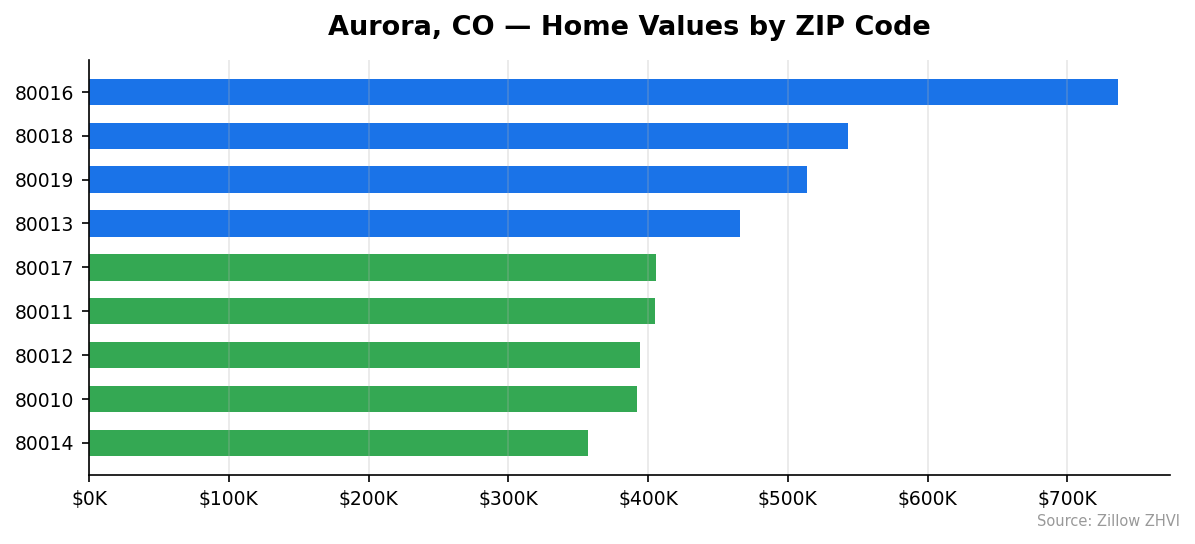
The price range across Aurora is wide. The gap between the cheapest and most expensive ZIP codes is nearly $380,000. Where you buy within city limits matters as much as when you buy.
Aurora Home Prices by Neighborhood
| ZIP Code | Median Home Value | Avg Monthly Rent |
|---|---|---|
| 80016 | $736,410 | $1,950 |
| 80018 | $543,279 | $2,469 |
| 80019 | $513,730 | $2,735 |
| 80013 | $466,096 | $1,930 |
| 80011 | $405,217 | $1,605 |
| 80017 | $405,584 | $1,519 |
| 80012 | $394,252 | $1,482 |
| 80010 | $392,094 | $1,477 |
| 80014 | $356,720 | $1,628 |
Most Expensive
80016 leads Aurora at $736,410 — nearly 57% above the city median, with relatively moderate rents of $1,950/month. 80018 comes in at $543,279 and commands the second-highest rents in the city at $2,469/month. 80019 rounds out the top three at $513,730 with the highest rents in Aurora at $2,735/month, suggesting strong demand from renters in this area.
Most Affordable
80014 is Aurora’s most budget-friendly ZIP at $356,720, about 24% below the city average, with mid-range rents of $1,628. 80010 follows at $392,094 and offers the lowest rents in the city at just $1,477/month — the best deal for cost-conscious renters and buyers alike. 80012 at $394,252 rounds out the bottom three, with rents of $1,482 that closely mirror 80010.
Rent vs Buy in Aurora
The rent-or-buy question comes down to monthly numbers. Here’s how they compare across Aurora’s ZIP codes.
Assume a 20% down payment on the median home of $468,154. That’s a $374,523 mortgage. At a 7% rate on a 30-year fixed loan, your monthly principal and interest payment runs about $2,491. Add property taxes and insurance, and you’re likely above $2,800/month.
The average rent across Aurora’s nine ZIP codes works out to roughly $1,755/month.
| ZIP Code | Monthly Rent | Est. Mortgage (P&I) |
|---|---|---|
| 80019 | $2,735 | ~$2,743 |
| 80018 | $2,469 | ~$2,900 |
| 80016 | $1,950 | ~$3,931 |
| 80013 | $1,930 | ~$2,488 |
| 80014 | $1,628 | ~$1,904 |
| 80011 | $1,605 | ~$2,163 |
| 80017 | $1,519 | ~$2,165 |
| 80012 | $1,482 | ~$2,105 |
| 80010 | $1,477 | ~$2,093 |
Renting is cheaper in every ZIP code on a pure monthly basis. The gap is smallest in 80019, where rent and a mortgage payment nearly match. It’s widest in 80016, where the mortgage payment doubles the rent.
But monthly cost isn’t the whole story. Buying builds equity. With prices declining 3.5% annually, though, that equity argument weakens. If you buy today and prices drop another 3-4% next year, you’ve lost more in value than you would have spent on rent above the mortgage.
Population Growth and Migration
Aurora added over 16,000 residents in four years.
| Year | Population |
|---|---|
| 2020 | 386,804 |
| 2021 | 390,589 |
| 2022 | 394,128 |
| 2023 | 397,573 |
| 2024 | 403,130 |
The 4.2% growth from 2020 to 2024 puts Aurora among the faster-growing cities in the Denver metro. The pace accelerated in 2024, with a jump of over 5,500 residents — the largest single-year gain in the period.
How does that compare to neighbors?
| City | 2024 Population | 4-Year Growth |
|---|---|---|
| Greeley | 114,363 | 4.6% |
| Aurora | 403,130 | 4.2% |
| Thornton | 146,689 | 3.2% |
| Colorado Springs | 493,554 | 2.5% |
| Denver | 729,019 | 1.6% |
| Centennial | 108,853 | 0.6% |
Only Greeley grew faster. Aurora outpaced Denver by more than double the growth rate. For a city of 400,000+, that’s meaningful demand pressure on housing. More people means more buyers and renters competing for the same homes.
The contradiction — growing population but falling prices — suggests supply is keeping up with or outpacing demand. New construction in ZIP codes like 80019 and 80018 could explain part of this.
Aurora Housing Market Trends
Prices have fallen every month for a year.
| Month | Median Home Value | Change from Prior Month |
|---|---|---|
| March 2025 | $485,364 | — |
| April 2025 | $482,001 | -$3,363 |
| May 2025 | $478,595 | -$3,406 |
| June 2025 | $475,728 | -$2,867 |
| July 2025 | $473,191 | -$2,537 |
| August 2025 | $471,470 | -$1,721 |
| September 2025 | $470,500 | -$970 |
| October 2025 | $470,045 | -$455 |
| November 2025 | $469,778 | -$267 |
| December 2025 | $469,566 | -$212 |
| January 2026 | $469,138 | -$428 |
| February 2026 | $468,154 | -$984 |
The pattern tells a clear story. Prices dropped fastest in spring and early summer 2025, losing over $3,000 per month. The decline slowed dramatically through the fall, with November and December barely moving. Then February showed a renewed dip of nearly $1,000.
Total decline over the 12-month window: $17,210, or about 3.5%.
The deceleration through fall suggested the market might stabilize. February’s steeper drop raises questions about whether a second leg down is forming.
Is Aurora a Good Place to Buy in 2026?
The data points to a buyer’s market.
Prices are down 3.5% year over year. Inventory pressure from population growth hasn’t been enough to reverse the slide. Renting remains cheaper than buying in every neighborhood.
For buyers, that means negotiating power. Sellers who listed at 2024 prices are watching their homes sit. The monthly trend shows consistent downward movement — no month in the past year posted a gain.
But “buyer’s market” doesn’t mean “buy right now.” If you need to live in Aurora for five-plus years, today’s prices are more attractive than last year’s by $17,000 on the median home. If you’re looking at a shorter horizon, falling prices mean you could buy and watch your equity shrink.
The strongest buy signal is in the affordable ZIPs — 80014, 80010, 80012 — where you can get in under $400,000 and rents are strong enough to cover a mortgage if you later convert to a rental.
Aurora Housing Market Outlook for 2026-2027
The 12-month trend shows a clear deceleration in price declines. From March through June 2025, the market shed $2,800-$3,400 per month. By fall, that slowed to under $500 per month. February’s $984 drop was larger than the previous three months but still far below the spring 2025 pace.
If the current pace continues, expect Aurora’s median to drift toward the $460,000-$465,000 range by mid-2026. A spring selling season could temporarily slow the decline — seasonal patterns typically boost prices from March through June.
The wildcard is mortgage rates. Any meaningful drop in rates would bring sidelined buyers back into the market and could flatten or reverse the trend. Rates staying above 7% would likely keep downward pressure on prices through 2027.
Population growth of 4.2% provides a floor. Aurora isn’t losing residents — it’s gaining them faster than most Colorado cities. That underlying demand limits how far prices can fall.
Similar Markets in CO
Aurora buyers weighing their options might want to compare these Colorado markets:
- Denver — the metro anchor, with slower population growth at 1.6% but a much larger market
- Thornton — a smaller north-metro suburb growing at 3.2%, often priced between Aurora and Denver
- Colorado Springs — the state’s second-largest city with 2.5% growth and historically lower prices than Denver metro
- Centennial — Aurora’s neighbor with barely 0.6% growth, a more established market
- Lakewood — west-side Denver metro alternative worth comparing for price and commute
Frequently Asked Questions
What is the average home price in Aurora?
The median home value in Aurora, CO is $468,154 as of February 2026. Prices range from $356,720 in ZIP code 80014 to $736,410 in 80016. The city-wide figure reflects the Zillow Home Value Index for the 35th to 65th percentile of homes.
Are home prices going up or down in Aurora?
Down. Aurora home prices fell 3.5% year over year, dropping from roughly $485,000 in March 2025 to $468,154 in February 2026. Prices declined every single month during that period, though the pace of decline slowed significantly in the fall.
Is it cheaper to rent or buy in Aurora?
Renting is cheaper on a monthly basis. The average rent across Aurora is approximately $1,755/month, while a mortgage payment on a median-priced home runs about $2,491/month (principal and interest only, assuming 20% down at 7%). That gap widens further when you add taxes and insurance.
What is the most affordable neighborhood in Aurora?
ZIP code 80014 has Aurora’s lowest median home value at $356,720 — roughly $111,000 below the city average. ZIP codes 80010 ($392,094) and 80012 ($394,252) are also well under $400,000. These three areas offer the lowest entry points for buyers.
Methodology
Home values are based on the Zillow Home Value Index (ZHVI), a smoothed measure of typical home values in the 35th to 65th percentile range. Rent estimates use the Zillow Observed Rent Index (ZORI). Population figures come from the U.S. Census Bureau Population Estimates Program (2020-2024 vintage). All datasets are publicly available. Housing data updated 2026-02-28.