Colorado Springs Home Prices: $473K, Down 1.5% — 22 ZIPs (2026)
Can you still afford a house in Colorado Springs? $473,030 — that’s the median home price as of February 2026. It’s down 1.5% from a year ago, marking a slow but steady retreat from the peaks of early 2025.
Quick answer: The average home price in Colorado Springs, CO is $473,030 as of February 2026, down 1.5% year over year according to Zillow.
Current Home Prices in Colorado Springs
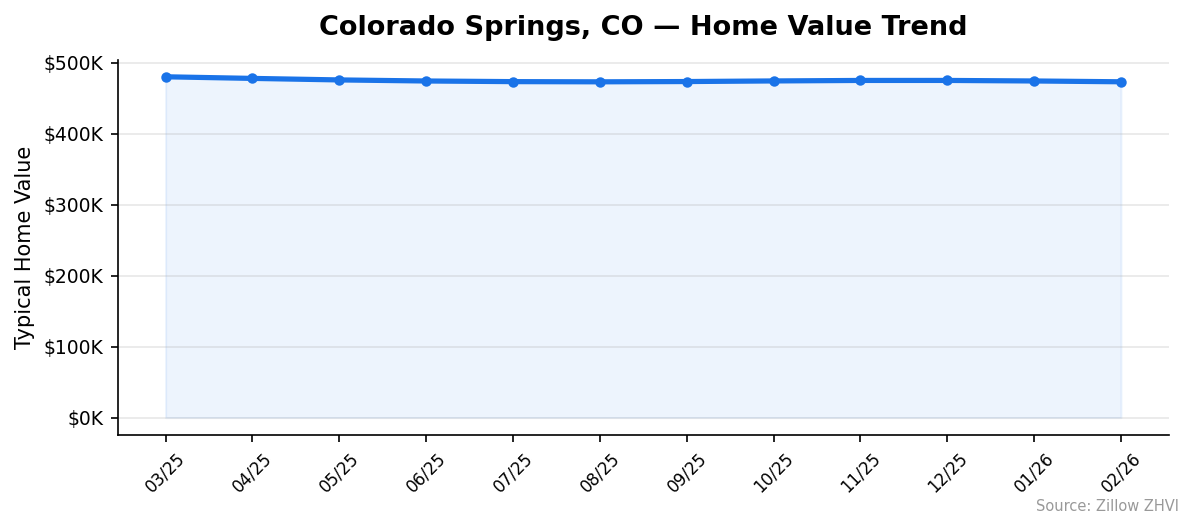
The Colorado Springs housing market has cooled. Prices peaked near $480,065 in March 2025 and have slipped about $7,000 since.
| Metric | Value |
|---|---|
| Median Home Price | $473,030 |
| Year-over-Year Change | -1.5% |
| Lowest ZIP Price | $317,546 (80910) |
| Highest ZIP Price | $711,748 (80921) |
| ZIP Codes Tracked | 22 |
| Data As Of | February 2026 |
The price spread tells a bigger story than the median alone. A $394,000 gap separates the cheapest and most expensive neighborhoods. You could buy two homes in 80910 for the price of one in 80921.
That 1.5% annual decline won’t scare anyone, but the direction matters. Prices have fallen in eight of the last twelve months. The declines are small — $1,000 to $2,000 per month — but consistent. This isn’t a crash. It’s a market slowly releasing pressure.
For buyers who sat out the 2021–2023 surge, this is the first sustained period of price relief in years. The question is whether it continues.
Colorado Springs Home Prices by Neighborhood
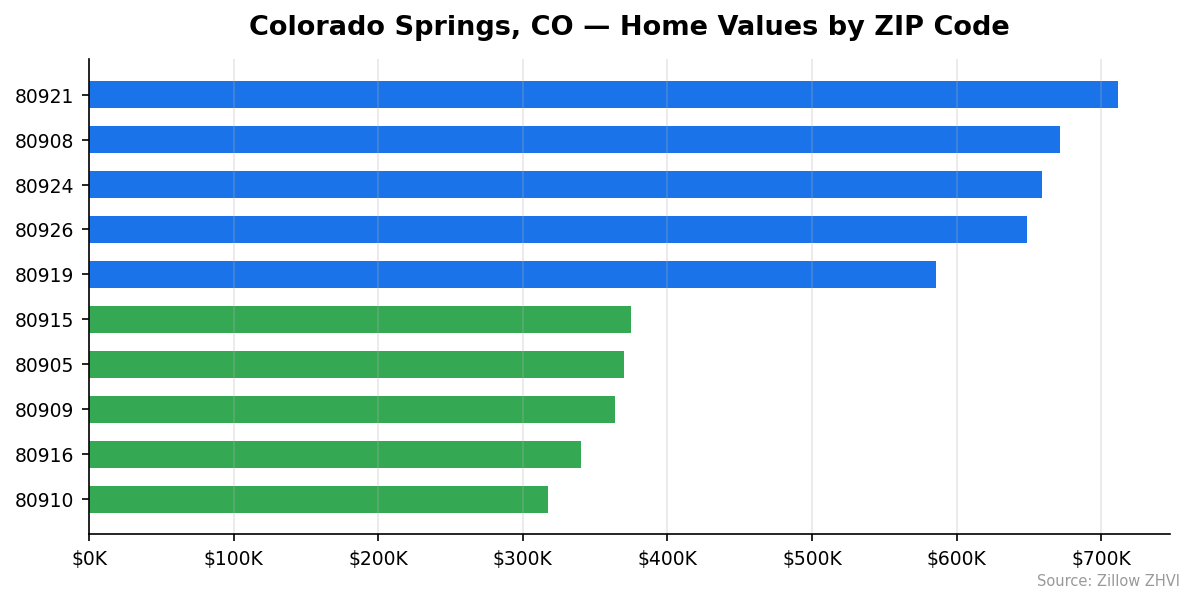
All 22 tracked ZIP codes, sorted by home value:
| ZIP Code | Median Home Price | Typical Rent |
|---|---|---|
| 80921 | $711,748 | $1,769 |
| 80908 | $671,332 | $2,140 |
| 80924 | $658,828 | $1,744 |
| 80926 | $648,856 | N/A |
| 80919 | $585,447 | $1,608 |
| 80906 | $521,264 | $1,566 |
| 80920 | $520,223 | $1,890 |
| 80927 | $502,461 | $2,027 |
| 80923 | $465,885 | $1,847 |
| 80925 | $448,216 | $2,487 |
| 80922 | $445,672 | $1,861 |
| 80904 | $436,108 | $1,456 |
| 80918 | $431,897 | $1,477 |
| 80951 | $427,517 | N/A |
| 80907 | $395,183 | $1,568 |
| 80917 | $393,662 | $1,278 |
| 80903 | $376,690 | $1,739 |
| 80915 | $374,459 | $1,707 |
| 80905 | $369,677 | $1,353 |
| 80909 | $363,819 | $1,240 |
| 80916 | $340,178 | $1,617 |
| 80910 | $317,546 | $1,415 |
Most Expensive ZIPs
80921 leads at $711,748, a full 50% above the city median — yet rents there run just $1,769, making it one of the weaker rent-to-price ratios in the city. 80908 comes in at $671,332 with the highest rents in Colorado Springs at $2,140/month. 80924 rounds out the top three at $658,828, a newer-construction area on the north side where rents sit at $1,744.
Most Affordable ZIPs
80910 is the entry point at $317,546, roughly 33% below the city median and the only ZIP under $320,000. 80916 follows at $340,178, offering relatively moderate rents at $1,617. 80909 at $363,819 has the lowest typical rent in the city at just $1,240/month, making it one of the more budget-friendly areas whether you rent or buy.
Rent vs Buy in Colorado Springs
Rent data is available for 20 of the 22 tracked ZIP codes. The numbers favor renters right now.
A mortgage on the median $473,030 home — assuming 20% down, a 7% rate, and a 30-year term — runs about $2,520/month in principal and interest alone. Add property taxes and insurance, and you’re looking at $3,000 or more.
Meanwhile, typical rents across the city range from $1,240 (80909) to $2,487 (80925). Most ZIPs fall in the $1,400–$1,900 range.
| Scenario | Monthly Cost |
|---|---|
| Mortgage (median home, 20% down, 7%) | ~$2,520 |
| Mortgage + taxes/insurance (est.) | ~$3,000+ |
| Typical rent (city range) | $1,240–$2,487 |
| Typical rent (most ZIPs) | $1,400–$1,900 |
One oddity stands out: ZIP 80925 has a median home value of $448,216 but rents of $2,487 — the highest in the city. That’s an unusually strong rent-to-price ratio compared to areas like 80921, where homes cost $711,748 but rent for just $1,769.
If you’re purely running the numbers, renting is cheaper in almost every neighborhood. The gap between a mortgage payment and rent runs $600–$1,500/month depending on the ZIP. That said, renters don’t build equity, and prices are only 1.5% off their highs.
Population Growth and Migration
Colorado Springs added nearly 12,000 residents between 2020 and 2024. The city grew 2.5% over that four-year period, reaching 493,554.
| Year | Population |
|---|---|
| 2020 | 481,713 |
| 2021 | 484,837 |
| 2022 | 488,136 |
| 2023 | 491,301 |
| 2024 | 493,554 |
Growth has been steady — about 3,000 new residents per year — without the boom-and-bust swings some Sun Belt cities experienced.
How does that compare to the rest of Colorado?
| City | 2024 Population | 4-Year Growth |
|---|---|---|
| Greeley | 114,363 | 4.6% |
| Aurora | 403,130 | 4.2% |
| Thornton | 146,689 | 3.2% |
| Colorado Springs | 493,554 | 2.5% |
| Denver | 729,019 | 1.6% |
| Centennial | 108,853 | 0.6% |
Colorado Springs is growing faster than Denver but slower than the northern Front Range cities like Greeley and Aurora. That 2.5% growth rate puts steady upward pressure on housing demand. More people means more buyers and renters competing for the same inventory — which helps explain why prices haven’t fallen faster despite the cooling trend.
Colorado Springs Housing Market Trends
Here’s how prices moved month by month over the past year:
| Month | Median Price | Change from Prior Month |
|---|---|---|
| March 2025 | $480,065 | — |
| April 2025 | $477,790 | -$2,275 |
| May 2025 | $475,643 | -$2,147 |
| June 2025 | $474,144 | -$1,499 |
| July 2025 | $473,250 | -$894 |
| August 2025 | $472,978 | -$272 |
| September 2025 | $473,369 | +$391 |
| October 2025 | $474,213 | +$844 |
| November 2025 | $474,913 | +$700 |
| December 2025 | $474,932 | +$19 |
| January 2026 | $474,166 | -$766 |
| February 2026 | $473,030 | -$1,136 |
The pattern is clear. Prices fell sharply from March through August 2025, losing about $7,000 in five months. A brief autumn bounce added back roughly $2,000 between September and November. Then the decline resumed.
February’s $1,136 drop was the steepest monthly decline since May 2025. The autumn rebound appears to have been seasonal, not structural.
Is Colorado Springs a Good Place to Buy in 2026?
The data points to a buyer-friendly market, but not a buyer’s paradise.
Prices are falling — down 1.5% year over year and trending lower since March 2025. That gives buyers more negotiating room than they’ve had since the pandemic run-up. The wide price range across ZIP codes ($317K to $712K) means there are options at multiple price points.
But the declines are modest. A 1.5% drop on a $473K home saves you roughly $7,200 — meaningful, but not the kind of discount that justifies waiting indefinitely. Population growth of 2.5% over four years keeps a floor under demand.
The rent-versus-buy math still favors renting for most buyers in the short term. If you plan to stay five or more years, buying at current prices locks in a cost that rents will eventually catch. If you’re looking at a shorter horizon, the numbers don’t yet justify the premium over renting.
Colorado Springs Housing Market Outlook for 2026-2027
The 12-month trend suggests prices will continue drifting lower through mid-2026. The March-to-August decline pattern from 2025 could repeat as the spring selling season adds inventory.
If the current pace continues — roughly $1,000–$2,000/month in declines — the median could test the $465,000–$470,000 range by summer 2026. Another seasonal bounce in fall is possible based on last year’s pattern, but the autumn 2025 recovery was weak and short-lived.
The 3-month trend from December through February shows accelerating monthly losses: -$19, then -$766, then -$1,136. That momentum points downward heading into spring.
Population growth provides a counterweight. As long as 3,000+ people move to Colorado Springs each year, demand won’t collapse. Expect a slow grind lower, not a sharp correction.
Similar Markets in CO
If you’re exploring the Colorado market beyond Colorado Springs, consider these cities:
- Aurora — growing 4.2% and just north along the Front Range, worth comparing for price differences
- Denver — the state’s largest market at 729,000 residents, though growth has slowed to 1.6%
- Centennial — a smaller suburb south of Denver with modest 0.6% growth
- Fort Collins — a college-town market in northern Colorado with a different demand profile
- Thornton — one of the faster-growing Denver suburbs at 3.2% population growth
Frequently Asked Questions
What is the average home price in Colorado Springs?
The average home price in Colorado Springs is $473,030 as of February 2026. That figure represents the Zillow Home Value Index, which measures typical home values in the 35th to 65th percentile range. Prices vary widely by ZIP code, from $317,546 in 80910 to $711,748 in 80921.
Are home prices going up or down in Colorado Springs?
Prices are going down. The median fell 1.5% year over year, dropping from roughly $480,000 in March 2025 to $473,030 in February 2026. Monthly data shows the decline accelerating in early 2026 after a brief autumn plateau.
Is it cheaper to rent or buy in Colorado Springs?
Renting is cheaper in most neighborhoods right now. A mortgage on the median home costs roughly $2,520/month before taxes and insurance, while typical rents run $1,400–$1,900. The gap is $600–$1,500/month depending on the area. ZIP 80909 has the lowest rents at $1,240/month.
What is the most affordable neighborhood in Colorado Springs?
ZIP code 80910 is the most affordable at $317,546, about 33% below the city median. Rents there average $1,415/month. Other affordable options include 80916 ($340,178) and 80909 ($363,819), all on the city’s south and east sides.
Methodology
Home values are based on the Zillow Home Value Index (ZHVI), a smoothed measure of typical home values in the 35th to 65th percentile range. Rent estimates use the Zillow Observed Rent Index (ZORI). Population figures come from the U.S. Census Bureau Population Estimates Program (2020-2024 vintage). All datasets are publicly available. Housing data updated 2026-02-28.