Oak Park Home Prices: $393K, Up 7.7% — 3 ZIPs Analyzed (2026)
$392,933. That is the typical home value in Oak Park, IL as of February 2026. Prices are up 7.7% from a year ago, and the trend has not paused once in the last 12 months of data.
Quick answer: The average home price in Oak Park, IL is $392,933 as of February 2026, up 7.7% year over year according to Zillow.
Current Home Prices in Oak Park
Oak Park sits in the Chicago-Naperville-Elgin metro and prices a typical home at $392,933. That number is the average across the village’s three tracked ZIP codes. The cheapest area runs $268,978. The most expensive runs $479,640. The spread between top and bottom is about $211,000 — a 78% gap inside a village of only a few square miles.
| Metric | Value |
|---|---|
| Median home value | $392,933 |
| Year-over-year change | +7.7% |
| Lowest ZIP value | $268,978 |
| Highest ZIP value | $479,640 |
| ZIP codes tracked | 3 |
| Data month | February 2026 |
| Metro area | Chicago-Naperville-Elgin |
A 7.7% annual gain is firm. For context, the typical home here added roughly $28,000 in value over the past 12 months. That is faster than wage growth in most fields. If you bought a year ago at the average, you are sitting on meaningful equity already.
The price floor matters too. At $268,978, the lowest-priced ZIP in Oak Park costs less than a typical home in many Chicago neighborhoods. Buyers who assumed Oak Park was out of reach should look at the actual numbers before crossing it off the list.
Oak Park Home Prices by Neighborhood
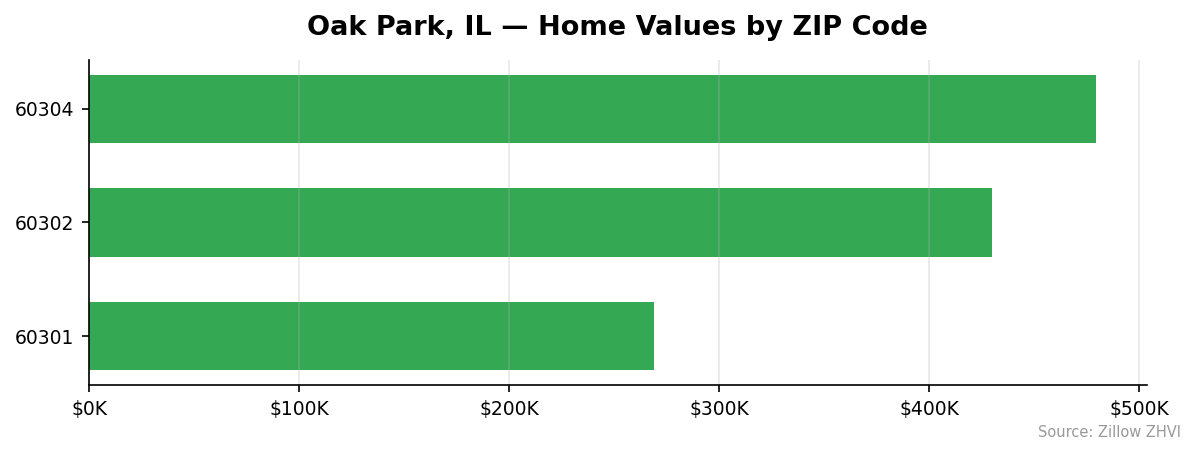
Three ZIP codes carry the village. Each tells a different story.
| ZIP | Typical Home Value | Avg Rent | Position |
|---|---|---|---|
| 60304 | $479,640 | $1,444 | Most expensive |
| 60302 | $430,180 | $1,984 | Mid-tier |
| 60301 | $268,978 | $2,245 | Most affordable |
Most Expensive
- 60304 — $479,640. The priciest ZIP in Oak Park, running about 22% above the village average. Despite the high home values, rent here is the lowest of the three at $1,444.
- 60302 — $430,180. Sits about 9% above the village average. Rent here is mid-range at $1,984.
- 60301 — $268,978. Even the most affordable ZIP is not “cheap” by national standards, but it runs 32% below the village average.
Most Affordable
- 60301 — $268,978. The clear value play. You pay less to buy here than anywhere else in Oak Park.
- 60302 — $430,180. Next up the ladder, but a $161K jump from the bottom rung.
- 60304 — $479,640. The ceiling. Buyers here are paying for something the data doesn’t quantify — likely housing stock, lot size, or proximity to specific corridors.
The rent picture flips the value equation. The cheapest ZIP to buy (60301) is the most expensive to rent ($2,245). The most expensive ZIP to buy (60304) is the cheapest to rent ($1,444). If you are renting and saving for a down payment, your money may go further in 60301 than the price tag suggests once you factor in the rent gap.
Rent vs Buy in Oak Park
Rent across the three Oak Park ZIPs averages roughly $1,891 per month. A buyer financing the $392,933 average home with 20% down at a 7% 30-year fixed rate would face a principal-and-interest payment of about $2,090 per month. Add property taxes — Cook County runs high — plus insurance and you are likely well above $3,000 monthly.
| Cost | Monthly |
|---|---|
| Average rent (3-ZIP average) | $1,891 |
| Estimated mortgage P&I (20% down, 7%) | $2,090 |
| Likely total monthly with taxes & insurance | $3,000+ |
Renting wins on cash flow. By a lot. The math gets even more renter-friendly in 60301, where a $2,245 rent buys you exposure to the cheapest sale prices in town. If you are not planning to stay five-plus years, renting is the cleaner play.
Buying makes sense if you want the 7.7% appreciation working on your balance sheet instead of your landlord’s. A year of that gain on a $393K home is roughly $28,000 — more than the rent-versus-buy gap pays out over the same period. The break-even depends entirely on whether prices keep climbing.
Oak Park Housing Market Trends
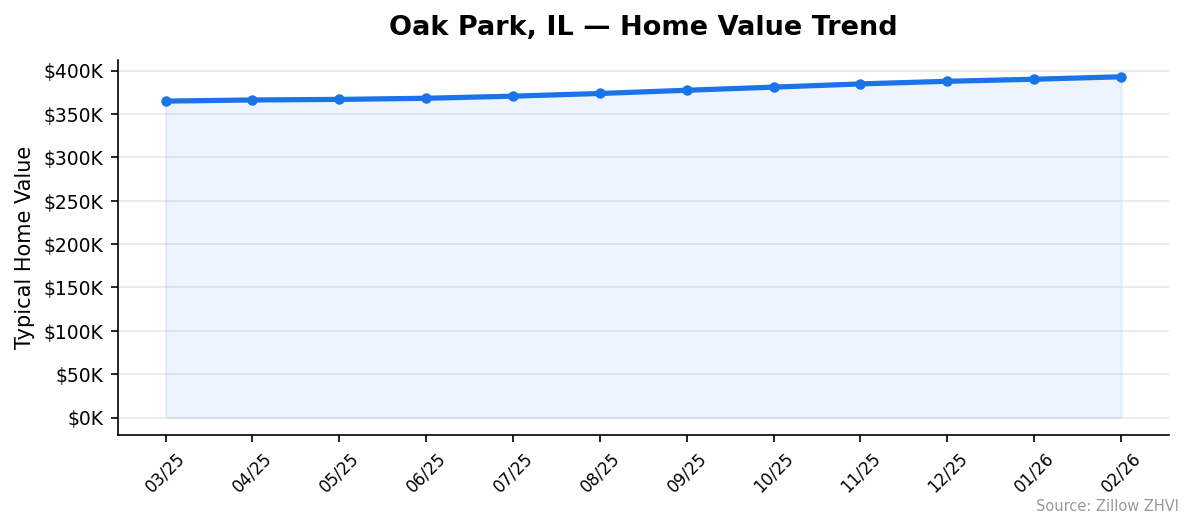
The trend is one direction: up. Every month in the 12-month series posts a higher value than the one before it.
| Month | Avg Value | Min | Max |
|---|---|---|---|
| Feb 2026 | $392,933 | $268,978 | $479,640 |
| Jan 2026 | $390,125 | $268,873 | $475,000 |
| Dec 2025 | $387,755 | $269,591 | $470,430 |
| Nov 2025 | $384,716 | $270,329 | $464,734 |
| Oct 2025 | $381,017 | $268,885 | $459,747 |
| Sep 2025 | $377,393 | $266,195 | $455,898 |
| Aug 2025 | $373,690 | $262,946 | $452,061 |
| Jul 2025 | $370,610 | $260,264 | $448,205 |
| Jun 2025 | $368,159 | $258,504 | $444,486 |
| May 2025 | $366,874 | $257,635 | $442,040 |
| Apr 2025 | $366,216 | $257,873 | $440,167 |
| Mar 2025 | $364,904 | $257,725 | $437,588 |
From March 2025 to February 2026, the average gained $28,029 — roughly $2,335 per month. The pace did not slow. February 2026 added $2,808 over January, slightly above the trailing average. There is no sign of a top in this data.
The min line tells a quieter story. The cheapest ZIP gained from $257,725 to $268,978 — about 4.4%. Slower than the village average. The max ZIP went from $437,588 to $479,640 — about 9.6%. The high end pulled away from the low end during the year.
Is Oak Park a Good Place to Buy in 2026?
The data points to a seller’s market. Twelve consecutive months of gains. A 7.7% annual move. Both the floor and ceiling rising. Buyers are not getting discounts here.
If you are buying to live in Oak Park, the question is whether you can afford the monthly cost — not whether prices will be lower next year. Nothing in the trend data suggests they will be.
If you are buying as an investment, the rent-to-price ratios are tight. At a $268,978 sale price and $2,245 rent, the gross yield is about 10% — workable. At $479,640 and $1,444 rent, the gross yield falls below 4% — tough to make work after taxes and maintenance.
For appreciation plays, Oak Park has delivered. Past performance is not a guarantee, but the 12-month consistency is unusual.
Oak Park Housing Market Outlook for 2026-2027
The 3-month trend shows monthly gains of $2,808, $2,370, and $3,039 — averaging about $2,739 per month. If the current pace continues through the spring buying season, the village average would clear $400,000 by mid-2026.
The signal in this data is steady, not accelerating. Each monthly increment falls within a narrow band. There is no sign of a sudden cooldown, and no sign of a breakaway either. The most likely 3-to-6-month outcome is more of the same: gains in the low-to-mid single thousands per month, with the high-end ZIPs continuing to pull ahead of the cheapest one.
The rate environment and broader Chicago metro conditions will shape what happens next. Within the data shown here, the trend is intact.
Similar Markets in IL
- Evanston — Another inner-ring Chicago suburb with similar appeal to Oak Park buyers.
- Naperville — Larger suburb further west, often considered alongside Oak Park by family buyers.
- Chicago — The metro’s anchor; buyers priced out of Oak Park’s mid-tier ZIPs often look at Chicago neighborhoods.
- Schaumburg — Northwest suburb that competes with Oak Park on commute and amenities.
- Aurora — A lower-priced alternative for buyers who want more square footage for the dollar.
Frequently Asked Questions
What is the average home price in Oak Park?
The average home price in Oak Park, IL is $392,933 as of February 2026. That figure is the Zillow Home Value Index average across the village’s three tracked ZIP codes. The range runs from $268,978 to $479,640.
Are home prices going up or down in Oak Park?
Prices are up 7.7% year over year. Every month in the trailing 12-month series posts a higher value than the prior month — there is no pause in the data. The typical home added roughly $28,000 in value over the past year.
Is it cheaper to rent or buy in Oak Park?
Renting is cheaper on a monthly basis. The average rent across Oak Park ZIPs is about $1,891, while a typical mortgage payment with 20% down at 7% would run around $2,090 in principal and interest alone — before Cook County property taxes and insurance push the total above $3,000.
What is the most affordable neighborhood in Oak Park?
ZIP 60301 is the most affordable at $268,978 — about 32% below the village average. Notably, it has the highest rent of the three ZIPs at $2,245, which makes it an interesting target for buyers tired of paying premium rent for entry-level prices.
Methodology
Home values are based on the Zillow Home Value Index (ZHVI), a smoothed measure of typical home values in the 35th to 65th percentile range. Rent estimates use the Zillow Observed Rent Index (ZORI). Population figures come from the U.S. Census Bureau Population Estimates Program (2020-2024 vintage). All datasets are publicly available. Housing data updated 2026-02-28.