Lansing Home Prices: $161K, Up 4.6% — 7 ZIPs Analyzed (2026)
$160,930. That is what a typical home costs in Lansing, MI, based on Zillow data through February 2026. Prices are up 4.6% from a year ago, and the city kept gaining residents through 2024.
Quick answer: The average home price in Lansing, MI is $160,930 as of February 2026, up 4.6% year over year according to Zillow.
Current Home Prices in Lansing
Lansing remains one of the cheapest state-capital housing markets in the country. The typical home sits well under $200,000, and the gap between the priciest and cheapest ZIPs is wide.
| Metric | Value |
|---|---|
| Median home value | $160,930 |
| Year-over-year change | +4.6% |
| Cheapest ZIP | $118,498 (48915) |
| Most expensive ZIP | $257,259 (48917) |
| ZIP codes tracked | 7 |
| Data through | February 2026 |
The 4.6% annual gain outpaces what a lot of larger Midwest metros logged over the same stretch. Detroit, Grand Rapids, and several other Michigan markets have been moving sideways or rising more slowly. Lansing buyers are paying about $7,000 more for the same house than they would have a year ago.
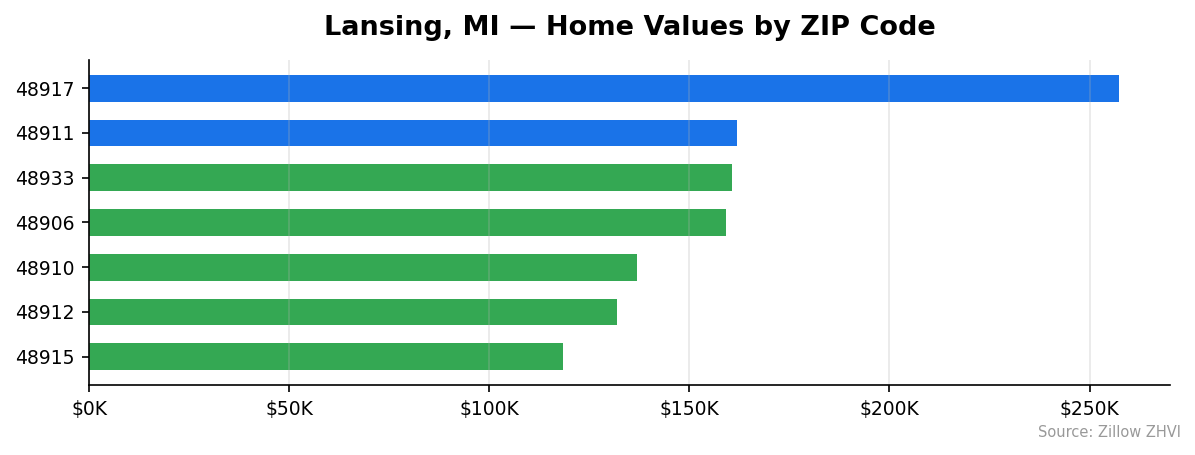
The price range tells the rest of the story. The most expensive ZIP, 48917 on the west side, runs more than double the cheapest ZIP, 48915, just west of downtown. That spread of roughly $139,000 is unusually large for a city this size and gives buyers real options at different price points.
You will not find many cities where the entry-level ZIP sits below $120,000 while a more suburban pocket clears $250,000 — both inside city limits.
Lansing Home Prices by Neighborhood
Seven Lansing ZIPs have enough Zillow data to track. Here is how they line up.
| ZIP | Typical Home Value | Median Rent (ZORI) |
|---|---|---|
| 48917 | $257,259 | $1,465 |
| 48911 | $162,016 | $1,085 |
| 48933 | $160,754 | $930 |
| 48906 | $159,161 | $1,176 |
| 48910 | $136,799 | $1,318 |
| 48912 | $132,025 | $1,361 |
| 48915 | $118,498 | — |
Most Expensive
- 48917 — $257,259. The Delta Township-adjacent west side is the priciest pocket, running about 60% above the city average and pulling the highest rents in town at $1,465.
- 48911 — $162,016. South Lansing sits just above the city median, with notably modest rents around $1,085 — a sign owners hold the area more than renters do.
- 48933 — $160,754. Downtown is right at the city average for sale prices but posts the lowest rent figure on the list at $930.
Most Affordable
- 48915 — $118,498. The cheapest ZIP in the city, about 26% below the average. Rent data is too thin to publish for this area.
- 48912 — $132,025. The east side, near the Frandor and Eastside neighborhoods, runs 18% under the city average yet posts strong rents around $1,361, suggesting a rental-heavy mix.
- 48910 — $136,799. Another south-central ZIP that comes in 15% below average, with rents close to $1,318.
Rent vs Buy in Lansing
Lansing is one of the rare U.S. markets where buying and renting cost about the same.
Across the six ZIPs with rent data, the average ZORI rent is roughly $1,222 a month. On the buy side, a $160,930 home with 20% down ($32,186) and a 30-year mortgage at 7% comes out to about $857 in principal and interest. Add property taxes and insurance — Michigan property taxes are not light — and your total monthly payment lands somewhere around $1,150 to $1,300.
| Cost | Approximate Monthly |
|---|---|
| Average rent (citywide) | $1,222 |
| Mortgage P&I on median home (20% down, 7%) | $857 |
| Estimated taxes + insurance | $300–$450 |
| Total ownership cost | $1,150–$1,300 |
Owning is roughly a wash with renting on the monthly cash side. The catch is the down payment. You need about $32,000 in cash to buy at the median, and another $5,000-plus in closing costs.
Where the math tilts: if you can come up with the down payment and plan to stay at least five years, ownership in Lansing builds equity at a similar monthly cost to renting. Renters who move often or want flexibility lose less by sticking with a lease.
The most renter-friendly ZIPs are 48933 ($930) and 48911 ($1,085). The priciest rents are in 48917 ($1,465) and 48912 ($1,361).
Population Growth and Migration
Lansing is gaining people again after a flat early-2020s stretch.
| Year | Population |
|---|---|
| 2020 | 112,555 |
| 2021 | 112,497 |
| 2022 | 112,652 |
| 2023 | 113,224 |
| 2024 | 114,336 |
The city added 1,781 residents between 2020 and 2024, a 1.6% gain. Growth was nearly flat through 2022 and then picked up sharply in 2023 and 2024. The 2024 jump alone was over 1,100 people.
Here is how Lansing stacks up against other Michigan cities tracked by the Census:
| City | 2024 Population | 4-Year Growth |
|---|---|---|
| Troy | 89,209 | +2.4% |
| Lansing | 114,336 | +1.6% |
| Detroit | 645,705 | +1.1% |
| Grand Rapids | 200,117 | +0.7% |
| Farmington Hills | 84,173 | +0.4% |
| Sterling Heights | 134,342 | +0.2% |
Lansing is growing faster than every Michigan city on this list except Troy. That has direct implications for housing. A city adding residents while building modest amounts of new housing will see steady price pressure — and you can see that already in the 4.6% annual price gain.
Lansing Housing Market Trends
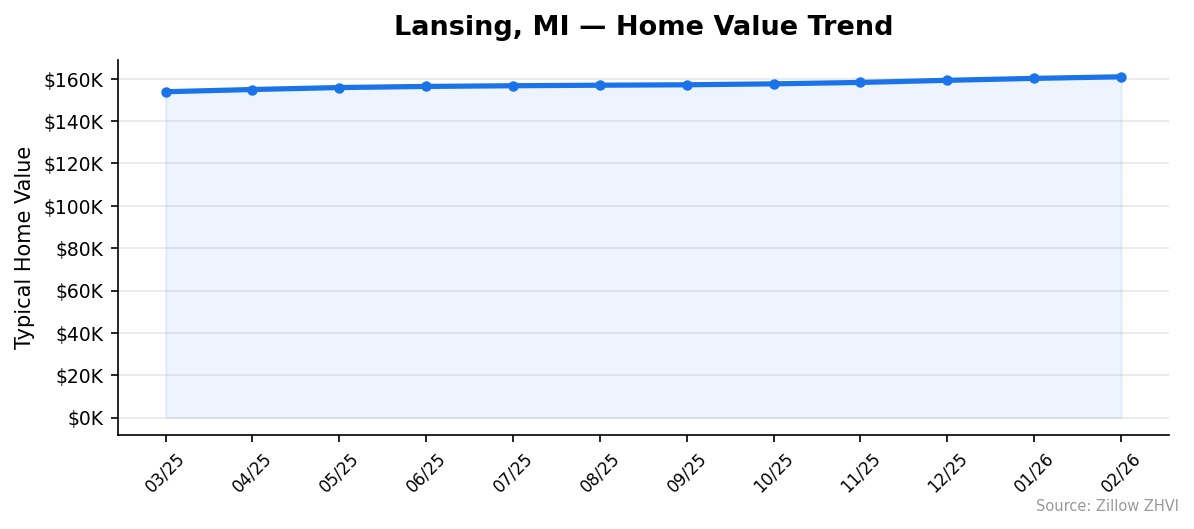
Prices have moved in one direction for a year. Up.
| Month | Median Value |
|---|---|
| March 2025 | $153,861 |
| April 2025 | $154,923 |
| May 2025 | $155,850 |
| June 2025 | $156,374 |
| July 2025 | $156,708 |
| August 2025 | $156,954 |
| September 2025 | $157,155 |
| October 2025 | $157,595 |
| November 2025 | $158,262 |
| December 2025 | $159,264 |
| January 2026 | $160,179 |
| February 2026 | $160,930 |
That is 12 straight months of monthly gains. No pauses, no dips. The pace did pick up over the last quarter — November through February added almost $2,700, compared with about $1,000 per month earlier in the year.
The cheapest ZIP, 48915, is also climbing steadily. It went from $113,477 in March 2025 to $118,498 in February 2026, a 4.4% gain that roughly tracks the citywide rate. So the affordability floor is rising too.
This is a market with consistent, mild momentum. Not a boom, but no signs of a top either.
Is Lansing a Good Place to Buy in 2026?
Lansing looks like a buyer’s market on price and a balanced market on timing.
The price case is straightforward. At $160,930, you are buying below most Michigan cities and well below national medians. The 4.6% YoY gain means waiting has a real cost — about $7,000 a year if the trend continues. Rent and ownership costs are close enough that buying is competitive for anyone with a down payment ready.
The timing case is more nuanced. Twelve straight monthly increases tell you sellers have the upper hand. There is no sign of weakness in the data. But the increases are mild — under 1% per month — so this is not a frenzied bidding-war market either.
If you want a low-cost entry into homeownership in a state-capital metro that is gaining residents, Lansing fits. The risk is the inverse: this is not a market with much price-cushion, and a buyer paying close to ZIP-average prices is not getting a deal — just a fair number.
Lansing Housing Market Outlook for 2026-2027
The 12-month trend is the cleanest signal here. Twelve straight monthly gains, no reversals, with the most recent three months running about $850-$900 per month.
If the current pace continues, the median lands somewhere near $165,000 to $168,000 by late summer 2026. The 3-month trend suggests momentum is firming up rather than fading.
Two things would change that picture: a sharp move in mortgage rates, which would slow buyer demand quickly at this price point, or a big jump in listings, which Lansing has not seen. Without one of those, the data points to continued mild upward pressure for the next 6 months.
Beyond that, the population trend matters more than monthly pricing data. A city growing 1.6% over four years and accelerating in 2024 does not produce a price drop on its own.
Similar Markets in MI
If you are looking around Michigan for context or alternatives:
- Detroit — Michigan’s largest city offers a different price tier and a slower growth profile than Lansing.
- Ann Arbor — A premium college-town market that runs well above Lansing’s median for buyers wanting a different mix.
- Grand Rapids — West Michigan’s biggest market, growing slower than Lansing but with a larger housing base.
- Kalamazoo — Another mid-sized college-anchored Michigan city worth comparing on price and rent.
- Jackson — A smaller market 40 miles south, often cheaper than Lansing on a per-home basis.
Frequently Asked Questions
What is the average home price in Lansing?
The average home price in Lansing, MI is $160,930 as of February 2026. That figure comes from the Zillow Home Value Index across 7 ZIP codes inside the city.
Are home prices going up or down in Lansing?
Prices are up 4.6% year over year. The median has climbed every month for the last 12 months, going from $153,861 in March 2025 to $160,930 in February 2026.
Is it cheaper to rent or buy in Lansing?
Average rent across the city is about $1,222 a month. A mortgage on the median $160,930 home with 20% down at 7% comes to roughly $857 in principal and interest, plus an estimated $300–$450 in taxes and insurance — putting total ownership in the $1,150–$1,300 range. Buying and renting cost about the same monthly, but buying requires roughly $32,000 in down payment cash.
What is the most affordable neighborhood in Lansing?
ZIP 48915, just west of downtown, is the cheapest at $118,498. That is about 26% below the city average and the only Lansing ZIP under $120,000.
Methodology
Home values are based on the Zillow Home Value Index (ZHVI), a smoothed measure of typical home values in the 35th to 65th percentile range. Rent estimates use the Zillow Observed Rent Index (ZORI). Population figures come from the U.S. Census Bureau Population Estimates Program (2020-2024 vintage). All datasets are publicly available. Housing data updated 2026-02-28.