Falls Church Home Prices: $745K, Down 0.5% — 5 ZIPs Analyzed (2026)
$745,271. That’s what a typical home costs in Falls Church, VA right now. Prices slipped 0.5% over the past year — a small drop, but the first sustained dip the data has shown in this corridor of the DC metro.
Quick answer: The average home price in Falls Church, VA is $745,271 as of February 2026, down 0.5% year over year according to Zillow.
Current Home Prices in Falls Church
The Falls Church market sits well above the national median, anchored by its position inside the Washington-Arlington-Alexandria metro. The typical home value covers a wide span — from the low $440Ks in the southern ZIPs to over $1M in the older village core.
| Metric | Value |
|---|---|
| Median home value | $745,271 |
| Year-over-year change | -0.5% |
| Cheapest ZIP | $441,701 (22041) |
| Most expensive ZIP | $1,037,020 (22046) |
| Price range | $441K – $1.04M |
| ZIP codes tracked | 5 |
| Data through | February 2026 |
The 0.5% drop translates to about $4,000 in lost value for a typical home. That’s a soft landing compared to what some Sun Belt metros have seen, but it ends a long stretch of upward movement that defined the 2021-2024 run.
What’s interesting is the spread. Falls Church is a small jurisdiction surrounded by Fairfax County ZIPs that the Postal Service still labels “Falls Church.” The result: a single search area that contains both starter condos at $441K and detached homes north of $1M. You’re effectively shopping five different markets under one name.
The city itself has roughly 15,000 residents, but the broader 22042-22046 ZIP area covers parts of Fairfax County with a much larger population base. That mismatch matters when reading these prices — you’re seeing a regional snapshot, not just the two-square-mile City of Falls Church.
Falls Church Home Prices by Neighborhood
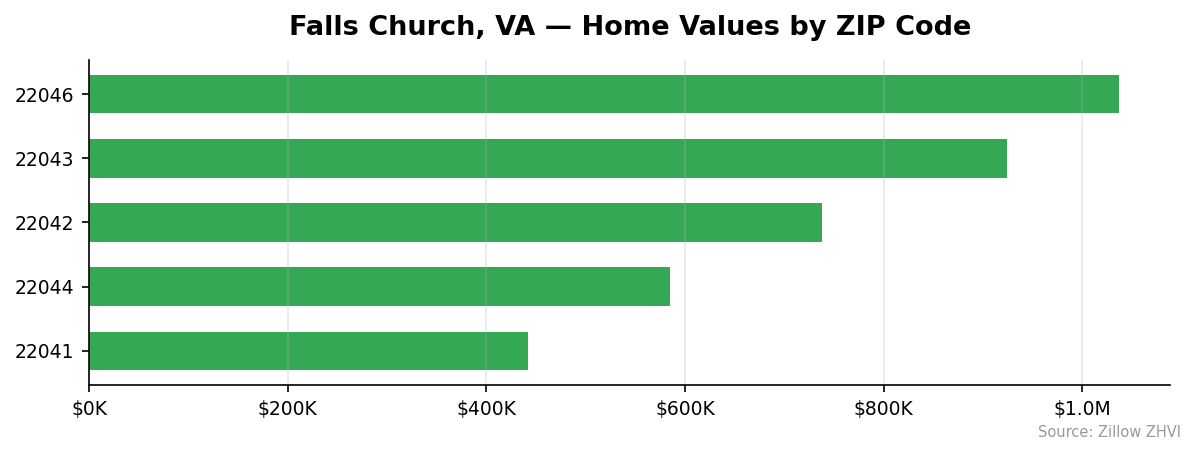
Five ZIP codes make up the Falls Church market. The price gap between the cheapest and the priciest is more than $595,000 — one of the wider spreads you’ll see in a single small-city dataset.
| ZIP Code | Median Home Price | Median Rent | vs City Avg |
|---|---|---|---|
| 22046 | $1,037,020 | $2,789 | +39% |
| 22043 | $923,909 | $2,392 | +24% |
| 22042 | $738,344 | $2,618 | -1% |
| 22044 | $585,381 | $1,900 | -21% |
| 22041 | $441,701 | $2,381 | -41% |
Most Expensive ZIPs
22046 — $1,037,020. This is the City of Falls Church proper, the small independent jurisdiction. Rents top the list at $2,789 a month, matching the home values.
22043 — $923,909. West Falls Church and Pimmit Hills. Sits 24% above the city average, but rents are surprisingly moderate at $2,392 — suggesting more owner-occupied housing than rental stock.
22042 — $738,344. Right at the city average. The mid-tier of the Falls Church footprint.
Most Affordable ZIPs
22041 — $441,701. The cheapest ZIP by a wide margin, 41% below the city average. Rents are $2,381 — only $250 less than the most expensive ZIP, which makes the buy-to-rent math here much more favorable than elsewhere in Falls Church.
22044 — $585,381. Mid-priced for the area, with the lowest rents in the city at $1,900 a month. The Seven Corners area falls within this ZIP.
22042 — $738,344. Not really “affordable” in absolute terms, but it’s the median anchor for the city.
Rent vs Buy in Falls Church
Renting wins on monthly cash flow. Here’s the math.
The average ZORI rent across Falls Church ZIPs is $2,416 a month. To buy the average $745,271 home with 20% down, you’d finance $596,217. At a 7% mortgage rate, that’s $3,966 in principal and interest — before property taxes (Virginia averages 0.75%, adding $465/month) or homeowners insurance ($200/month).
| Cost type | Monthly |
|---|---|
| Average rent (5 ZIPs) | $2,416 |
| Mortgage P&I ($596K loan, 7%) | $3,966 |
| Property tax estimate | $465 |
| Insurance estimate | $200 |
| Total to buy | ~$4,631 |
That’s a gap of roughly $2,200 a month between renting and buying. You’d need to factor in the equity you build, mortgage interest deduction, and long-term appreciation to make buying pencil out — and with prices flat-to-down, near-term appreciation isn’t doing the heavy lifting it did three years ago.
The exception is ZIP 22041. At $441,701 and rents of $2,381, the buy-vs-rent gap narrows to about $850 a month. If you’re committed to staying put for 7+ years, that’s where the numbers work hardest.
Population Growth and Migration
Falls Church added 357 residents between 2020 and 2024 — a 2.4% gain. Steady, not explosive.
| Year | Population |
|---|---|
| 2020 | 14,677 |
| 2021 | 14,515 |
| 2022 | 14,518 |
| 2023 | 14,805 |
| 2024 | 15,034 |
The city actually lost population in 2021 and stayed flat in 2022 — a pandemic-era pattern visible across many DC-area jurisdictions. Growth resumed in 2023 and accelerated into 2024, adding 229 residents in a single year.
How does that compare to other Virginia cities?
| City | 2024 Population | 4-yr Growth |
|---|---|---|
| Suffolk | 103,105 | +8.8% |
| Richmond | 233,655 | +3.0% |
| Falls Church | 15,034 | +2.4% |
| Chesapeake | 254,997 | +2.1% |
| Hampton | 137,596 | +0.2% |
| Alexandria | 159,102 | -0.0% |
Falls Church is growing faster than its larger neighbor Alexandria, which has plateaued. It’s behind Suffolk and Richmond in growth rate, but those cities had more room to expand. For a 2-square-mile jurisdiction that’s already built out, 2.4% growth means continued pressure on the housing supply — even as prices have softened.
Falls Church Housing Market Trends
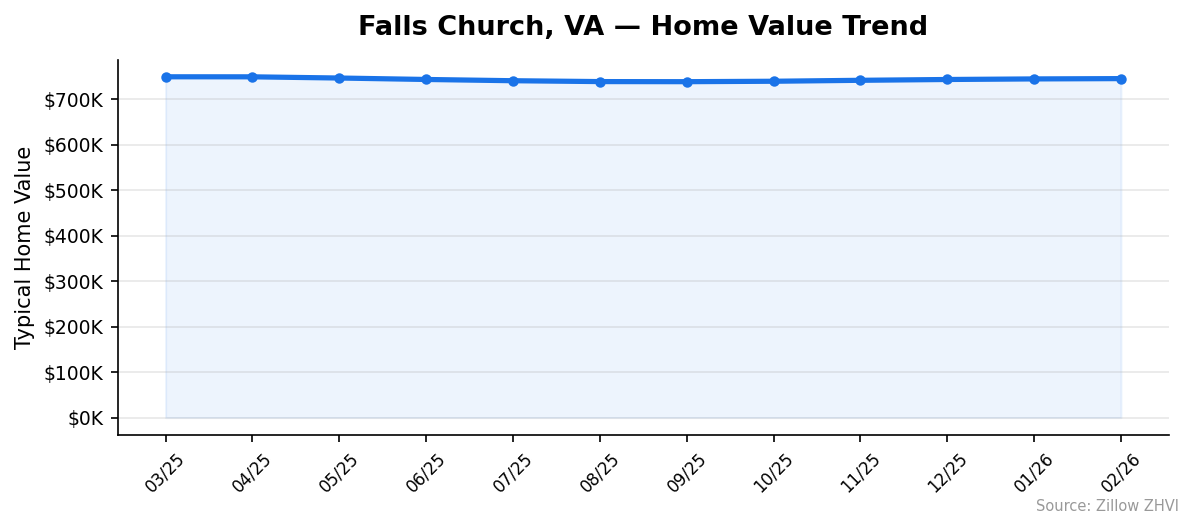
Twelve months of monthly Zillow data tell a story of a peak, a slide, and a tentative bottom.
| Month | Median Value |
|---|---|
| Mar 2025 | $749,277 |
| Apr 2025 | $749,197 |
| May 2025 | $746,557 |
| Jun 2025 | $743,386 |
| Jul 2025 | $740,622 |
| Aug 2025 | $738,728 |
| Sep 2025 | $738,522 |
| Oct 2025 | $739,457 |
| Nov 2025 | $741,552 |
| Dec 2025 | $743,332 |
| Jan 2026 | $744,595 |
| Feb 2026 | $745,271 |
Prices peaked in March-April 2025 around $749K, fell for six straight months to a September low of $738,522, and have climbed every month since. The current $745,271 is $6,750 above the September trough.
That recovery pattern — five consecutive monthly gains — is the most informative line in the data. The annual figure says “down 0.5%,” but the recent direction is up. If you’re trying to time the market, the bottom looks like it formed in late summer 2025.
Is Falls Church a Good Place to Buy in 2026?
The market is balanced — leaning slightly toward buyers, but the window is closing.
Here’s why. Year-over-year prices are still negative, which gives buyers room to negotiate. Inventory in the DC metro has loosened from the 2021-2022 peak, and sellers no longer get 20 offers in 48 hours. That’s the buyer’s case.
The seller’s case: prices have risen for five months straight, the population is growing, and the rent-to-price ratio in the cheaper ZIPs (especially 22041) is attractive enough that investor demand could pick up. If mortgage rates ease at all in 2026, the recent uptrend would likely steepen.
For owner-occupiers, the cheapest ZIPs offer the best entry point. ZIP 22041 at $441,701 is reachable on a household income around $130,000 — well below what’s needed for the $1M-plus homes in 22046. For investors, the same ZIP throws off a 6.5% gross rent yield, which is rare in a market this close to DC.
Falls Church Housing Market Outlook for 2026-2027
The 3-month trend points modestly up. From November to February, the median rose $3,719 — about 0.5% in three months, or roughly a 2% annualized pace.
If the current pace continues, Falls Church would re-test its early-2025 peak of $749,277 by mid-2026. Whether it breaks through depends on rates and supply, neither of which is in this dataset.
The data does show one thing clearly: the bottom appears to be in. Five consecutive monthly gains after a six-month slide is a reversal pattern, not noise. Buyers waiting for further drops should weigh that against the carrying cost of waiting — every month of $2,400 rent is money you don’t get back, and a 1-2% price gain over the next year would erase any negotiating room today’s flat market provides.
The one risk to this outlook is rate volatility. If mortgage rates climb back above 7.5%, affordability compression could pull prices flat or slightly negative again.
Similar Markets in VA
- Arlington — Falls Church’s closest comparable, with similar DC-metro pricing and inside-the-Beltway access.
- Fairfax — A larger jurisdiction surrounding Falls Church, often a step down in price for a step up in lot size.
- Woodbridge — Buyers priced out of Falls Church frequently land here, trading proximity for affordability.
- Fredericksburg — A longer commute, but materially cheaper than the inner DC suburbs.
- Virginia Beach — A different market entirely, but useful as a Virginia-wide price benchmark.
Frequently Asked Questions
What is the average home price in Falls Church?
The average home price in Falls Church, VA is $745,271 as of February 2026. That figure averages five ZIP codes that range from $441,701 in 22041 to $1,037,020 in 22046.
Are home prices going up or down in Falls Church?
Year over year, prices are down 0.5% — about $4,000 below the February 2025 level. But the short-term trend has flipped: prices have risen for five consecutive months since the September 2025 low of $738,522.
Is it cheaper to rent or buy in Falls Church?
Renting is cheaper. Average rent runs $2,416 a month across Falls Church ZIPs, while buying the average $745K home costs roughly $4,600 a month after taxes and insurance — a gap of about $2,200. ZIP 22041 narrows that gap considerably for buyers willing to look at the cheaper end of the market.
What is the most affordable neighborhood in Falls Church?
ZIP 22041 at $441,701 is the cheapest, sitting 41% below the city average. It’s also the only ZIP where rent yields are favorable enough to make investor math work, with $2,381 monthly rents on a sub-$450K purchase price.
Methodology
Home values are based on the Zillow Home Value Index (ZHVI), a smoothed measure of typical home values in the 35th to 65th percentile range. Rent estimates use the Zillow Observed Rent Index (ZORI). Population figures come from the U.S. Census Bureau Population Estimates Program (2020-2024 vintage). All datasets are publicly available. Housing data updated 2026-02-28.