Midland Home Prices: $318K, Up 1.8% — 5 ZIPs Analyzed (2026)
$318,414. That is what a typical home in Midland, TX is worth as of February 2026. Prices are up 1.8% over the past year, and the climb has been steady for six straight months.
Quick answer: The average home price in Midland, TX is $318,414 as of February 2026, up 1.8% year over year according to Zillow.
Current Home Prices in Midland
The Midland market is moving in one direction — up. Slowly. The 1.8% annual gain trails the kind of double-digit appreciation Texas saw earlier in the decade, but it puts the city back in positive territory.
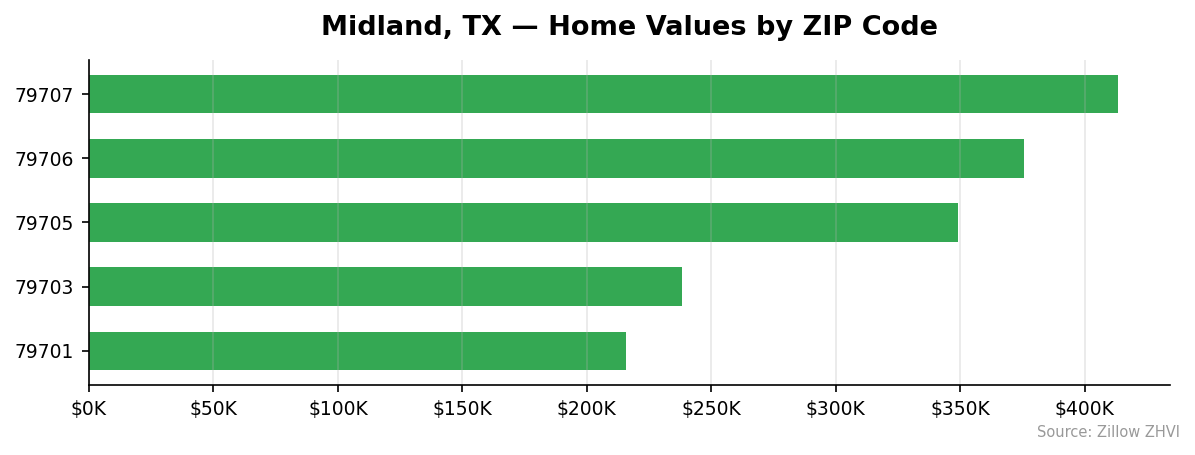
Five ZIP codes make up the analysis. The cheapest typical home sits at $215,746. The priciest area touches $413,445. That is a $197,699 gap between Midland’s most affordable and most expensive neighborhoods — a wide spread for a city this size.
| Metric | Value |
|---|---|
| Median home value | $318,414 |
| Year-over-year change | +1.8% |
| Most expensive ZIP | $413,445 (79707) |
| Most affordable ZIP | $215,746 (79701) |
| ZIP codes analyzed | 5 |
| Data through | February 2026 |
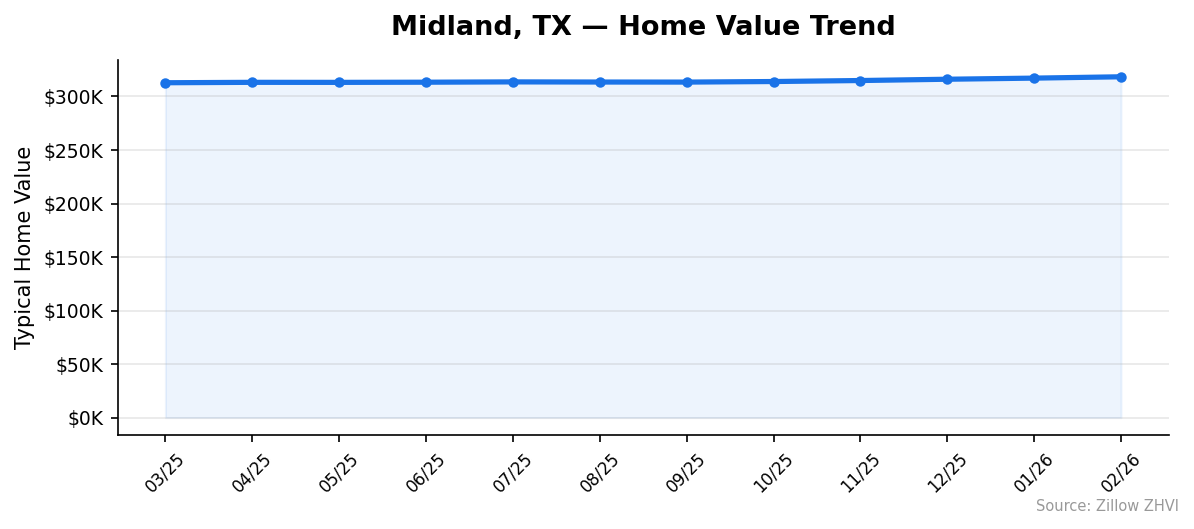
The data shows a market that has stopped sliding and started edging higher. From March 2025 to February 2026, the typical home gained $5,562 in value. Modest growth — but consistent. The monthly numbers do not show the seesaw pattern you see in choppier markets. Each month since August 2025 has posted a higher reading than the one before it.
For buyers, that means waiting for a dip is a losing strategy right now. For sellers, it means you can list with confidence that the market is on your side, but you should not expect bidding wars.
Midland Home Prices by Neighborhood
Five ZIP codes tell the story. The split between the west-side neighborhoods and the older central areas is sharp.
| ZIP Code | Typical Home Value | Avg Monthly Rent |
|---|---|---|
| 79707 | $413,445 | $1,517 |
| 79706 | $375,569 | $1,951 |
| 79705 | $349,010 | $1,610 |
| 79703 | $238,301 | $1,467 |
| 79701 | $215,746 | $1,674 |
Most Expensive
79707 tops the list at $413,445 — about 30% above the city median. Rents here are actually the second-lowest in town at $1,517, suggesting it is a buy-to-own area rather than an investor pocket.
79706 comes in second at $375,569 with the highest rent in the city at $1,951. That gives it the strongest rent-to-price ratio of any Midland ZIP.
79705 holds the third spot at $349,010, sitting roughly 10% above the city average.
Most Affordable
79701 is the cheapest place to buy at $215,746 — 32% below the city average — but rent here runs $1,674, higher than three of the more expensive ZIPs.
79703 is the second-cheapest at $238,301, paired with the lowest rent in the city at $1,467.
That mismatch between price and rent in 79701 is unusual. You can buy a house there for $200K less than in 79707, but you will pay more rent. That is a setup that often signals strong rental demand from oilfield workers and short-term residents.
Rent vs Buy in Midland
Rent is winning right now. The math is straightforward.
The average rent across Midland’s five ZIPs is $1,644 per month. A typical home at $318,414 — assuming 20% down ($63,683) at a 7% mortgage rate — produces a principal-and-interest payment of about $1,694 per month. Add property taxes (Texas runs around 1.8%) and insurance, and the all-in monthly cost climbs closer to $2,100 to $2,200.
| Scenario | Monthly Cost |
|---|---|
| Rent (city average) | ~$1,644 |
| Mortgage P&I only (20% down, 7%) | ~$1,694 |
| Mortgage + taxes + insurance | ~$2,100–$2,200 |
That is a $450 to $550 monthly gap in favor of renting. Over a year, you save roughly $5,400 to $6,600 by renting. Plus you avoid the $63,683 down payment and the maintenance bill that comes with ownership.
The argument for buying still works if you plan to stay five-plus years and believe Midland’s price trend will continue. The 1.8% annual gain on a $318K home is about $5,700 in equity per year — enough to roughly cancel out the rent-vs-buy gap if appreciation holds.
If you are oilfield workforce or expect to leave within two years, rent. The transaction costs of buying and selling will eat any short-term gain.
Population Growth and Migration
Midland is gaining people. The Census Bureau pegs the 2024 population at 143,687, up from 133,245 in 2020 — a 7.8% gain in four years.
| Year | Population |
|---|---|
| 2020 | 133,245 |
| 2021 | 131,918 |
| 2022 | 135,099 |
| 2023 | 139,488 |
| 2024 | 143,687 |
There was a dip in 2021 — the pandemic year hit oil-economy cities hard — but growth has accelerated every year since. Midland added 4,199 residents in 2024 alone.
How does that stack up against other Texas cities?
| City | 2024 Population | 4-Year Growth |
|---|---|---|
| Fort Worth | 1,008,106 | +9.1% |
| Midland | 143,687 | +7.8% |
| San Antonio | 1,526,656 | +6.1% |
| Lubbock | 272,086 | +5.4% |
| Houston | 2,390,125 | +4.0% |
| Austin | 993,588 | +2.9% |
| Midland | 143,687 | +7.8% |
Midland is growing faster than San Antonio, Lubbock, Houston, and Austin. Only Fort Worth is outpacing it among the comparison cities. For a small-metro economy tied heavily to one industry, that is a strong signal — and it helps explain why home prices have flipped from flat to rising.
More residents need more housing. With construction always lagging demand, that puts a floor under prices.
Midland Housing Market Trends
Twelve months of data, one direction.
| Month | Typical Home Value |
|---|---|
| Feb 2026 | $318,414 |
| Jan 2026 | $317,168 |
| Dec 2025 | $316,128 |
| Nov 2025 | $314,919 |
| Oct 2025 | $313,988 |
| Sep 2025 | $313,455 |
| Aug 2025 | $313,510 |
| Jul 2025 | $313,645 |
| Jun 2025 | $313,352 |
| May 2025 | $313,197 |
| Apr 2025 | $313,235 |
| Mar 2025 | $312,852 |
You can see two phases. From March through September 2025, Midland was essentially flat — values bounced in a tight $313K range with no real direction. Then something shifted in October. The market has gained value every single month since, adding $4,495 in five months.
That is a 1.4% gain over five months, or roughly 3.4% on an annualized basis. The recent pace is running faster than the trailing twelve-month figure of 1.8%. Momentum, in other words, is building — not fading.
Is Midland a Good Place to Buy in 2026?
Buyer’s market — but barely.
The case for buying: prices are still climbing month after month. Population growth is outpacing most Texas peers. The cheapest ZIP code lets you get into the market for under $220K, which is rare in a state where most major cities have priced out the under-$250K tier entirely.
The case against: rent is meaningfully cheaper than buying right now. Mortgage rates near 7% mean the all-in monthly cost is roughly 30% above what you would pay to rent a similar home. And Midland’s economy still rises and falls with oil prices — a sustained downturn in crude would hit local employment fast, the way it did during the 2020 dip.
If you have stable Permian Basin income and plan to stay at least five years, the numbers favor buying — especially in 79701 or 79703, where the entry price keeps your monthly payment below the citywide rent average. If you are mobile or unsure of your timeline, rent.
Midland Housing Market Outlook for 2026-2027
The 3-month trend points up. From November 2025 to February 2026, the typical home gained $3,495 — a 1.1% jump over a quarter.
If the current pace continues through the rest of 2026, Midland would see annual price gains in the 3% to 4% range — meaningfully above the 1.8% trailing figure. That assumes oil prices hold steady and population growth keeps adding 4,000-plus residents per year.
The risk to that outlook is mortgage rates. If 30-year rates climb back above 7.5%, the rent-vs-buy gap widens further and demand likely cools. The other risk is the Permian Basin itself — Midland’s housing market follows oil employment with a 6-to-9-month lag.
For now, the data points to slow, steady appreciation rather than a boom or bust.
Similar Markets in TX
If you are weighing Midland against other Texas cities, a few comparisons make sense:
- Houston — The biggest Texas market, with more inventory and neighborhood variety than Midland.
- San Antonio — A larger metro with a more diversified economy than oil-dependent Midland.
- El Paso — Often cheaper than Midland for buyers prioritizing entry price.
- Dallas — A bigger-city alternative for buyers willing to trade Midland’s small-metro feel for more job options.
- Sugar Land — A suburban Houston market for buyers who want the Houston-area economy with a quieter setting.
Frequently Asked Questions
What is the average home price in Midland?
The typical home in Midland, TX is worth $318,414 as of February 2026. That figure is the Zillow Home Value Index across the city’s five ZIP codes, which range from $215,746 in 79701 to $413,445 in 79707.
Are home prices going up or down in Midland?
Up. Year-over-year, values are 1.8% higher than February 2025. The trend has accelerated recently — Midland has posted six straight months of price gains, adding $4,495 to the typical home value since September 2025.
Is it cheaper to rent or buy in Midland?
Renting is cheaper by about $450 to $550 per month. Average rent across the city is $1,644, while a mortgage on a median-priced home with 20% down runs roughly $2,100 once you add taxes and insurance. Buying makes sense only if you plan to stay long enough for appreciation to offset the gap.
What is the most affordable neighborhood in Midland?
ZIP 79701 is the cheapest at $215,746 — about 32% below the city average. Notably, rents in 79701 are not the cheapest in town, suggesting steady rental demand that could support property values for investors.
Methodology
Home values are based on the Zillow Home Value Index (ZHVI), a smoothed measure of typical home values in the 35th to 65th percentile range. Rent estimates use the Zillow Observed Rent Index (ZORI). Population figures come from the U.S. Census Bureau Population Estimates Program (2020-2024 vintage). All datasets are publicly available. Housing data updated 2026-02-28.