Grand Prairie Home Prices: $330K, Down 2.5% — 4 ZIPs Analyzed (2026)
$330,137. That’s what a typical home costs in Grand Prairie right now — and it’s less than it was a year ago. Prices have slipped 2.5% year over year, part of a steady downward drift that started in spring 2025. For buyers watching the Dallas-Fort Worth market, Grand Prairie is one of the more affordable entry points.
Quick answer: The average home price in Grand Prairie, TX is $330,137 as of February 2026, down 2.5% year over year according to Zillow.
Current Home Prices in Grand Prairie
Here’s where the market stands:
| Metric | Value |
|---|---|
| Median Home Value | $330,137 |
| Year-over-Year Change | -2.5% |
| Lowest ZIP Code Value | $243,293 |
| Highest ZIP Code Value | $484,616 |
| Number of ZIP Codes | 4 |
| Data as of | February 2026 |
That 2.5% annual drop works out to roughly $8,400 in lost value on the median home. Not a crash, but a clear signal that sellers no longer have the upper hand.
The spread between the cheapest and most expensive ZIP codes is $241,323. That’s a wide gap for a city of this size — you can find a starter home or a move-up property without leaving city limits.
Grand Prairie sits in the Dallas-Fort Worth-Arlington metro, where prices vary enormously by suburb. At $330K, Grand Prairie undercuts many neighboring cities while still offering DFW metro access.
Grand Prairie Home Prices by Neighborhood
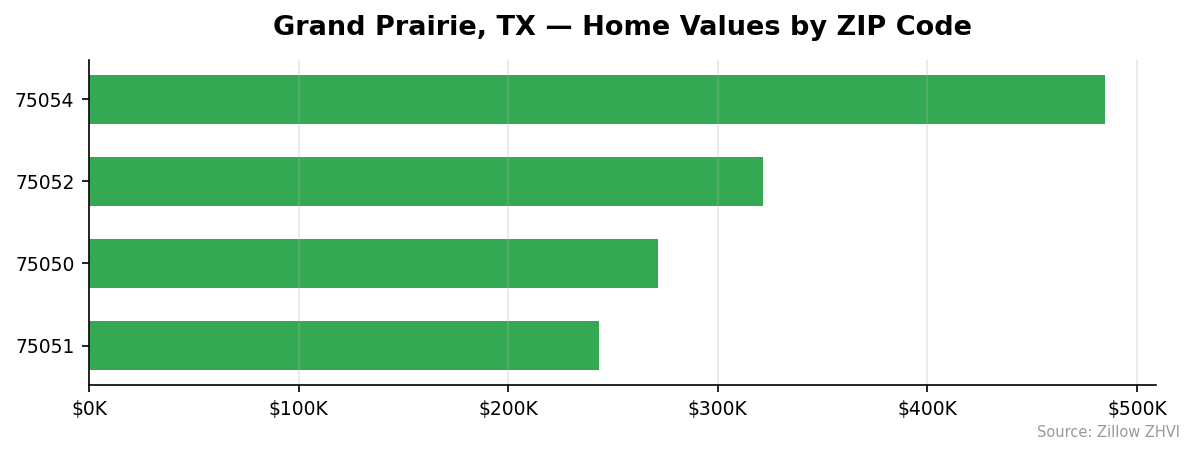
Four ZIP codes cover Grand Prairie. The price differences between them are significant.
| ZIP Code | Median Home Value | Median Rent |
|---|---|---|
| 75054 | $484,616 | $1,889/mo |
| 75052 | $321,349 | $1,647/mo |
| 75050 | $271,289 | $1,426/mo |
| 75051 | $243,293 | $1,486/mo |
Most Expensive
75054 tops the list at $484,616 — nearly 47% above the city median. Rents here are the highest in Grand Prairie at $1,889/month, reflecting newer housing stock and higher demand.
Most Affordable
75051 is the budget entry point at $243,293, roughly 26% below the city average. Rent here runs $1,486/month. 75050 follows at $271,289 with the lowest rents in the city at $1,426/month. Both ZIPs offer home prices well under $300K, which is increasingly rare in the DFW metro.
Rent vs Buy in Grand Prairie
Renting is cheaper than buying in most of Grand Prairie right now. Here’s the math.
The average rent across all four ZIP codes is approximately $1,612/month. A mortgage on the median-priced $330,137 home — assuming 20% down, a 7% rate on a 30-year fixed loan — comes to about $1,757/month in principal and interest alone. Add property taxes and insurance, and the monthly cost of owning pushes well past $2,000.
| ZIP Code | Monthly Rent | Est. Mortgage (P&I) |
|---|---|---|
| 75054 | $1,889 | $2,578 |
| 75052 | $1,647 | $1,710 |
| 75050 | $1,426 | $1,444 |
| 75051 | $1,486 | $1,295 |
75051 is the only ZIP where the raw mortgage payment comes in below rent. But that estimate doesn’t include property taxes — Texas has no state income tax, so property tax rates run high.
If you’re buying, you’re paying a premium for equity. If you’re renting, you keep more cash monthly but build nothing long-term. Your timeline matters more than the monthly number.
Population Growth and Migration
Grand Prairie is getting bigger. The city’s population hit 207,331 in 2024, up 5.7% from 196,201 in 2020.
| Year | Population |
|---|---|
| 2020 | 196,201 |
| 2021 | 197,313 |
| 2022 | 202,220 |
| 2023 | 204,067 |
| 2024 | 207,331 |
Growth accelerated between 2021 and 2022, when the city added nearly 5,000 residents in a single year. The pace has stayed steady since.
How does Grand Prairie compare to other Texas cities?
| City | 2024 Population | 4-Year Growth |
|---|---|---|
| Fort Worth | 1,008,106 | 9.1% |
| San Antonio | 1,526,656 | 6.1% |
| Grand Prairie | 207,331 | 5.7% |
| Lubbock | 272,086 | 5.4% |
| Houston | 2,390,125 | 4.0% |
| Austin | 993,588 | 2.9% |
Grand Prairie’s 5.7% growth rate outpaces Houston and Austin. More people means more housing demand — yet prices are still falling. That tension suggests the market may be absorbing new supply faster than demand can keep up, or that affordability pressures are capping what buyers will pay.
Grand Prairie Housing Market Trends
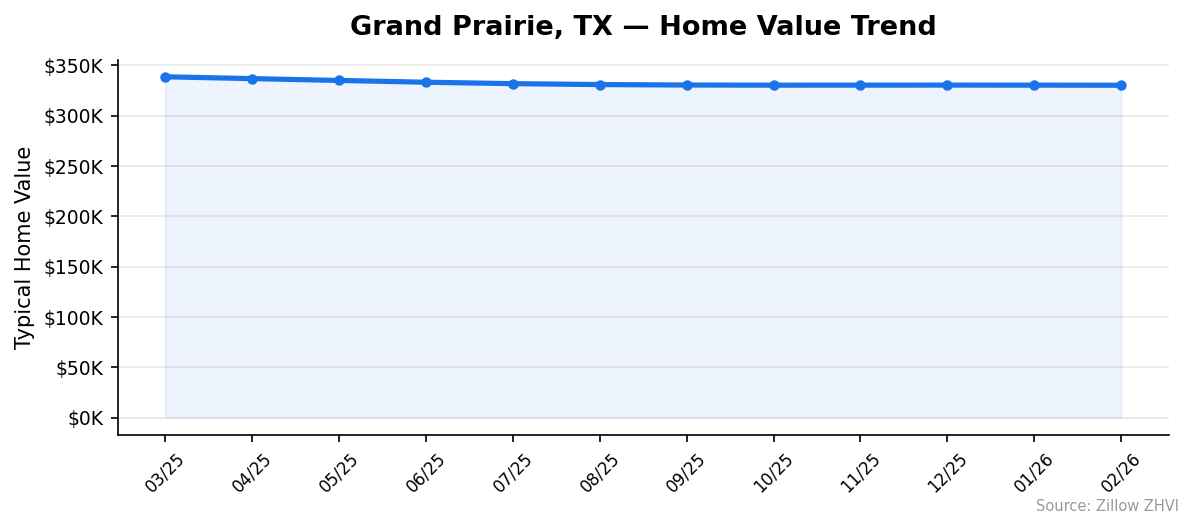
Here’s the month-by-month picture over the past year:
| Month | Average Value | Low | High |
|---|---|---|---|
| Mar 2025 | $338,544 | $252,328 | $490,833 |
| Apr 2025 | $336,720 | $250,321 | $489,559 |
| May 2025 | $334,907 | $248,273 | $488,582 |
| Jun 2025 | $333,134 | $246,425 | $486,976 |
| Jul 2025 | $331,729 | $245,350 | $484,907 |
| Aug 2025 | $330,814 | $244,774 | $483,237 |
| Sep 2025 | $330,365 | $244,548 | $482,593 |
| Oct 2025 | $330,217 | $244,201 | $483,149 |
| Nov 2025 | $330,244 | $243,932 | $484,060 |
| Dec 2025 | $330,301 | $243,496 | $485,015 |
| Jan 2026 | $330,255 | $243,425 | $485,012 |
| Feb 2026 | $330,137 | $243,293 | $484,616 |
The decline was steepest from March to August 2025, when the median dropped about $7,700. Since September, the market has flattened — values are barely moving month to month. The last six months show a total decline of just $228, essentially a plateau.
Both the floor and ceiling have compressed slightly. The cheapest ZIP lost about $9,000 over the year, while the most expensive ZIP dropped about $6,200.
Is Grand Prairie a Good Place to Buy in 2026?
The numbers favor buyers right now. Prices are down, the decline has slowed nearly to a stop, and the gap between renting and owning is narrow in several ZIP codes.
Grand Prairie offers something rare in DFW: a median under $335K in a metro where many suburbs have pushed past $400K. The city is growing, which supports long-term demand.
If you’re looking in the $240K-$320K range, ZIPs 75050, 75051, and 75052 all qualify. If you want more house and can stretch to $485K, 75054 is the premium option.
The risk? Prices haven’t bottomed out with certainty. The last six months show stabilization, not recovery. But you’re not catching a falling knife — this is more of a slow coast than a drop.
Grand Prairie Housing Market Outlook for 2026-2027
The 12-month trend shows two distinct phases: a clear decline from March through August 2025, followed by six months of near-flat movement. The market appears to have found a floor around $330K.
If the current pace continues, expect Grand Prairie home values to hover in the $328K-$332K range through mid-2026. There’s no momentum pointing toward a sharp rebound or a deeper slide.
The spring buying season could push prices slightly upward — seasonal demand tends to do that. But the year-over-year number is still negative, so any gains would likely be modest.
Watch mortgage rates. If rates drop below 6.5%, buyer demand could return fast in an affordable market like Grand Prairie. If rates hold at 7% or above, the plateau likely continues.
Similar Markets in TX
If you’re shopping in Texas, these cities offer useful comparisons:
- Dallas — The big neighbor. Higher prices but more inventory and job density.
- Fort Worth — Western DFW anchor with strong population growth of 9.1%.
- Katy — Houston suburb popular with families, similar mid-market positioning.
- Spring — Another Houston-area option for buyers priced out of the core metro.
- El Paso — Far West Texas, significantly lower price points for buyers willing to relocate.
Frequently Asked Questions
What is the average home price in Grand Prairie?
The average home price in Grand Prairie is $330,137 as of February 2026. Prices range from $243,293 in ZIP code 75051 to $484,616 in 75054. The city-wide median sits well below many other Dallas-Fort Worth suburbs.
Are home prices going up or down in Grand Prairie?
Prices are down 2.5% compared to a year ago. The decline was sharpest in spring and summer 2025, but the market has flattened since September. Monthly changes are now measured in the hundreds of dollars, not thousands.
Is it cheaper to rent or buy in Grand Prairie?
Renting is cheaper in most ZIP codes. The average rent across Grand Prairie is roughly $1,612/month, while a mortgage on the median home runs about $1,757/month before taxes and insurance. ZIP 75051 is the exception — the mortgage payment there is lower than the local rent.
What is the most affordable neighborhood in Grand Prairie?
ZIP code 75051 has the lowest home values at $243,293, about 26% below the city median. Rent in 75051 is $1,486/month. The next most affordable area is 75050 at $271,289.
Methodology
Home values are based on the Zillow Home Value Index (ZHVI), a smoothed measure of typical home values in the 35th to 65th percentile range. Rent estimates use the Zillow Observed Rent Index (ZORI). Population figures come from the U.S. Census Bureau Population Estimates Program (2020-2024 vintage). All datasets are publicly available. Housing data updated 2026-02-28.