Melbourne Home Prices: $374K, Down 3.4% — 5 ZIPs Analyzed (2026)
$373,935. That is what a typical Melbourne home is worth as of February 2026, and the number has been shrinking for nearly a year. Prices are down 3.4% from a year earlier, with the steepest cuts hitting the lower end of the market.
Quick answer: The average home price in Melbourne, FL is $373,935 as of February 2026, down 3.4% year over year.
Current Home Prices in Melbourne
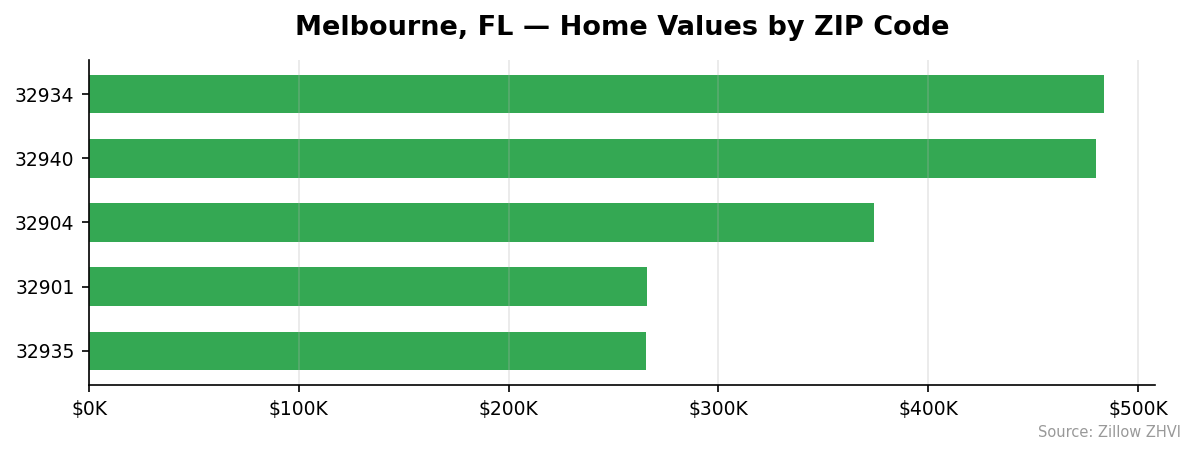
Melbourne sits in the Palm Bay-Melbourne-Titusville metro on Florida’s Space Coast. The city’s 5 tracked ZIP codes span a wide price range — the most expensive area is worth 82% more than the cheapest.
| Metric | Value |
|---|---|
| Median home value | $373,935 |
| Year-over-year change | -3.4% |
| Cheapest ZIP | $265,289 (32935) |
| Most expensive ZIP | $484,057 (32934) |
| Price spread | $218,768 |
| ZIP codes tracked | 5 |
| Data through | February 2026 |
The $374K median puts Melbourne below Florida’s big metros. Tampa and Orlando run in the high $300Ks to low $400Ks. Miami is much higher. Homestead and Jacksonville land closer to Melbourne.
What stands out is how tight the middle of Melbourne’s market is. The median ZIP, 32904, sits at $374,396 — almost exactly the citywide average. Everything else splits cleanly into a cheap half and an expensive half, with very little in between. If you want a house in the $300K to $400K band, your options are thin.
The 3.4% drop wiped roughly $13,000 off the typical Melbourne home over the past year. That is real money, but it’s a correction, not a crash. Values are still well above where they sat before the 2021-2022 run-up.
Melbourne Home Prices by Neighborhood
| ZIP | Median Value | Avg Rent (ZORI) | vs City Avg |
|---|---|---|---|
| 32934 | $484,057 | $1,702 | +29% |
| 32940 | $479,955 | $2,212 | +28% |
| 32904 | $374,396 | $1,985 | 0% |
| 32901 | $265,977 | $1,660 | -29% |
| 32935 | $265,289 | $1,611 | -29% |
Most Expensive
- 32934 — $484,057. The priciest ZIP in the city, sitting 29% above the citywide average. Rent here is surprisingly moderate at $1,702, which points to more owner-occupied housing than rental stock.
- 32940 — $479,955. Nearly tied with 32934 on price, but rents run $500 higher at $2,212. That rent-to-value ratio suggests newer product and a larger share of rentals.
- 32904 — $374,396. The middle of the market. Prices match the city median almost exactly, and rent at $1,985 is the second-highest in Melbourne.
Most Affordable
- 32935 — $265,289. The cheapest ZIP in Melbourne. Rent is also the lowest at $1,611, so yields for landlords are typical, not exceptional.
- 32901 — $265,977. A virtual tie with 32935 on price, just $700 higher. Rent runs $1,660.
- 32904 — $374,396. Technically mid-market, not cheap. But it is the most affordable option if you want to be out of the sub-$270K tier.
Rent vs Buy in Melbourne
Average rent across Melbourne’s five ZIPs is roughly $1,834 per month. The cheapest rents are in 32935 ($1,611) and the most expensive in 32940 ($2,212).
Now the buying side. On a $373,935 home with 20% down ($74,787), a 30-year loan at a 7% rate would run about $1,990 per month in principal and interest. Add Florida property taxes (roughly $330/month at Brevard County rates) and homeowners insurance (which has been brutal in this state — budget $400+ per month). Your all-in monthly cost lands near $2,720.
That’s a gap of almost $900 between renting and buying the median home.
Here’s the picture in a table:
| Scenario | Monthly Cost |
|---|---|
| Rent (city average) | $1,834 |
| Mortgage P&I ($299K loan, 7%) | $1,990 |
| + taxes & insurance | $730 |
| Total owner cost | $2,720 |
Buying only makes the math work if you plan to stay long enough for price appreciation and principal paydown to offset the gap. With values still falling, that timeline is longer than it was two years ago. Renters in Melbourne are not losing money right now — they’re sidestepping a market that’s still correcting.
Population Growth and Migration
Melbourne is growing, but the pace is slow compared with the rest of Florida.
| Year | Population |
|---|---|
| 2020 | 85,080 |
| 2021 | 86,063 |
| 2022 | 86,737 |
| 2023 | 87,396 |
| 2024 | 87,561 |
That’s a 2.9% gain over four years, or roughly 620 net new residents per year. Growth slowed sharply between 2023 and 2024 — the city added only 165 people in that stretch, down from 659 the year before.
Compare that to what’s happening elsewhere in Florida:
| City | 2024 Pop | 4-Yr Growth |
|---|---|---|
| Port St. Lucie | 258,575 | +25.0% |
| Cape Coral | 233,025 | +19.2% |
| Miami | 487,014 | +10.0% |
| Orlando | 334,854 | +8.8% |
| Tampa | 414,547 | +6.7% |
| Melbourne | 87,561 | +2.9% |
Melbourne is growing at less than one-eighth the pace of Port St. Lucie. That matters for housing. Cities pulling in new residents at 20%+ rates have upward pressure on home prices regardless of interest rates. Melbourne doesn’t have that tailwind. The 3.4% price decline here is consistent with a city where demand is flat and supply is catching up.
If you’re buying in Melbourne as an investor betting on population-driven appreciation, the math is weaker than it would be an hour south.
Melbourne Housing Market Trends
| Month | Avg Value | Min ZIP | Max ZIP |
|---|---|---|---|
| 2026-02 | $373,935 | $265,289 | $484,057 |
| 2026-01 | $373,405 | $265,150 | $482,964 |
| 2025-12 | $372,934 | $264,918 | $481,989 |
| 2025-11 | $372,857 | $264,929 | $481,342 |
| 2025-10 | $373,219 | $265,487 | $481,281 |
| 2025-09 | $374,025 | $266,466 | $481,989 |
| 2025-08 | $375,399 | $267,815 | $483,520 |
| 2025-07 | $377,496 | $269,433 | $486,248 |
| 2025-06 | $380,122 | $271,558 | $489,316 |
| 2025-05 | $382,757 | $273,916 | $492,158 |
| 2025-04 | $385,206 | $276,111 | $494,438 |
| 2025-03 | $387,261 | $277,966 | $496,505 |
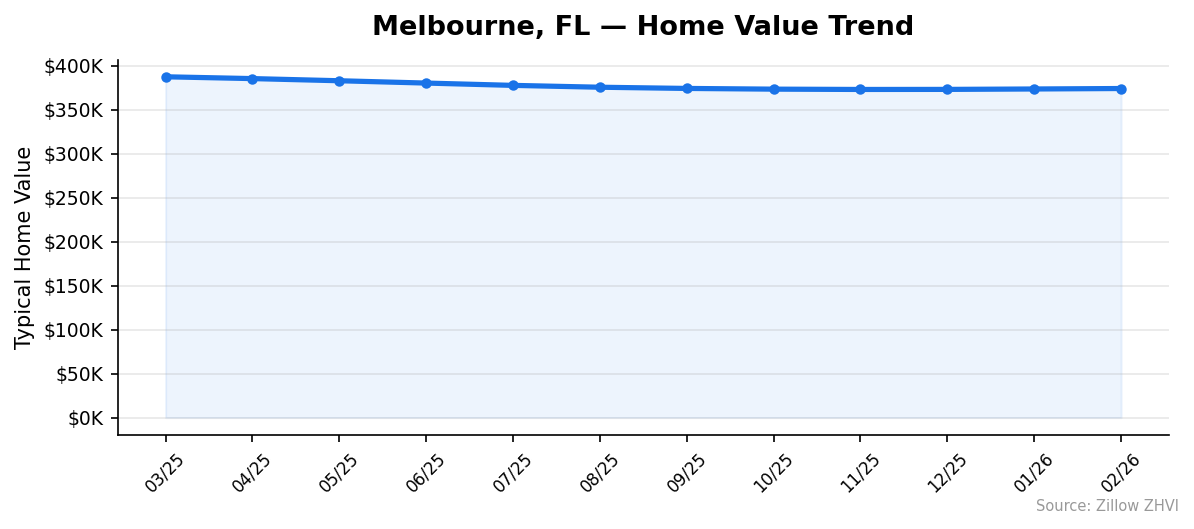
The peak was March 2025 at $387,261. Values slid every month from April through November, bottomed briefly at $372,857, and have ticked up fractionally over the last three months.
That last detail matters. The 3-month change (November to February) is +0.3%. Still small, still noisy, but the steady monthly declines have stopped. The bottom end of the market — the min ZIP — follows the same pattern. It bled from $277,966 down to $264,929, then clawed back to $265,289.
The top of the market has been slightly firmer. Max ZIP peaked at $496,505 and is now $484,057, a 2.5% decline. The bottom ZIP dropped 4.6% from peak to trough. Cheaper homes took the bigger hit in percentage terms — typical for a rate-driven correction where first-time buyers feel mortgage costs most.
Is Melbourne a Good Place to Buy in 2026?
The data says this is a buyer’s market, but not a screaming one.
Prices are down 3.4% year over year. Inventory has been rebuilding across Florida. Insurance costs are high, which is scaring away some marginal buyers. And population growth has stalled — Melbourne added only 165 residents in 2024.
Counterpoint: the decline has flattened. The last three months show $373K → $373K → $374K. If you wait six more months hoping to catch a further drop, you might be waiting for something that isn’t coming. Sellers who had to sell have sold. The rest are sitting.
What you should do depends on your ZIP. In the $265K band (32935, 32901), prices have come off 5% from peak and entry costs are the lowest in the city. In the $480K band (32934, 32940), the correction is smaller in percentage terms and the absolute dollars at risk are bigger.
Bottom line: you can negotiate in Melbourne right now. But the desperation discount is gone.
Melbourne Housing Market Outlook for 2026-2027
The 12-month trend is clearly down. The 3-month trend is flat. That split tells you the market is hunting for a floor.
If the current pace continues, prices in Melbourne likely stay within a narrow band — say, plus or minus 2% — over the next 6 months. The steep part of the decline is over. What would break this pattern: a sharp move in mortgage rates (either direction), a Florida insurance shock, or a change in hurricane season severity that shifts buyer psychology.
The weakest data point is population. A city adding only 165 residents per year does not generate organic price pressure. Absent migration from higher-cost Florida markets or a rate-driven demand bump, Melbourne’s recovery timeline looks longer than faster-growing peers like Port St. Lucie or Cape Coral.
Watch the min ZIP. If 32935 starts climbing consistently, the bottom is in.
Similar Markets in FL
- Tampa — bigger metro, faster growth, and prices in a comparable range to Melbourne’s upper ZIPs.
- Orlando — stronger population growth than Melbourne and a different demand driver in tourism employment.
- Jacksonville — another mid-priced Florida option with a larger job base if you want scale over coastal proximity.
- Port Saint Lucie — the fastest-growing comparison in the state; a good benchmark if you want to see what a high-migration Florida city looks like.
- Homestead — closer to Miami’s orbit and useful for comparing entry-level Florida prices.
Frequently Asked Questions
What is the average home price in Melbourne?
The average home price in Melbourne, FL is $373,935 as of February 2026. That figure covers 5 ZIP codes, with values ranging from $265,289 in 32935 to $484,057 in 32934.
Are home prices going up or down in Melbourne?
Down. Prices have fallen 3.4% year over year from roughly $387,000 to $373,935. The decline has flattened in the last three months, with values essentially holding steady from November through February.
Is it cheaper to rent or buy in Melbourne?
Renting is cheaper by a wide margin right now. Average rent is about $1,834 per month, while owning the median home costs closer to $2,720 per month once you include Florida’s property taxes and insurance. Buying only pays off over a longer holding period.
What is the most affordable neighborhood in Melbourne?
ZIP 32935 is the cheapest at $265,289, with 32901 essentially tied at $265,977. Both sit roughly 29% below the citywide average and carry rents in the $1,600-$1,660 range.
Methodology
Home values are based on the Zillow Home Value Index (ZHVI), a smoothed measure of typical home values in the 35th to 65th percentile range. Rent estimates use the Zillow Observed Rent Index (ZORI). Population figures come from the U.S. Census Bureau Population Estimates Program (2020-2024 vintage). All datasets are publicly available. Housing data updated 2026-02-28.