Palm Bay Home Prices: $290K, Down 4.4% — 4 ZIPs Analyzed (2026)
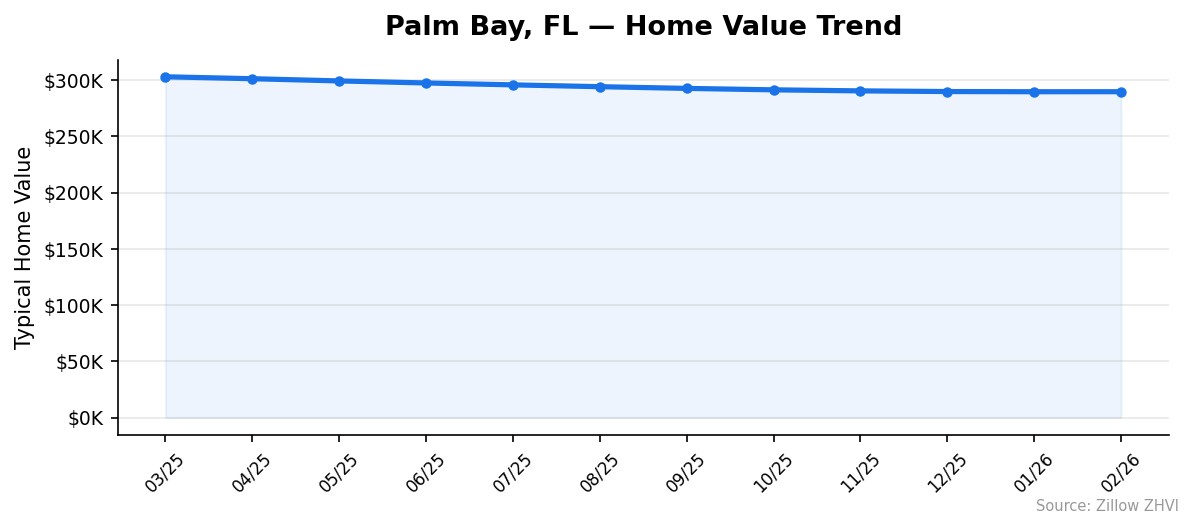
$289,678. That’s the typical home value in Palm Bay, Florida, as of February 2026. Prices are down 4.4% over the last year, and the drop has been steady rather than sudden — values have fallen every single month since March 2025.
Quick answer: The average home price in Palm Bay, FL is $289,678 as of February 2026, down 4.4% year over year according to Zillow.
Current Home Prices in Palm Bay
The median home in Palm Bay sits at $289,678. That’s roughly $13,300 less than it was a year ago.
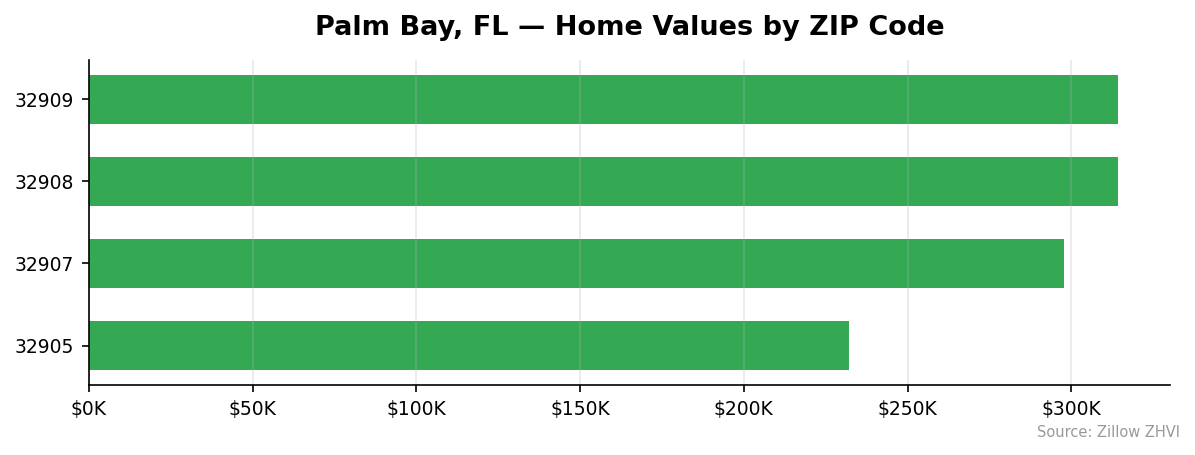
Across the city’s four tracked ZIP codes, prices range from $232,215 at the low end to $314,394 at the top. That’s an $82,179 spread between the cheapest and most expensive neighborhoods — a 35% gap.
| Metric | Value |
|---|---|
| Median home value | $289,678 |
| Year-over-year change | -4.4% |
| Cheapest ZIP | $232,215 |
| Most expensive ZIP | $314,394 |
| ZIP codes tracked | 4 |
| Metro area | Palm Bay-Melbourne-Titusville |
| Data as of | February 2026 |
Palm Bay is cheaper than you might expect for a Florida coastal metro. The median is well below Tampa, Orlando, and the South Florida cities. Buyers priced out of Miami-Dade or Broward have been looking north, and Palm Bay sits in that affordable-but-still-Atlantic-coast zone along with the rest of the Space Coast.
The 4.4% annual decline puts Palm Bay among Florida cities that peaked earlier and are still working through an adjustment. Insurance costs and higher mortgage rates hit price-sensitive Florida markets harder, and the data reflects that.
One number to keep in mind: the high and low of the city have barely moved against each other. Both the cheapest and most expensive ZIPs dropped in step over the last 12 months, so relative affordability within Palm Bay looks about the same as it did last spring.
Palm Bay Home Prices by Neighborhood
Four ZIP codes make up Palm Bay’s housing data. Three cluster near the top end, and one stands out as notably cheaper.
| ZIP Code | Median Value | Monthly Rent |
|---|---|---|
| 32909 | $314,394 | $1,934 |
| 32908 | $314,247 | $2,103 |
| 32907 | $297,858 | $2,012 |
| 32905 | $232,215 | $1,577 |
Most Expensive ZIPs
32909 tops the list at $314,394 — about 8.5% above the city median. Despite the highest home prices, rent here ($1,934) sits mid-pack, which suggests more owner-occupied housing than rental stock.
32908 comes in at $314,247, essentially tied with 32909 on price. Rent here is the highest in the city at $2,103.
32907 rounds out the upper tier at $297,858. Slightly below the top two on price, with rent at $2,012.
Most Affordable ZIPs
32905 is the clear bargain at $232,215 — 20% under the city median. Rent is also the lowest in Palm Bay at $1,577 a month. If you’re looking for the cheapest way into the Palm Bay market, this is it.
With only four ZIP codes, there’s no middle tier worth calling out separately. You’re either in 32905 or you’re paying close to $300K.
Rent vs Buy in Palm Bay
Average rent across Palm Bay’s four ZIPs works out to about $1,906 per month.
Compare that to the cost of owning the median $289,678 home. With 20% down and a 7% mortgage rate on a 30-year loan, principal and interest alone run about $1,540 per month. Add Florida property taxes (roughly $240 at a 1% effective rate) and homeowners insurance (Florida averages north of $300, often higher on the coast), and the all-in monthly cost lands closer to $2,100-$2,200.
| Housing Option | Typical Monthly Cost |
|---|---|
| Rent (average of 4 ZIPs) | $1,906 |
| Own $289,678 home (P&I, 20% down, 7%) | ~$1,540 |
| Own + taxes + insurance | ~$2,100-$2,200 |
The math is close. Renting is about $200-$300 cheaper per month than owning once you include carrying costs. For buyers planning to stay put for five-plus years, building equity still tips the scales toward buying — especially if prices stabilize. For short-term residents, renting is the cheaper option on paper today.
The rent-to-price spread is tighter in 32905 too. A $1,577 rent against a $232,215 home value gives one of the friendlier buying setups in the city if you can handle the down payment.
Population Growth and Migration
Palm Bay is growing faster than most big Florida cities.
The population jumped from 120,168 in 2020 to 142,023 in 2024 — a gain of nearly 22,000 residents, or 18.2% in four years. That’s a sharp acceleration for a mid-sized Space Coast city.
| Year | Population |
|---|---|
| 2020 | 120,168 |
| 2021 | 122,994 |
| 2022 | 129,405 |
| 2023 | 136,084 |
| 2024 | 142,023 |
Growth picked up notably between 2021 and 2023, with 2022 alone adding more than 6,400 people.
Here’s how Palm Bay stacks up against other Florida cities on 4-year growth:
| City | 2024 Population | 4-Year Growth |
|---|---|---|
| Port St. Lucie | 258,575 | +25.0% |
| Cape Coral | 233,025 | +19.2% |
| Palm Bay | 142,023 | +18.2% |
| Miami | 487,014 | +10.0% |
| Orlando | 334,854 | +8.8% |
| Tampa | 414,547 | +6.7% |
Palm Bay’s growth rate beats Miami, Orlando, and Tampa by wide margins. Only Port St. Lucie and Cape Coral — both similar in size and climate — are growing faster.
What does this mean for housing? Prices are falling in the short term, but the underlying population demand keeps pressure on the market. A 4.4% price dip plus an 18% population gain is a tension that usually resolves in favor of prices — just not immediately.
Palm Bay Housing Market Trends
Twelve straight months of price declines. That’s the story.
| Month | Median Value |
|---|---|
| Feb 2026 | $289,678 |
| Jan 2026 | $289,654 |
| Dec 2025 | $289,830 |
| Nov 2025 | $290,417 |
| Oct 2025 | $291,348 |
| Sep 2025 | $292,627 |
| Aug 2025 | $294,145 |
| Jul 2025 | $295,769 |
| Jun 2025 | $297,452 |
| May 2025 | $299,263 |
| Apr 2025 | $301,229 |
| Mar 2025 | $302,942 |
The drop from $302,942 in March 2025 to $289,678 in February 2026 is $13,264 — about $1,100 per month on average.
Here’s what’s worth watching: the rate of decline is slowing. The steepest monthly drops came in mid-2025 (May to August averaged around $1,600 lost per month). The last three months? Combined, Palm Bay lost only about $152. Prices have flattened, not reversed, but they’ve stopped sliding fast.
If that pattern holds, the year-over-year number will start looking better by summer. A price that stops falling against a declining year-ago figure will eventually turn positive.
Is Palm Bay a Good Place to Buy in 2026?
The data points to a buyer’s market — but one that’s cooling off rather than crashing.
Prices have fallen 4.4% in a year, giving buyers room to negotiate. Sellers who bought in 2022 or 2023 are less eager to list. Inventory tends to sit longer when prices are drifting down, which gives buyers more bargaining power.
The rent-buy gap is tight enough that ownership makes sense for longer-term residents. Rent is roughly $200-$300 cheaper per month than owning, but renters build zero equity. Over five years, the math usually flips toward buying — especially if population growth keeps pushing demand.
Affordability is the main reason to look at Palm Bay now. ZIP 32905 still has homes under $235,000 in a state where that’s genuinely hard to find on the Atlantic coast. The trade-off: Florida insurance premiums and HOA fees can add real money to monthly costs, and those are outside the median price figure.
For first-time buyers willing to house-hunt in 32905 or 32907, this market offers better entry points than most of the Florida coast.
Palm Bay Housing Market Outlook for 2026-2027
The 3-month trend suggests prices are flattening. Values barely moved from December to February — a swing of just $152 across three months, compared to $13,000 of decline earlier in the year.
If the current pace continues, Palm Bay’s median should hover in the high $280Ks through spring. The year-over-year number will probably stay negative through mid-2026, then narrow as last year’s steeper declines fall out of the comparison.
Population growth of 18.2% over four years tells a different story long-term. That much demand doesn’t quietly evaporate. Sustained population gains tend to put a floor under home prices, even when short-term affordability and insurance pressures weigh on values.
Watch two signals over the next six months: whether prices tick up month-over-month for the first time in over a year, and whether the cheapest ZIP (32905) holds its value or closes the gap with the higher-priced areas.
Similar Markets in FL
If you’re weighing Palm Bay against other Florida cities, a few make for fair comparisons:
- Port Saint Lucie — the closest peer, with similar population size and even faster growth at 25%.
- Jacksonville — another affordable Florida city at scale, worth checking if you want a larger metro.
- Tampa — a step up in price and job market, on Florida’s Gulf coast.
- Orlando — inland alternative with a bigger economy but slower population growth.
- Homestead — South Florida option to compare against Palm Bay’s affordability.
Frequently Asked Questions
What is the average home price in Palm Bay?
The average home price in Palm Bay, FL is $289,678 as of February 2026. That figure is the Zillow Home Value Index across four ZIP codes in the city. Prices range from $232,215 in the cheapest area to $314,394 in the most expensive.
Are home prices going up or down in Palm Bay?
Prices are down 4.4% year over year. The decline has been steady — values have fallen every single month since March 2025, dropping from $302,942 to $289,678. The good news for sellers: the rate of decline has slowed noticeably in the last three months.
Is it cheaper to rent or buy in Palm Bay?
Renting is cheaper month to month. Average rent runs about $1,906, while owning a typical home costs roughly $2,100-$2,200 once you add taxes and Florida insurance. Over five-plus years, buying usually wins because of equity — but renting is the lower short-term cost.
What is the most affordable neighborhood in Palm Bay?
ZIP 32905 is the cheapest, with a median home value of $232,215 — about 20% under the city average. Rent in 32905 also sits lowest at $1,577 per month. For budget-conscious buyers, this is the clearest entry point into the Palm Bay market.
Methodology
Home values are based on the Zillow Home Value Index (ZHVI), a smoothed measure of typical home values in the 35th to 65th percentile range. Rent estimates use the Zillow Observed Rent Index (ZORI). Population figures come from the U.S. Census Bureau Population Estimates Program (2020-2024 vintage). All datasets are publicly available. Housing data updated 2026-02-28.