Santa Cruz Home Prices: $1,154K, Up 2.5% — 4 ZIPs Analyzed (2026)
$1,154,247. That’s what a typical home costs in Santa Cruz right now. Prices climbed 2.5% over the past year, and the gap between the cheapest and most expensive ZIP codes spans nearly $700,000. If you’re house-hunting here, the neighborhood you pick matters more than almost anywhere else in California.
Quick answer: The average home price in Santa Cruz, CA is $1,154,247 as of February 2026, up 2.5% year over year according to Zillow.
Current Home Prices in Santa Cruz
| Metric | Value |
|---|---|
| Median Home Value | $1,154,247 |
| Year-over-Year Change | +2.5% |
| Lowest ZIP Median | $664,711 |
| Highest ZIP Median | $1,349,012 |
| Number of ZIPs Tracked | 4 |
| Data As Of | February 2026 |
The median puts Santa Cruz well above most California cities and far above the national average. A 2.5% annual gain sounds modest, but on a $1.15 million base, that’s roughly $28,000 in added value over 12 months.
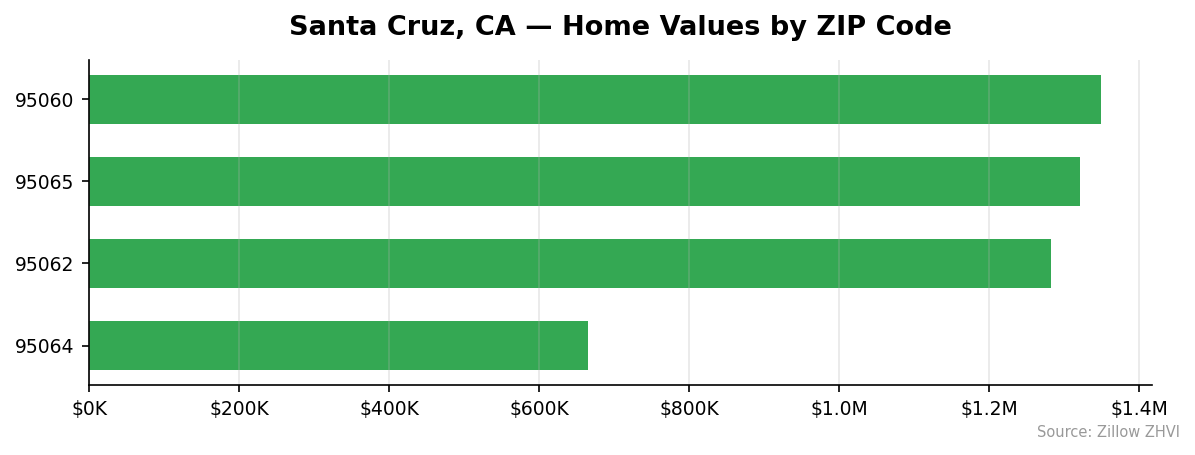
The price floor sits at $664,711 in ZIP 95064, while the ceiling hits $1,349,012 in ZIP 95060. That $684,000 spread means your buying power shifts dramatically depending on which side of town you’re looking at.
For a buyer putting 20% down on the median-priced home, you’d need about $230,849 in cash just for the down payment. The remaining mortgage of roughly $923,398 at a 6.5% rate would run approximately $5,836 per month — before taxes and insurance.
Santa Cruz Home Prices by Neighborhood
| ZIP Code | Median Home Value | vs. City Median |
|---|---|---|
| 95060 | $1,349,012 | +16.9% |
| 95065 | $1,320,685 | +14.4% |
| 95062 | $1,282,578 | +11.1% |
| 95064 | $664,711 | -42.4% |
Most Expensive
95060 leads at $1,349,012 — this area commands the highest prices in the city and carries monthly rents of about $3,298.
95065 follows closely at $1,320,685, sitting 14.4% above the city median with no rent data currently available.
95062 rounds out the top three at $1,282,578, and it actually has the highest rents among tracked ZIPs at $3,611 per month.
Most Affordable
95064 stands alone as the budget option at $664,711 — 42.4% below the city median. This ZIP costs less than half of what you’d pay in the most expensive area. No rent data is tracked here. For buyers priced out of the $1.2–$1.3 million neighborhoods, 95064 is the only realistic entry point within city limits.
Rent vs Buy in Santa Cruz
Rent data is available for two of Santa Cruz’s four ZIP codes.
| ZIP Code | Monthly Rent (ZORI) |
|---|---|
| 95060 | $3,298 |
| 95062 | $3,611 |
Those rents look steep until you compare them to ownership costs. A mortgage on the citywide median of $1,154,247 — assuming 20% down and a 6.5% rate — runs about $5,836 per month in principal and interest alone. Add property taxes (roughly 1.1% in Santa Cruz County, or $1,058/month) and homeowner’s insurance, and you’re looking at $7,000+ per month.
That’s roughly double the rent in ZIP 95060.
The math is clear: renting saves you $3,000–$4,000 per month in cash flow. But renters build no equity. At 2.5% annual appreciation on a $1.15 million home, owners gain about $28,800 per year in value — assuming the trend holds.
The rent-vs-buy decision here comes down to how long you plan to stay. A five-year hold starts to close the gap. Anything shorter, and renting wins on pure numbers.
Population Growth and Migration
Santa Cruz is losing residents. The city’s population dropped from 64,218 in 2020 to 62,581 in 2024 — a 2.5% decline over four years.
| Year | Population |
|---|---|
| 2020 | 64,218 |
| 2021 | 55,432 |
| 2022 | 63,016 |
| 2023 | 62,857 |
| 2024 | 62,581 |
The 2021 dip to 55,432 is notable — a sharp drop of nearly 9,000 people in a single year. Most of that recovered by 2022, but the city never returned to its 2020 peak. Since 2022, the trend has been a slow bleed of a few hundred residents per year.
How Santa Cruz Compares
| City | 2024 Population | 4-Year Growth |
|---|---|---|
| Bakersfield | 417,468 | +3.0% |
| Sacramento | 535,798 | +1.9% |
| San Diego | 1,404,452 | +1.4% |
| Fresno | 550,105 | +1.4% |
| Oakland | 443,554 | +0.6% |
| Santa Cruz | 62,581 | -2.5% |
Every comparison city is growing. Santa Cruz is not. A shrinking population typically eases housing demand, but prices rose 2.5% anyway. That disconnect suggests supply constraints — not enough homes being built to offset demand from buyers willing to pay a premium for the location, even as some residents leave.
Santa Cruz Housing Market Trends
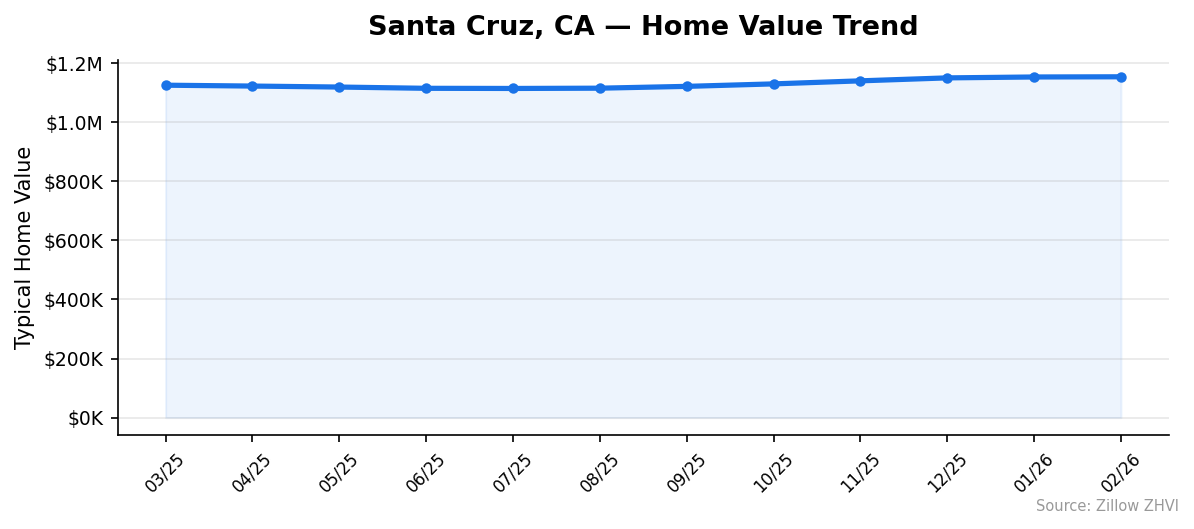
| Month | Average Value | Monthly Change |
|---|---|---|
| Feb 2026 | $1,154,247 | +$654 |
| Jan 2026 | $1,153,593 | +$3,047 |
| Dec 2025 | $1,150,546 | +$10,045 |
| Nov 2025 | $1,140,501 | +$10,294 |
| Oct 2025 | $1,130,207 | +$8,418 |
| Sep 2025 | $1,121,789 | +$6,143 |
| Aug 2025 | $1,115,646 | +$928 |
| Jul 2025 | $1,114,718 | -$506 |
| Jun 2025 | $1,115,224 | -$4,281 |
| May 2025 | $1,119,505 | -$3,332 |
| Apr 2025 | $1,122,837 | -$2,926 |
| Mar 2025 | $1,125,763 | — |
The 12-month pattern tells a clear story. Prices dipped slightly from March through July 2025, bottoming out at $1,114,718 in July. Then the market reversed. From August through February 2026, values climbed every single month.
The pace of gains accelerated in the fall — October and November each added about $10,000 — then cooled significantly in early 2026. February’s gain of just $654 suggests the upward momentum is fading.
Is Santa Cruz a Good Place to Buy in 2026?
The numbers paint a mixed picture for buyers.
On the plus side: price growth is slowing. February’s near-flat reading ($654 gain) signals the market may be losing steam after a strong fall rally. If you’ve been waiting, the urgency to act has dropped.
Working against buyers: the entry price is punishing. Even the cheapest ZIP at $664,711 requires serious capital. The three other ZIPs all exceed $1.28 million. With mortgage rates still elevated, monthly payments on these homes stretch well past $6,000.
Population decline of 2.5% hasn’t dented prices. That tells you demand isn’t driven by local population growth — it’s driven by the area’s appeal to remote workers, second-home buyers, and people relocating from the Bay Area.
For buyers with the capital, the slowing appreciation trend offers a window. For everyone else, ZIP 95064 remains the only realistic entry point.
Santa Cruz Housing Market Outlook for 2026-2027
The three-month trend through February 2026 shows deceleration. Monthly gains went from $10,000+ in November to $3,047 in January and just $654 in February.
If the current pace continues, prices may plateau through spring 2026. The market ran hard from August to December and appears to be digesting those gains.
Looking at last year’s seasonal pattern, prices dipped from March through July 2025. A similar seasonal softening could bring modest price declines in mid-2026, potentially pulling values back toward the $1,140,000–$1,150,000 range before another fall uptick.
The 2.5% year-over-year gain is likely to compress. Don’t expect a crash — nothing in the data supports that. But a year-end growth rate closer to 1–2% would align with the fading momentum visible in the monthly data.
Similar Markets in CA
If you’re exploring California options beyond Santa Cruz, these cities offer different price points:
- Bakersfield — A fraction of Santa Cruz prices, with a growing population of 417,000 in the Central Valley.
- Fresno — Another Central Valley alternative with 550,000 residents and steady 1.4% population growth.
- San Diego — Coastal living at a different price tier, with a metro population over 1.4 million.
- Long Beach — Southern California urban living with more inventory than Santa Cruz.
- Anaheim — Orange County access with a wider range of housing options.
Frequently Asked Questions
What is the average home price in Santa Cruz?
The average home price in Santa Cruz is $1,154,247 as of February 2026. Across the city’s four tracked ZIP codes, values range from $664,711 in ZIP 95064 to $1,349,012 in ZIP 95060.
Are home prices going up or down in Santa Cruz?
Prices are going up. The median rose 2.5% year over year. However, the monthly rate of increase has slowed sharply — February 2026 saw just a $654 gain compared to $10,000+ monthly gains in late 2025.
Is it cheaper to rent or buy in Santa Cruz?
Renting is significantly cheaper on a monthly basis. Typical rents run $3,298–$3,611 per month, while a mortgage on the median home costs roughly $5,836 in principal and interest alone — before taxes and insurance push total costs above $7,000.
What is the most affordable neighborhood in Santa Cruz?
ZIP code 95064 is the most affordable at $664,711 — 42.4% below the city median. The next cheapest ZIP, 95062, jumps to $1,282,578. No other ZIP in Santa Cruz comes close to 95064’s price point.
Methodology
Home values are based on the Zillow Home Value Index (ZHVI), a smoothed measure of typical home values in the 35th to 65th percentile range. Rent estimates use the Zillow Observed Rent Index (ZORI). Population figures come from the U.S. Census Bureau Population Estimates Program (2020-2024 vintage). All datasets are publicly available. Housing data updated 2026-02-28.